
An Arc Fault Circuit Interrupter, commonly known as AFCI is a specialized electrical safety device designed to protect homes and buildings from electrical fires caused by arcing faults. The standard circuit breakers only respond to overloads and short circuits. However, AFCIs detect dangerous arcing conditions in electrical wiring and automatically disconnect the circuit before a fire can start. The National Electrical Code (NEC) has mandated AFCI protection in residential settings since 1999.
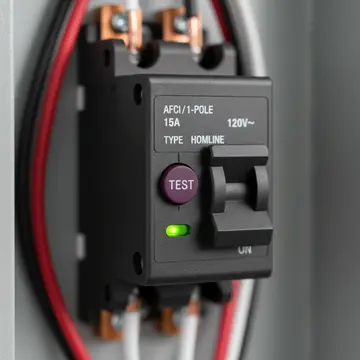
Arc faults occur when electrical current flows through an unintended path and creates high-temperature plasma that can ignite surrounding materials. These faults can develop from damaged wire insulation, loose connections, overheated cords, or nails accidentally driven through electrical cables. Statistics from the U.S. Consumer Product Safety Commission indicate that electrical fires cause approximately 300 deaths and 1,400 injuries annually in the United States with arcing faults being a leading cause.
1. How Arc Faults Develop
An arc fault happens when electricity jumps across a gap between two conductors or from a conductor to a grounded object. This phenomenon creates temperatures exceeding 10,000 degrees Fahrenheit at the arc point. Such extreme heat can easily ignite wood framing, insulation, and other combustible materials commonly found in building.
Series Arc Faults occur within a single conductor when the wire becomes damaged or broken. For example, if a lamp cord gets pinched under a piece of furniture the internal conductors may break while the outer insulation remains intact. Current continues to flow across the break through an arc and generates heat that can start a fire.
Parallel Arc Faults happen between two different conductors such as the hot wire and neutral wire or between a hot wire and ground. These faults produce higher current levels and are generally easier to detect than series arcs.
2. Working Principle of AFCI
AFCIs use advanced electronic circuit to analyze the current waveform flowing through a circuit. The device contains a microprocessor that continuously monitors the electrical signature of the circuit and compares it against known arc fault patterns stored in its memory. When the AFCI detects a waveform characteristic of a dangerous arc, it trips the circuit within milliseconds.
The detection algorithm must distinguish between dangerous arcs and normal arcing that occurs during everyday activities. Motors in vacuum cleaners, light switches being operated, and electric drills all produce some level of arcing during normal operation. AFCI technology is programmed to ignore these harmless arc signatures and responds to hazardous conditions.
The internal components of an AFCI include:
| Component | Function |
|---|---|
| Current Sensor | Monitors current flow through the circuit |
| Microprocessor | Analyzes waveform patterns and makes trip decisions |
| Test Circuit | Allows user verification of proper operation |
| Trip Mechanism | Physically opens the circuit when arc detected |
| Arc Signature Memory | Stores patterns of dangerous vs. normal arcs |
3. Types of AFCI Devices
Several types of AFCI protection are available for different applications and installation requirements.
3.1 AFCI Circuit Breakers
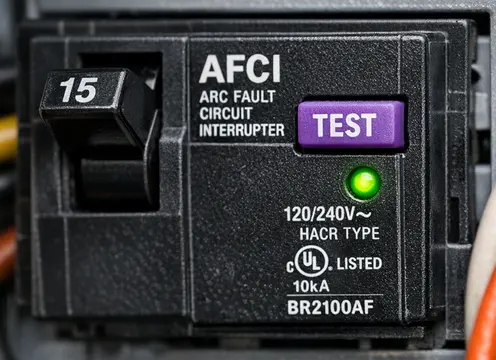
These devices replace standard circuit breakers in the electrical panel and provide protection for the entire branch circuit. AFCI breakers are the most common type installed in residential settings and come in both single-pole and combination configurations. They protect all wiring and devices connected to that circuit from the panel to the farthest outlet.
3.2 Outlet Type AFCIs
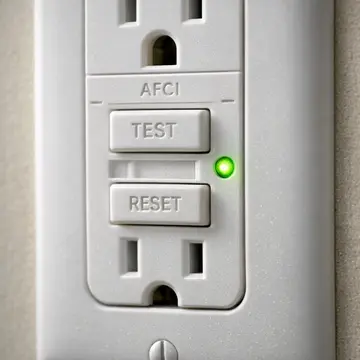
These devices install at the first outlet of a circuit and protect downstream wiring and devices. Outlet-type AFCIs are useful when upgrading older homes where replacing the panel breaker is not practical. They look similar to GFCI outlets but provide arc fault protection instead of ground fault protection.
3.3 Portable AFCIs
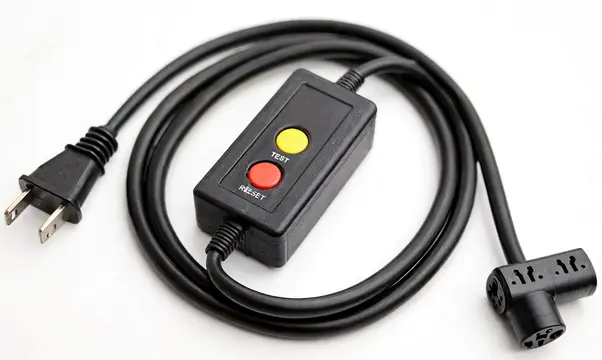
These plug-in devices provide arc fault protection for specific appliances or extension cords. While not a substitute for permanent AFCI protection, portable units can add safety in situations where other protection is not available.
3.4 Combination Type AFCIs
Combination AFCIs detect both series and parallel arc faults and provides the highest level of protection currently available. The NEC now requires combination-type AFCIs for new construction in most applications.
| AFCI Type | Installation Location | Protection Coverage |
|---|---|---|
| Branch/Feeder | Electrical Panel | From panel to last device |
| Outlet Type | First outlet on circuit | Downstream wiring only |
| Combination | Electrical Panel | Both series and parallel arcs |
| Portable | Plugged into outlet | Connected cord and device |
4. AFCI vs GFCI
Students often confuse AFCIs with Ground Fault Circuit Interrupters (GFCIs), but these devices protect against different hazards.
GFCIs monitor the balance between current flowing on the hot and neutral wires. If current leaks to ground (through a person), the GFCI detects this imbalance and trips quickly to prevent electrocution. GFCIs are required in wet locations like bathrooms, kitchens, and outdoor areas.
AFCIs monitor the waveform characteristics of current flow to detect arcing conditions that could cause fires. AFCIs are required in bedrooms, living rooms, and other areas where electrical fires are a concern.
| Feature | AFCI | GFCI |
|---|---|---|
| Primary Hazard Addressed | Electrical Fires | Electrocution |
| Detection Method | Waveform Analysis | Current Imbalance |
| Trip Threshold | Arc Signature Match | 4-6 milliamps difference |
| Required Locations | Bedrooms, Living Areas | Bathrooms, Kitchens, Outdoors |
| Reset Location | Panel or Outlet | At Device |
Some manufacturers now offer dual-function devices that provide both AFCI and GFCI protection in a single unit. These combination devices are becoming more popular as code requirements expand for both types of protection.
5. NEC Requirements for AFCI Protection
The National Electrical Code has progressively expanded AFCI requirements since their initial introduction. Here is a timeline of major code changes:
| NEC Edition | AFCI Requirements |
|---|---|
| 1999 | Bedroom receptacle outlets |
| 2002 | All bedroom outlets |
| 2008 | Added family rooms, dining rooms, living rooms, parlors, libraries, dens, bedrooms, sunrooms, recreation rooms, closets, hallways |
| 2014 | Added kitchens and laundry areas |
| 2017 | Extended to dormitory units |
| 2020 | Guest rooms in hotels and motels |
The current NEC (2023) requires AFCI protection in nearly all habitable rooms of dwelling units. The only areas typically exempt from AFCI requirements are bathrooms, garages, and outdoor locations where GFCI protection takes priority.
6. Installation Guidelines
Installing AFCI circuit breakers requires following specific procedures to achieve proper operation. Here are the basic steps:
- Step 1: Turn off the main breaker to de-energize the panel.
- Step 2: Remove the existing circuit breaker for the branch circuit receiving AFCI protection.
- Step 3: Connect the circuit hot wire (typically black) to the AFCI breaker terminal marked “Load Power.”
- Step 4: Connect the circuit neutral wire (white) to the AFCI breaker terminal marked “Load Neutral.” This is different from standard breakers, which do not have a neutral connection.
- Step 5: Connect the coiled white pigtail wire from the AFCI breaker to the panel neutral bar.
- Step 6: Snap the AFCI breaker into place in the panel.
- Step 7: Restore power and test the AFCI using the built-in test button.
The neutral wire connection requirement means that each AFCI-protected circuit must have its own dedicated neutral run back to the panel. Shared neutrals common in older installations will cause nuisance tripping of AFCI devices.
7. Common Causes of Nuisance Tripping
One challenge with AFCI technology is nuisance tripping, where the device activates without an actual dangerous condition. Several factors can cause this problem:
- Shared Neutral Wires: When multiple circuits share a common neutral conductor, the AFCI cannot properly analyze the current signature and may trip unexpectedly.
- Older Appliances: Some older motors and electronic devices produce electrical noise that resembles arc fault signatures. Vacuum cleaners, treadmills, and certain power tools are common offenders.
- Incompatible Dimmers: Certain dimmer switches create waveform distortions that AFCI breakers interpret as arc faults. Using AFCI-compatible dimmers solves this problem.
- Long Circuit Runs: Very long circuits may develop enough electrical noise to trigger false trips, particularly if the wiring runs near other electrical equipment.
- Loose Connections: Ironically, some nuisance trips are actually the AFCI detecting real problems. A loose connection anywhere in the circuit may produce intermittent arcing that causes occasional trips.
8. Troubleshooting AFCI Circuits
When an AFCI trips, follow this systematic approach to identify the cause:
- Step 1: Reset the AFCI and observe if it trips immediately. An immediate trip indicates a direct short or serious wiring problem.
- Step 2: If the AFCI resets and holds, plug devices back in one at a time. If the AFCI trips when a specific device is connected, that device may be faulty or incompatible.
- Step 3: Inspect all outlets and switches on the circuit for signs of damage, burning, or loose connections.
- Step 4: Check for damaged cords or wires that may be causing actual arc faults.
- Step 5: Verify that the circuit neutral is not shared with other circuits.
- Step 6: Test the AFCI using the built-in test button. If the test function does not trip the device, the AFCI itself may be defective.
9. Testing and Maintenance
Regular testing of AFCI devices confirms they remain functional. The NEC recommends monthly testing using the following procedure:
- Locate the test button on the AFCI device (either at the panel or outlet)
- Press the test button firmly
- Verify that the AFCI trips and power is cut to the protected circuit
- Reset the AFCI by turning the breaker fully off then back on, or by pressing the reset button on outlet-type devices
- Verify power is restored to the circuit
10. Limitations of AFCI Protection
While AFCIs provide excellent protection against arc faults, they do have limitations:
- AFCIs cannot detect all types of electrical hazards, such as overloaded extension cords that do not produce arcing
- Very small arcs below the detection threshold may not trigger the device
- AFCIs do not provide protection against electric shock (GFCI is needed for that)
- Devices installed after the AFCI outlet (on outlet-type installations) protect only downstream wiring
11. Conclusion
Arc Fault Circuit Interrupters is a major advancement in electrical fire prevention technology. AFCIs have saved countless lives and prevented millions of dollars in property damage since their introduction by detecting dangerous arcing conditions before they can ignite fires.