
Selecting the right MCB (Miniature Circuit Breaker) for a 25-litre geyser is one of the most common questions homeowners and electricians face in India. Imagine stepping into your bathroom after a long day, ready for a warm shower. You turn on your 25-litre geyser, and within minutes, the circuit breaker trips. You reset it, only for the same thing to happen again. Or worse you notice a faint burning smell from the wiring near your geyser, but have no clue why. These are not random issues. They stem from one simple mistake: choosing the wrong MCB rating for your 25-litre geyser.
In this technical guide, we will discuss everything you need to know about selecting the right MCB rating for a 25-litre geyser in India, including its power consumption, current calculation, MCB type selection, wire sizing, relevant industry standards, and safety.
1. Power Rating of a 25-Litre Geyser in India
Before selecting the MCB rating, you must know the power consumption of your 25-litre geyser accurately. Most 25-litre storage water heaters available in the Indian market have a power rating between 2000W and 3000W. Some energy efficient water heater models consume around 2000W. Higher-end or fast-heating models may consume up to 3000W.
Here are some common examples:
| Brand | Model (25L) | Power Rating |
|---|---|---|
| Havells | Adonia i | 2000W |
| Bajaj | New Shakti | 2000W |
| AO Smith | HSE-SHS | 2000W |
| V-Guard | Divino | 2000W |
| Crompton | Arno Neo | 2000W |
| Racold | Eterno Pro | 3000W |
Most 25-litre geysers sold in India operate at 2000 watts on a 230V single-phase AC supply. Always check the nameplate of your geyser for the exact wattage before proceeding with circuit breaker sizing.
2. How to Calculate the Full Load Current of a 25L Geyser
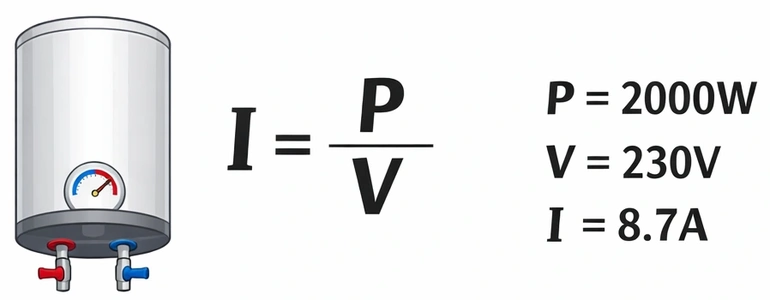
The full load current determines the MCB rating directly. You can calculate it using a simple formula. This formula applies to all single-phase resistive loads universally.
Formula:
\(I=\dfrac{P}{V}\)
Where:
- \(I\) = Full Load Current (in Amperes)
- \(P\) = Power Rating (in Watts)
- \(V\) = Supply Voltage (in Volts)
2.1 Example 1: For a 2000W Geyser
\(I=\dfrac{2000}{230}=8.69 A\)
The full load current is approximately 8.7 Amperes.
2.2 Example 2: For a 3000W Geyser
\(I=\dfrac{3000}{230}=13.04 A\)
The full load current is approximately 13 Amperes.
3. Recommended MCB Rating for 25-Litre Geyser
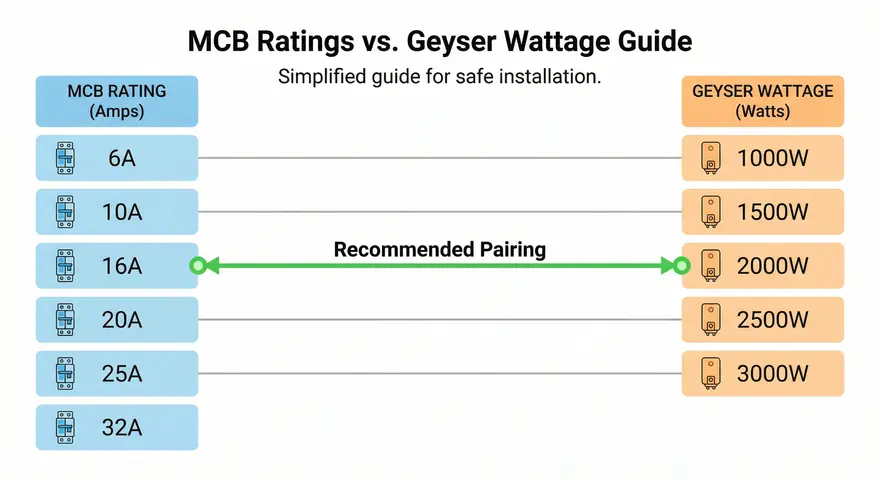
The MCB rating should always be higher than the full load current but not excessively oversized. As a standard practice, the MCB is rated at 125% of the full load current of the appliance. This follows the general overcurrent protection guidelines found in NEC Article 422.11 and IS 732 accordingly.
3.1 Calculation for 2000W Geyser
\(\text{MCB Rating}=1.25\times 8.69=10.87 A\)
The next available standard MCB size is 16A. So, a 16A MCB is the recommended choice for a 2000W, 25-litre geyser.
3.2 Calculation for 3000W Geyser
\(\text{MCB Rating}=1.25\times 13.04=16.3 A\)
The next available standard MCB size is 20A. So, a 20A MCB is the recommended choice for a 3000W, 25-litre geyser.
3.3 Quick Reference Table:
| Geyser Power | Full Load Current | Recommended MCB Rating |
|---|---|---|
| 2000W | 8.7A | 16A |
| 2500W | 10.87A | 16A |
| 3000W | 13.04A | 20A |
The most commonly recommended MCB rating for a standard 25-litre geyser (2000W) in India is 16 Amperes.
4. MCB Type Selection: Type B or Type C?
MCBs come in different tripping curve types. The two most common types used in residential electrical wiring are Type B and Type C. The tripping curve defines how fast the MCB reacts to overcurrent situations precisely.
4.2 Type B MCB
- Trips at 3 to 5 times the rated current
- Best suited for resistive loads like geysers, heaters, and lighting
- Provides faster tripping for lower fault currents
4.3 Type C MCB
- Trips at 5 to 10 times the rated current
- Best suited for inductive loads like motors, pumps, and compressors
- Allows higher inrush currents without tripping
A geyser is a purely resistive load. It does not produce any inrush current during startup. The heating element draws a steady current from the moment it switches on. Therefore, a Type B MCB is the ideal choice for a 25-litre geyser technically.
However, in Indian markets, Type C MCBs are more commonly available and widely used. A Type C MCB will also work fine for a geyser. It just offers a slightly delayed trip response for high fault currents compared to Type B.
Recommended: 16A Type B MCB for a 2000W geyser, or 16A Type C MCB if Type B is unavailable locally.
5. Wire Size for 25-Litre Geyser Circuit
The MCB rating and wire size must be coordinated properly. Installing the correct miniature circuit breaker without matching wire gauge creates a dangerous mismatch electrically.
5.1 Wire Size Recommendations
| MCB Rating | Recommended Wire Size (Copper) | Current Carrying Capacity |
|---|---|---|
| 16A | 2.5 sq mm | Up to 18–21A |
| 20A | 4 sq mm | Up to 26–28A |
For a standard 2000W, 25-litre geyser with a 16A MCB, use 2.5 sq mm copper wire as the minimum. If the cable run from the distribution board to the geyser is longer than 15 meters, consider upgrading to 4 sq mm copper wire to compensate for voltage drop.
Always use three-core wire (Live, Neutral, and Earth) for geyser installation. The earth wire must be connected to the metal body of the geyser and to the earthing system of the house securely. This is mandatory for home appliance safety and is required by IS 732 and NEC Article 250 standards.
6. Dedicated Circuit for Geyser
A 25-litre geyser must always be connected to a dedicated circuit from the electrical panel. Sharing the circuit with other appliances like fans, lights, or other outlets overloads the wiring progressively.
Here is an example to explain this:
Scenario: You have a 16A MCB feeding a circuit that powers a 2000W geyser (8.7A) and a 1000W room heater (4.35A). The total current is 8.7 + 4.35 = 13.05A. This is close to the 16A MCB rating. Adding any more load on this circuit will trip the MCB repeatedly.
A dedicated circuit means one MCB in the distribution board is reserved exclusively for the geyser. No other appliance shares this circuit. This practice is standard in all residential electrical safety codes globally.
In the United States, NEC Article 422.12 requires that fixed storage water heaters rated over 1500W must have a dedicated branch circuit. Indian wiring standards under IS 732 also recommend the same practice strongly.
7. RCCB or ELCB Along with MCB: Additional Protection
An MCB protects against overcurrent and short circuit faults only. It does not protect against earth leakage or electric shock. For a water heater, the risk of electric shock is high because water and electricity are in close proximity constantly.
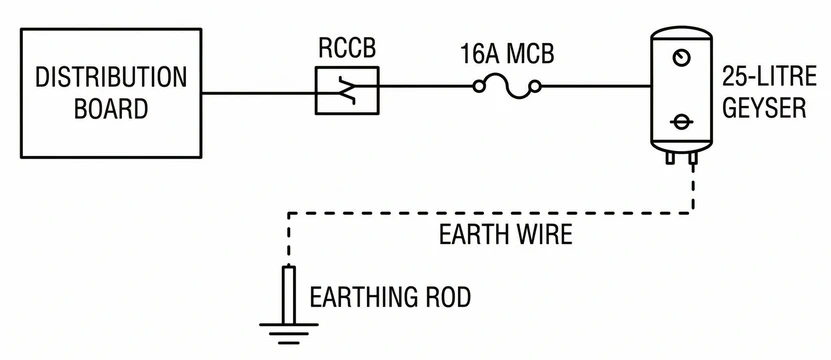
You should install an RCCB (Residual Current Circuit Breaker) along with the MCB for the geyser circuit. The RCCB detects leakage current and disconnects the supply within milliseconds instantly.
7.1 Recommended RCCB Specification for Geyser
| Parameter | Recommended Value |
|---|---|
| RCCB Rating | 25A or 40A (Two Pole) |
| Sensitivity | 30 mA |
| Type | Type A or Type AC |
The RCCB should be installed before the MCB in the circuit (upstream). This way, the RCCB provides earth leakage protection and the MCB provides overcurrent protection simultaneously.
This combination is the industry standard for electrical safety in wet areas like bathrooms and kitchens. NEC Article 210.8 requires GFCI protection (similar to RCCB) for bathroom circuits in the United States mandatorily.
8. Relevant Industry Standards and ANSI Codes
Several national and international standards govern the selection of MCBs and circuit protection for water heaters. Here are the most relevant ones for this application:
8.1 Indian Standards
- IS 8828 – Miniature Circuit Breakers for AC Circuits (Household and Similar Installations)
- IS 732 – Code of Practice for Electrical Wiring Installations
- IS 12640 – Residual Current Operated Circuit Breakers (RCCBs)
- IS 2082 – Storage Type Electric Water Heaters
8.2 International / ANSI Standards
- ANSI/UL 489 – Molded-Case Circuit Breakers, Molded-Case Switches, and Circuit Breaker Enclosures
- ANSI/NEMA AB 1 – Molded Case Circuit Breakers, Molded Case Switches, and Circuit Breaker Enclosures
- IEC 60898-1 – Circuit Breakers for Overcurrent Protection for Household and Similar Installations
- IEC 61008 – Residual Current Operated Circuit Breakers Without Integral Overcurrent Protection
- NEC (NFPA 70) Article 422 – Appliances (Section 422.11 for Overcurrent Protection)
- NEC Article 240 – Overcurrent Protection
These standards define the testing methods, trip characteristics, breaking capacity, and installation guidelines for MCBs used in residential applications thoroughly.
9. Breaking Capacity of the MCB
The breaking capacity (also called short circuit capacity) of the MCB is another important parameter. It defines the maximum fault current that the MCB can safely interrupt without damage.
For residential electrical installations in India, the minimum recommended breaking capacity is 10 kA (10,000 Amperes) as per IS 8828. Most branded MCBs from manufacturers like Havells, Legrand, Schneider, and Siemens offer a breaking capacity of 10 kA as standard.
Do not use cheap or unbranded MCBs with a breaking capacity of only 3 kA or 6 kA. These MCBs may fail to interrupt a high fault current and can explode or catch fire during a short circuit dangerously.
As per ANSI/UL 489, molded case circuit breakers used in the United States are tested for interrupting ratings starting from 10 kA. Matching this specification for your home electrical wiring is a good practice regardless of your location.
10. Common Mistakes to Avoid
Many homeowners and even some electricians make mistakes during geyser MCB selection and installation. Here are the most common ones:
- Using a 32A MCB for a 2000W Geyser: A 32A MCB is heavily oversized. It will allow the wire to overheat beyond its capacity before tripping. This defeats the purpose of overcurrent protection entirely.
- Using a 6A or 10A MCB: A 6A MCB will trip immediately because the geyser draws 8.7A at full load. A 10A MCB may also trip due to the continuous loading at 87% of its rating. MCBs are not designed to operate at such high percentages of their rating continuously.
- Not Providing Earthing: A geyser without proper earthing is a serious shock hazard. The metal body of the geyser can become live if the heating element develops an insulation fault internally.
- Using Thin Wires: Using 1.0 sq mm or 1.5 sq mm wires for a geyser circuit is dangerous. These wires cannot carry 8.7A for prolonged durations safely.
- Sharing Circuit with Other Loads: Running multiple appliances on the same MCB as the geyser increases the risk of overloading and fire progressively.
11. Step-by-Step Installation
Here is a concise summary of the recommended installation setup for a 25-litre geyser in India:
- Check the geyser nameplate for wattage (most commonly 2000W).
- Calculate full load current: 2000 / 230 = 8.7A.
- Select MCB rating: 16A Type B or Type C MCB.
- Select wire size: 2.5 sq mm three-core copper wire (minimum).
- Install RCCB: 25A or 40A, 30 mA sensitivity RCCB before the MCB.
- Run a dedicated circuit from the distribution board to the geyser location.
- Ensure proper earthing of the geyser body and the circuit.
- Test the installation by switching on the geyser and verifying no tripping occurs during normal operation.
This setup provides complete protection against overcurrent, short circuit, and earth leakage faults for the geyser circuit.
12. Conclusion
Selecting the right MCB for a 25-litre geyser in India is a straightforward process once you know the power rating and apply the correct formula. For the most common 2000W geyser, a 16A Type B MCB is the recommended rating. For a 3000W variant, a 20A MCB is the appropriate choice. Always pair the MCB with correctly sized copper wiring (2.5 sq mm for 16A or 4 sq mm for 20A). Install an RCCB with 30 mA sensitivity for earth leakage protection additionally. Run a dedicated circuit from the distribution board and ensure proper earthing of the geyser body at all times.
Following these guidelines and adhering to standards like IS 8828, IS 732, and NEC Article 422 will make your geyser installation safe and code-compliant completely. A few minutes spent on correct circuit breaker sizing can prevent electrical accidents and protect your family for years to come permanently.
13. Frequently Asked Questions (FAQs)
The correct MCB rating is 16A. A 2000W geyser draws approximately 8.7A at 230V. A 16A MCB provides adequate overcurrent protection without nuisance tripping.
Yes, a 20A MCB will work. However, it is slightly oversized for a 2000W load. It will still protect against short circuits. But during overload conditions, the trip response will be slower compared to a 16A MCB.
A Type B MCB is the best technical choice for a geyser because it is a resistive load. A Type C MCB also works but is designed for inductive loads with higher inrush currents.
Use a minimum of 2.5 sq mm copper wire for a 16A MCB circuit. If the wiring distance exceeds 15 meters, upgrade to 4 sq mm copper wire to reduce voltage drop.
Yes, absolutely. An RCCB with 30 mA sensitivity should be installed along with the MCB. The MCB protects against overcurrent. The RCCB protects against earth leakage and electric shock.
No. Both are high-power appliances. Each should have its own dedicated circuit with a separate MCB from the electrical panel.
A 32A MCB is dangerously oversized. It will not trip during an overload condition. The wiring (2.5 sq mm) will overheat and may catch fire before the MCB trips.
Yes. Earthing is mandatory as per IS 732 and the Indian Electricity Rules. A geyser without earthing poses a severe electric shock risk to users.
Reputed brands like Havells, Legrand, Schneider Electric, Siemens, and ABB offer reliable MCBs with proper certifications. Always choose ISI marked (BIS certified) MCBs for home electrical wiring installations.