
One of the most common questions homeowners and beginner electricians ask is: “Can I replace a 15 amp breaker with a 20 amp breaker?” The short answer is — it depends. Simply swapping a breaker without checking the rest of the circuit can create serious safety hazards, including overheated wires, melted insulation, and house fires. A circuit breaker is designed to protect the wiring in your home, not just the devices plugged into it. If the wire connected to a 15 amp breaker is only rated for 15 amps, putting a 20 amp breaker on that circuit removes the protection that wire needs.
In this technical guide, we will discuss everything you need to know about breaker sizing, including how circuit breakers work, wire ampacity ratings, NEC requirements, ANSI standards, safe upgrade procedures, common mistakes, and real-world examples. Practical examples are included throughout to help you apply these concepts in real-world scenarios confidently.
1. How Does a Circuit Breaker Work?
A circuit breaker is a protective device installed in your electrical panel. Its job is to interrupt the flow of electricity if the current exceeds a safe level. Each breaker has an ampere rating such as 15 amps or 20 amps that tells you the maximum current it will allow before tripping.
Inside the breaker, there are two main tripping mechanisms. The thermal mechanism uses a bimetallic strip that bends from heat caused by sustained overcurrent. The magnetic mechanism responds to sudden, high-level fault currents and trips the breaker almost instantly.
The breaker does not protect your appliances. It protects the wires running through your walls, attic, and crawl spaces. If too much current flows through a wire, the wire heats up. If the breaker does not trip in time, the wire insulation can melt and ignite nearby materials. This is why breaker sizing must always match the wire gauge in the circuit.
2. The Relationship Between Wire Gauge and Breaker Size
The size of a circuit breaker must match the ampacity of the wire connected to it. Ampacity is the maximum amount of current a wire can safely carry without overheating. The NEC provides ampacity tables that tell you exactly what each wire gauge can handle.
Here is a simplified reference table for common residential copper conductors based on NEC Table 310.16:
| Wire Gauge (AWG) | Ampacity (60°C Copper) | Typical Breaker Size |
|---|---|---|
| 14 AWG | 15 Amps | 15 Amp Breaker |
| 12 AWG | 20 Amps | 20 Amp Breaker |
| 10 AWG | 30 Amps | 30 Amp Breaker |
| 8 AWG | 40 Amps | 40 Amp Breaker |
| 6 AWG | 55 Amps | 50 Amp Breaker |
As you can see, 14 AWG wire is rated for 15 amps. If you put a 20 amp breaker on a circuit wired with 14 AWG copper, the breaker will not trip until the current reaches 20 amps. But the wire can only safely handle 15 amps. That 5-amp gap is where the danger lives. The wire can overheat, and the breaker will not do anything about it because it thinks everything is fine.
3. What Does the NEC Say About Breaker Sizing?
The National Electrical Code (NEC), published by the National Fire Protection Association (NFPA 70), is the primary standard for electrical installations in the United States. Several sections directly address breaker and wire sizing.
3.1 NEC Section 240.4 — Protection of Conductors
This section states that conductors must be protected against overcurrent in accordance with their ampacity. For small conductors used in residential circuits:
- NEC 240.4(D)(3): 14 AWG copper must be protected by a breaker rated at no more than 15 amps.
- NEC 240.4(D)(4): 12 AWG copper must be protected by a breaker rated at no more than 20 amps.
- NEC 240.4(D)(5): 10 AWG copper must be protected by a breaker rated at no more than 30 amps.
These are hard limits. There are no exceptions for residential branch circuits. You cannot put a 20 amp breaker on 14 AWG wire, period. The code is clear on this.
3.2 NEC Section 210.3 — Rating of Branch Circuits
This section requires that branch circuits be rated in accordance with the maximum permitted ampere rating of the overcurrent device. A 15 amp breaker creates a 15 amp branch circuit. A 20 amp breaker creates a 20 amp branch circuit. Each type of branch circuit has different rules for receptacle ratings and outlet types.
4. ANSI Standards Related to Circuit Breakers
The American National Standards Institute (ANSI) publishes standards that define the performance, testing, and safety requirements for circuit breakers used in residential and commercial installations.
4.1 ANSI/UL 489 — Molded-Case Circuit Breakers
This standard covers the construction, performance, and testing of molded-case circuit breakers. It specifies how breakers should respond to overcurrent conditions, including their trip curves and interrupting ratings. Every circuit breaker installed in a residential panel in the U.S. should be listed to this standard.
4.2 ANSI C37.13 — Low-Voltage AC Power Circuit Breakers
This standard applies to larger circuit breakers used in commercial and industrial settings. It covers breakers rated 1000 volts AC and below and specifies requirements for short-circuit current ratings and endurance testing.
4.3 ANSI/NFPA 70 (NEC)
The NEC itself is an ANSI-approved standard. All the wiring rules, breaker sizing requirements, and conductor protection guidelines discussed in this article are backed by this ANSI designation.
If you are working in countries outside the United States, equivalent standards include IEC 60898 for circuit breakers and IEC 60364 for wiring regulations. In Canada, the Canadian Electrical Code (CEC) applies, and in the UK, BS 7671 (the IET Wiring Regulations) governs these installations.
5. So, Can You Replace a 15 Amp Breaker with a 20 Amp?
The answer depends entirely on the wire gauge in the circuit.
5.1 Scenario 1: The Circuit Uses 14 AWG Wire
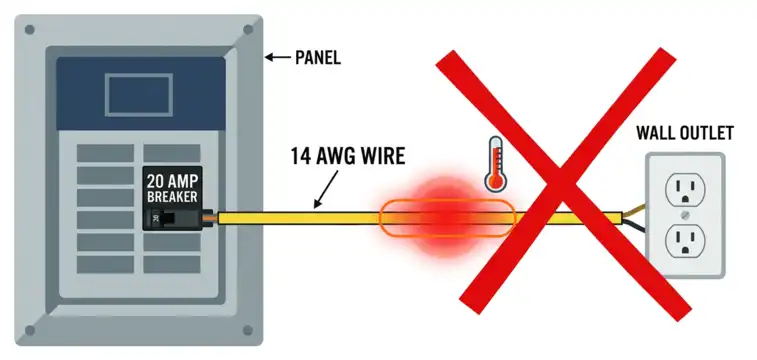
No, you cannot. If the circuit is wired with 14 AWG copper, the maximum breaker size allowed is 15 amps. Replacing it with a 20 amp breaker is a direct NEC violation and a fire hazard. The wire is not rated to carry 20 amps, and the breaker will fail to protect it.
Practical Example: Imagine you have a bedroom circuit on a 15 amp breaker. You add a space heater that draws 12.5 amps, plus a few other devices. The breaker keeps tripping. You might think, “I’ll just put in a 20 amp breaker.” But if the circuit uses 14 AWG wire, you have just removed the safety protection for that wire. The wire could overheat inside the wall without any warning.
5.2 Scenario 2: The Circuit Uses 12 AWG Wire
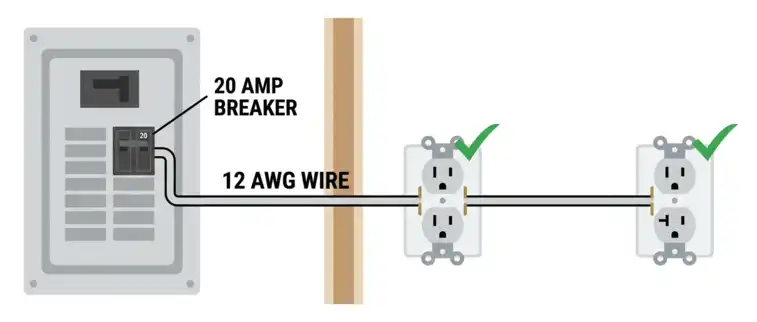
Yes, you can — but with conditions. If every inch of wire in the circuit, from the panel to the last outlet, is 12 AWG or larger, you can safely install a 20 amp breaker. The wire can handle 20 amps, so the breaker and wire will be properly matched.
However, you also need to check the receptacles on the circuit. NEC Section 210.21(B) requires that receptacles on a 20 amp branch circuit be rated for 20 amps. Standard 15 amp duplex receptacles are allowed on 20 amp circuits, but single receptacles must be 20 amp rated. A 20 amp receptacle has a T-shaped neutral slot that accepts both 15 amp and 20 amp plugs.
Practical Example: You have a kitchen counter circuit that keeps tripping its 15 amp breaker. You check the wire and find it is all 12 AWG. In this case, you can replace the 15 amp breaker with a 20 amp breaker. But you should also verify that the receptacles are rated appropriately and that the circuit does not serve areas where a 15 amp circuit is specifically required by code.
5.3 Scenario 3: The Circuit Has Mixed Wire Gauges
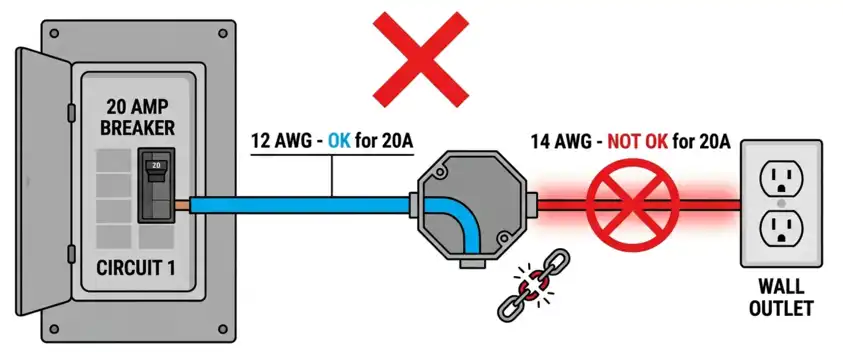
No, you cannot. If any portion of the circuit uses 14 AWG wire — even a short run to a switch or outlet — the entire circuit must be protected by a 15 amp breaker. The weakest link in the chain determines the maximum protection level.
6. Step-by-Step: How to Safely Evaluate a Breaker Upgrade
If you are considering replacing a 15 amp breaker with a 20 amp breaker, follow these steps:
Step 1: Turn Off the Breaker
Switch the breaker to the OFF position. Use a non-contact voltage tester to confirm there is no power on the circuit.
Step 2: Identify the Wire Gauge
Open the electrical panel and look at the wire connected to the 15 amp breaker. The wire gauge is printed on the jacket of the cable. Look for markings like “12/2 NM-B” or “14/2 NM-B.” The first number is the wire gauge.
Step 3: Trace the Entire Circuit
This is the hardest part. You need to confirm that every section of wire in the circuit is 12 AWG or larger. This includes wire running to switches, junction boxes, and outlets. If any part of the circuit uses 14 AWG, you cannot use a 20 amp breaker.
Step 4: Check the Receptacles
Verify that all receptacles on the circuit meet NEC requirements for a 20 amp branch circuit.
Step 5: Install the Correct Breaker
If all checks pass, install a 20 amp breaker that is compatible with your electrical panel. Never use a breaker from a different manufacturer unless it is listed and approved for use in your specific panel. Using incompatible breakers is a code violation and can cause arcing, overheating, and fires.
Step 6: Test the Circuit
Restore power and test the circuit with a receptacle tester and a clamp meter to verify normal operation.
7. Common Mistakes to Avoid
Many homeowners and even some handymen make dangerous errors with breaker sizing. Here are the most frequent mistakes:
Using the wrong breaker brand. Not all breakers are interchangeable between panel brands. A Square D breaker does not belong in a Siemens panel unless it is specifically classified as compatible. ANSI/UL 489 listing is brand-and-panel specific.
Ignoring the wire gauge. This is the number one mistake. People focus on the breaker and forget about the wire. The breaker protects the wire. If the wire cannot handle the breaker’s rating, you have a problem.
Upsizing a breaker to stop nuisance tripping. If a breaker keeps tripping, the correct response is to find out why — not to install a bigger breaker. The breaker might be tripping because the circuit is genuinely overloaded, or the breaker itself might be faulty. A faulty breaker should be replaced with the same size, not a larger one.
Assuming all outlets on a circuit are visible. Wiring inside walls can take unexpected paths. A junction box hidden in an attic might contain a splice to 14 AWG wire that you cannot see from the panel.
8. Cost of Upgrading a Circuit from 15 Amps to 20 Amps
If you determine that a breaker upgrade is necessary and the wiring needs to be replaced, here is a general idea of the costs involved in the United States:
| Item | Approximate Cost |
|---|---|
| 20 Amp Circuit Breaker | $5 – $15 |
| 12 AWG NM-B Cable (per 250 ft) | $50 – $100 |
| Electrician Labor (per hour) | $50 – $150 |
| Permit and Inspection Fee | $50 – $200 |
| 20 Amp Receptacles (each) | $3 – $8 |
Hiring a licensed electrician for this work is strongly recommended. Electrical work that does not meet code can void your homeowner’s insurance and create liability issues if a fire occurs.
9. The Danger of Oversizing a Breaker
Oversizing a circuit breaker is one of the leading causes of electrical fires in residential buildings. The U.S. Consumer Product Safety Commission (CPSC) and the National Fire Protection Association (NFPA) have documented numerous house fires caused by improperly sized breakers.
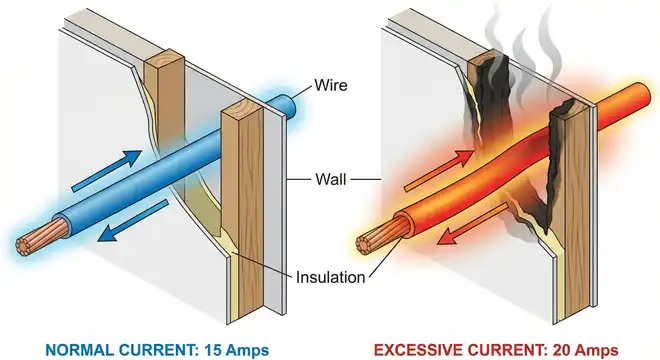
The physics is straightforward. A wire has electrical resistance. Current flowing through the wire generates heat (P = I²R). The more current, the more heat. If the breaker allows more current than the wire can handle, the wire gets hotter than it was designed for. Over time, the insulation breaks down, and the conductor can ignite surrounding materials like wood framing and insulation.
This process can take weeks, months, or even years. The fire might not happen immediately after the breaker swap. That delayed reaction makes oversized breakers especially dangerous because people assume the swap was harmless since nothing happened right away.
10. Conclusion
Replacing a 15 amp breaker with a 20 amp breaker is only safe and legal if the entire circuit is wired with 12 AWG copper or larger. If any portion of the circuit uses 14 AWG wire, you must keep the 15 amp breaker or rewire the circuit before upgrading. The NEC is clear on this point, and the rules exist to prevent electrical fires caused by overheated wiring.
Never upsize a breaker just to stop it from tripping. A tripping breaker is a warning sign, not a nuisance. Find the root cause, reduce the load, or add a new circuit instead. If you are unsure about the wire gauge in your circuit or feel uncomfortable working inside an electrical panel, hire a licensed electrician. The cost of professional electrical work is small compared to the cost of a house fire or a failed home inspection. Safety should always come first in any electrical project.
11. Frequently Asked Questions (FAQs)
It is only legal if the entire circuit is wired with 12 AWG copper or larger. If the circuit uses 14 AWG wire, replacing the breaker with a 20 amp unit violates NEC Section 240.4(D)(3) and is not permitted.
In most cases, yes. Breakers of the same brand and type are physically interchangeable between 15 amp and 20 amp ratings. However, physical compatibility does not mean the swap is safe or legal. You must verify the wire gauge first.
Look at the cable jacket in your electrical panel or at an accessible outlet box. The wire gauge is printed on the outer sheath. “14/2” means 14 AWG, and “12/2” means 12 AWG. You can also measure the wire diameter with calipers. 14 AWG solid copper is about 1.63 mm in diameter, and 12 AWG is about 2.05 mm.
No. A tripping breaker is doing its job. You should find out why it is tripping. Common causes include circuit overload, a short circuit, or a ground fault. You might also have a faulty breaker that needs to be replaced with the same ampere rating.
Yes, NEC Section 210.21(B)(3) allows 15 amp duplex receptacles on 20 amp multi-outlet branch circuits. However, if the circuit serves a single receptacle, that receptacle must be rated for 20 amps.
Permit requirements vary by jurisdiction. In many areas, a simple breaker replacement (same size) does not require a permit. However, upgrading a circuit from 15 amps to 20 amps especially if rewiring is involved may require a permit and inspection.
Both are single-pole breakers designed for 120-volt circuits. The only difference is the trip current rating. A 15 amp breaker trips at a lower current than a 20 amp breaker. They are designed to protect different wire sizes.
Only if the wire feeding the air conditioner circuit is 12 AWG or larger. Air conditioner circuits often have specific requirements in the NEC (Article 440), and the breaker size must match both the wire gauge and the manufacturer’s nameplate specifications.
Yes, 12 AWG wire costs more than 14 AWG wire because it contains more copper. A 250-foot roll of 12/2 NM-B cable typically costs 20% to 40% more than a similar roll of 14/2 NM-B cable.
The inspector will flag it as a code violation. You will be required to either replace the breaker with the correct size or rewire the circuit to match the breaker. This can delay project completion and increase costs.