
One of the most common questions in residential and commercial electrical work is whether you can mix 12 and 14 gauge wire on the same circuit. This question comes up frequently during home renovations, circuit extensions, and DIY electrical projects. The short answer is that it depends on the circuit breaker size, but the longer answer involves a careful look at electrical codes, safety standards, and practical wiring practices. Mixing wire gauges on a single circuit is not automatically illegal or dangerous, but doing it incorrectly can lead to overheated wires, tripped breakers, or even house fires.
In this technical guide, we will discuss everything you need to know about mixing 12 and 14 gauge wire on the same circuit, including wire ampacity ratings, NEC code requirements, ANSI standards, breaker sizing rules, practical scenarios, safety risks, and proper installation methods. Practical examples are included throughout to help you apply these concepts in real-world scenarios confidently.
1. Wire Gauge Basics: What Do 12 and 14 Gauge Mean?
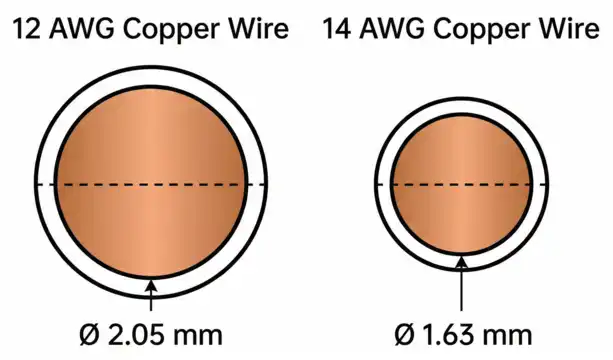
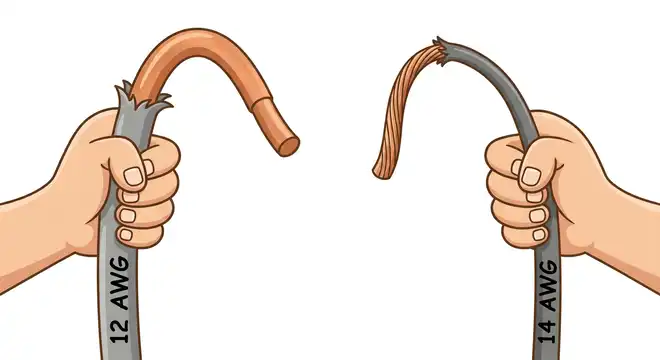
The American Wire Gauge (AWG) system is the standard method for measuring wire diameter in North America. A lower gauge number means a thicker wire, and a thicker wire can carry more current safely. A 12 AWG copper wire has a diameter of approximately 2.053 mm, and a 14 AWG copper wire has a diameter of approximately 1.628 mm.
According to NEC Table 310.16, the ampacity of a 12 AWG copper conductor with 60°C-rated insulation (such as NM-B cable) is 20 amperes. The ampacity of a 14 AWG copper conductor with the same insulation rating is 15 amperes. This difference in current-carrying capacity is the root of the entire discussion about mixing these two wire sizes.
In residential wiring, 14 AWG wire is commonly used for 15-amp circuits that power lighting and general-purpose receptacles. 12 AWG wire is used for 20-amp circuits that serve kitchen countertop outlets, bathroom receptacles, laundry rooms, and other areas with higher power demand. Each wire gauge is matched to a specific breaker size for safety.
2. What the National Electrical Code (NEC) Says
The NEC is the primary electrical safety standard in the United States and is adopted (with local amendments) across most jurisdictions. Several NEC articles directly address the question of mixing wire gauges.
2.1 NEC 240.4 – Protection of Conductors
NEC Section 240.4 states that conductors must be protected against overcurrent in accordance with their ampacity. This means the overcurrent protection device (circuit breaker or fuse) must not exceed the ampacity of the smallest conductor in the circuit.
If you have a circuit that uses both 12 AWG and 14 AWG wire, the breaker must protect the weakest link in the chain — the 14 AWG wire. Since 14 AWG wire is rated for 15 amps, the circuit breaker must be rated at no more than 15 amps.
2.2 NEC 210.3 – Rating of Branch Circuits
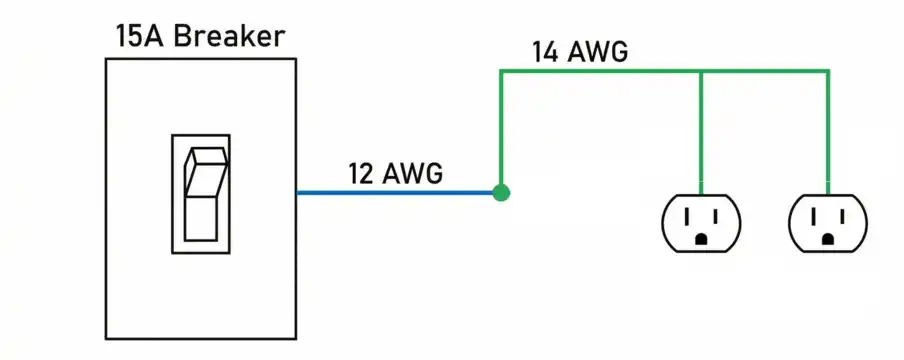
NEC 210.3 says that branch circuits are rated according to the maximum permitted ampere rating of the overcurrent device. A 15-amp breaker creates a 15-amp branch circuit, and a 20-amp breaker creates a 20-amp branch circuit. If you use a 15-amp breaker, you can technically use both 12 and 14 AWG wire on that circuit because both wire sizes are rated for at least 15 amps.
2.3 NEC 210.19(A)(1) – Minimum Circuit Conductor Size
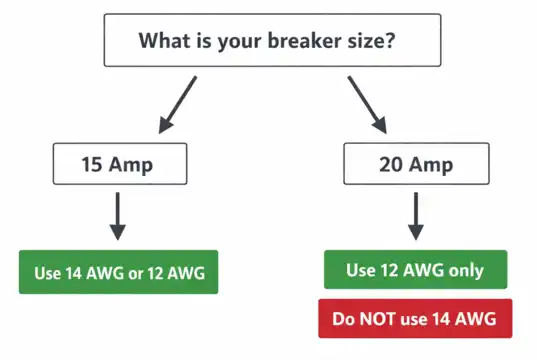
This section requires that branch circuit conductors have an ampacity not less than the maximum load to be served and not less than the rating of the branch circuit. On a 20-amp branch circuit, all conductors must be rated for at least 20 amps, which means 14 AWG wire cannot be used anywhere on a 20-amp circuit.
3. The Short Answer: Yes, But Only on a 15-Amp Breaker
Based on the NEC requirements above, here is the direct answer:
You can mix 12 AWG and 14 AWG wire on the same circuit only if the circuit breaker is rated at 15 amps.
On a 15-amp breaker, both 12 AWG (rated for 20 amps) and 14 AWG (rated for 15 amps) meet the minimum ampacity requirements. The breaker will trip before either wire is overloaded.
You cannot use 14 AWG wire anywhere on a 20-amp circuit. If the breaker is 20 amps, every conductor on that circuit must be rated for at least 20 amps. A 14 AWG wire on a 20-amp circuit is a code violation and a fire hazard because the breaker would allow 20 amps to flow through a wire rated for only 15 amps.
4. Why You Should Not Put 14 Gauge Wire on a 20-Amp Breaker
This is the most dangerous mistake people make, and it deserves its own section. Here is what happens in a practical scenario:
Example: A homeowner wants to add an outlet to an existing 20-amp kitchen circuit. The existing circuit uses 12 AWG wire throughout. The homeowner has leftover 14 AWG Romex from another project and uses it to run the extension to the new outlet.
In this situation, the 20-amp breaker will allow up to 20 amps of current to flow through the entire circuit, including the 14 AWG section. The 14 AWG wire is only rated for 15 amps. If the load on that circuit reaches 18 or 19 amps (which is perfectly normal for a kitchen circuit), the 14 AWG section will be forced to carry more current than it was designed for.
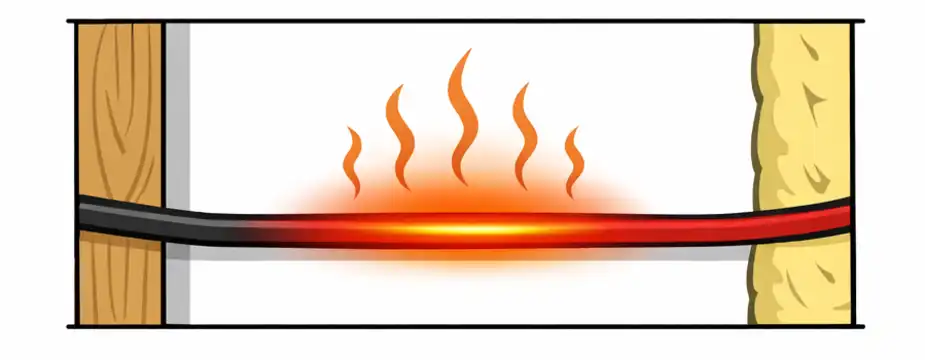
The wire insulation will heat up beyond its rated temperature. Over time, this heat can degrade the insulation, melt it, and eventually cause an electrical fire inside the wall. The breaker will not trip because it is designed to allow up to 20 amps. The breaker is doing its job — the problem is that the wire is too small for the breaker.
This is exactly why NEC 240.4 exists. The breaker must protect the smallest wire on the circuit.
5. Practical Scenarios Where Mixing Wire Gauges Comes Up
5.1 Scenario 1: Extending a Lighting Circuit
You have an existing 15-amp lighting circuit wired with 14 AWG. You want to add a few more light fixtures and you only have 12 AWG wire available. Can you use it?
Yes. You can use 12 AWG wire to extend a 15-amp circuit. The 12 AWG wire exceeds the minimum ampacity requirement for a 15-amp circuit. The breaker is 15 amps, and 12 AWG is rated for 20 amps, so the wire is more than adequately protected. This is a perfectly code-compliant installation.
5.2 Scenario 2: Adding a Receptacle to a 20-Amp Circuit
You have an existing 20-amp circuit in your kitchen wired with 12 AWG. You want to add one more receptacle and you only have 14 AWG wire. Can you use it?
No. This is a code violation. Every conductor on a 20-amp circuit must be rated for at least 20 amps. You must use 12 AWG or larger wire for this extension.
5.3 Scenario 3: Replacing a Breaker to Accommodate Mixed Wiring
You discover that a previous homeowner used 14 AWG wire for part of a circuit and 12 AWG for the rest, and the circuit has a 20-amp breaker. What should you do?
You have two options:
- Replace the 20-amp breaker with a 15-amp breaker. This downgrades the circuit but makes it code-compliant and safe.
- Replace all 14 AWG wire on the circuit with 12 AWG wire. This maintains the 20-amp circuit capacity but requires more work.
Option 1 is usually faster and cheaper. Option 2 may be necessary if the circuit serves loads that require a 20-amp circuit.
6. How to Identify Wire Gauge in Existing Installations
Before mixing wire gauges, you need to confirm what gauge wire is already installed. Here are practical methods:
Check the cable jacket printing. NM-B cable (Romex) has the wire gauge printed on the outer jacket. Look for markings like “14/2 NM-B” or “12/2 NM-B” along the length of the cable.
Measure the wire diameter. Strip back the insulation and use a caliper or micrometer. A 14 AWG solid copper conductor should measure approximately 1.63 mm in diameter. A 12 AWG solid copper conductor should measure approximately 2.05 mm.
Check the wire color. In many regions, Romex cable jackets follow a color convention: white jackets for 14 AWG, yellow jackets for 12 AWG, and orange jackets for 10 AWG. This is a manufacturer convention and not a code requirement, but it is widely followed.
Feel the wire stiffness. 12 AWG wire is noticeably stiffer and harder to bend than 14 AWG wire. This is a rough check but can help in situations where printed markings are not visible.
7. Electrical Safety Risks of Improper Wire Gauge Mixing
Mixing wire gauges improperly creates several risks:
Overheating and fire: The most serious risk. A wire carrying more current than its rated ampacity will generate excess heat. This heat can damage insulation, ignite nearby combustible materials, and start an electrical fire inside a wall cavity where it may go undetected for some time.
Nuisance tripping: If wire connections between different gauge wires are made poorly, increased resistance at the connection point can cause localized heating. This may trigger arc-fault circuit interrupters (AFCIs) to trip frequently.
Voltage drop issues: Smaller gauge wire has higher resistance per foot. A section of 14 AWG wire on a long circuit run can increase voltage drop beyond acceptable limits, especially under heavy loads. NEC recommends keeping voltage drop below 3% for branch circuits and 5% for the combined feeder and branch circuit.
Code violations and insurance issues: An improperly wired circuit that does not comply with the NEC can result in failed electrical inspections. It can also give your home insurance company grounds to deny a claim if a fire is caused by the faulty wiring.
8. Common Mistakes to Avoid
Mistake 1: Using 14 AWG pigtails on a 20-amp circuit. Some people use short 14 AWG pigtails to connect receptacles on 20-amp circuits. This is a code violation. Even a 6-inch pigtail must be rated for the breaker amperage.
Mistake 2: Relying on wire color alone. As mentioned earlier, jacket color conventions are manufacturer-specific and not mandated by code. Always verify wire gauge by reading the printed markings or measuring the conductor.
Mistake 3: Assuming “the load is small enough.” The NEC does not allow you to size wire based on expected load for standard branch circuits. The wire must be rated for the full breaker capacity, not just the anticipated load.
Mistake 4: Ignoring local code amendments. Some local jurisdictions have adopted amendments to the NEC that are stricter than the national code. Always check with your local building department or authority having jurisdiction (AHJ) before starting work.
9. Conclusion
Mixing 12 and 14 gauge wire on the same circuit is allowed under the NEC, but only if the circuit breaker is rated at 15 amps. The breaker must always protect the smallest conductor on the circuit. Placing 14 AWG wire on a 20-amp breaker is a code violation and a genuine fire hazard, regardless of how short the wire run is or how small the connected load may be.
The safest approach is to use a single, consistent wire gauge throughout each circuit. This eliminates confusion and reduces the chance of errors during future modifications or repairs. If you discover mixed gauge wiring in an existing installation, verify the breaker size immediately. Downgrade the breaker to 15 amps or replace the undersized wire to restore code compliance.
10. Frequently Asked Questions
No. NEC 240.4 requires that conductors be protected based on their ampacity, not the actual load. A 14 AWG wire must be protected by a breaker rated at 15 amps or less, regardless of how small the connected load is.
Yes. 12 AWG wire is rated for 20 amps, which exceeds the 15-amp breaker rating. This is completely safe and code-compliant.
Yes, as long as the circuit breaker is 15 amps. Both wire sizes can be connected in the same junction box on a 15-amp circuit without any code issues.
Most standard yellow wire nuts (such as Ideal Model 73B) can accommodate a combination of 12 and 14 AWG wires. Always check the manufacturer’s specifications on the packaging to confirm the wire gauge and quantity range.
Yes, if done incorrectly. An inspector will check that the breaker size matches the smallest wire gauge on the circuit. If 14 AWG wire is found on a 20-amp breaker, the installation will fail inspection.
No. The NEC does not make exceptions for short runs. Every inch of conductor on a 20-amp circuit must be rated for at least 20 amps.
Yes. Older homes were sometimes wired before modern code enforcement became standard. It is common to find mixed gauge wiring during renovations. These should be corrected to meet current codes.
Penalties vary by jurisdiction but usually involve a requirement to correct the violation and schedule a re-inspection. Repeat violations can result in fines or revocation of permits.