
The EMF equation of a transformer is one of the most fundamental concepts in electrical engineering. It describes the mathematical relationship between the induced electromotive force (EMF) in a transformer’s windings and the physical parameters like frequency, magnetic flux, and number of turns. Proper understanding of the EMF equation is essential for anyone working with power systems, transformer design, or electrical testing.
In this technical guide, we’ll break down the EMF equation into simple, easy-to-understand concepts with practical examples. If you’re a student, engineer, or professional in the electrical field, you’ll find this article helps clarify how transformers work and why the EMF equation matters.
What is EMF in a Transformer?
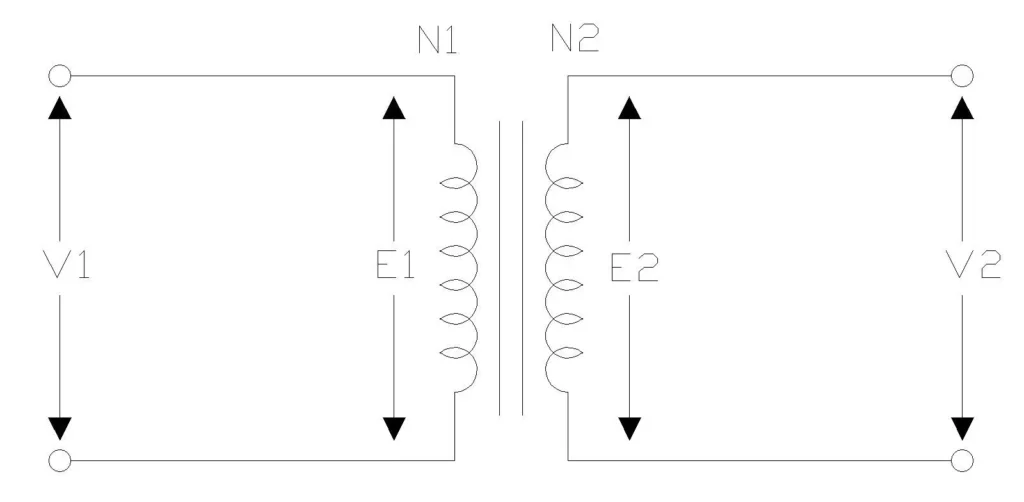
EMF stands for Electromotive Force. In a transformer, EMF is the voltage that is induced in the windings due to the changing magnetic flux in the core.
Imagine a transformer with two coils (windings) wrapped around an iron core:
- The primary winding receives AC supply voltage
- The secondary winding is where we get the output voltage
When AC current flows through the primary winding, it creates a changing magnetic flux in the core. This changing flux passes through the secondary winding and induces an EMF in it. The magnitude of this induced EMF depends on several factors, which we’ll explore in the EMF equation.
Faraday’s Law of Electromagnetic Induction
Before moving into the EMF equation, let’s understand the fundamental principle behind it: Faraday’s Law of Electromagnetic Induction.
Faraday’s law states:
The magnitude of induced EMF in a coil is directly proportional to the rate of change of magnetic flux through it and the number of turns in the coil.
Mathematically, Faraday’s law can be expressed as:
\( e = -N \frac{d\Phi}{dt} \)
Where:
- e = instantaneous EMF (in volts)
- N = number of turns in the coil
- dΦ/dt = rate of change of magnetic flux (in webers per second)
- − (negative sign) = represents Lenz’s law (EMF opposes the change in flux)
Derivation of the Transformer EMF Equation
Let’s derive the EMF equation step by step to understand where the “4.44” constant comes from.
Step 1: Assume Sinusoidal Magnetic Flux

In AC transformers, the magnetic flux varies sinusoidally with time:
\( \Phi = \Phi_m \sin(\omega t) \)
Where:
- Φ = instantaneous magnetic flux (in webers)
- Φ_m = maximum (peak) magnetic flux (in webers)
- ω = angular frequency = 2πf (in rad/s)
- f = supply frequency (in Hz)
- t = time (in seconds)
Step 2: Apply Faraday’s Law
For the primary winding, the instantaneous EMF induced is:
\( e_1 = -N_1 \frac{d\Phi}{dt} = -N_1 \frac{d}{dt}(\Phi_m \sin(\omega t)) \)
Differentiating:
\( e_1 = -N_1 \Phi_m \omega \cos(\omega t) \)
Substituting \(ω = 2πf\):
\( e_1 = -N_1 \Phi_m (2\pi f) \cos(2\pi f t) \)
Step 3: Find Maximum EMF
The maximum value of the instantaneous EMF occurs when \(cos(2πft) = 1\):
\( E_{m1} = 2\pi f N_1 \Phi_m \)
Where \(E_m1\) is the maximum (peak) value of EMF in the primary.
Step 4: Convert to RMS Value
Since we usually work with RMS (root mean square) values in AC circuits, we divide the maximum value by √2:
\( E_1 = \frac{E_{m1}}{\sqrt{2}} = \frac{2\pi f N_1 \Phi_m}{\sqrt{2}} \)
\( E_1 = \frac{2\pi}{\sqrt{2}} \times f \times N_1 \times \Phi_m \)
Calculating the constant:
\( \frac{2\pi}{\sqrt{2}} = \frac{6.283}{1.414} = 4.44 \)
Step 5: Final EMF Equation
Therefore, the RMS value of EMF induced in the primary winding is:
\( E_1 = 4.44 \times f \times N_1 \times \Phi_m \)
Similarly, for the secondary winding:
\( E_2 = 4.44 \times f \times N_2 \times \Phi_m \)
In general form, the EMF equation of a transformer is:
\( E = 4.44 \times f \times N \times \Phi_m \)
Or using flux density \((B_m)\):
\( E = 4.44 \times f \times N \times B_m \times A \)
Where:
- E = RMS induced EMF (in volts)
- f = frequency (in Hz)
- N = number of turns in the winding
- Φ_m = maximum magnetic flux (in webers, Wb)
- B_m = maximum magnetic flux density (in tesla, T)
- A = cross-sectional area of the core (in m²)
EMF Equation Parameters
Let’s understand what each parameter in the EMF equation means:
| Parameter | Symbol | Unit | Meaning |
|---|---|---|---|
| EMF | E | Volts (V) | The induced voltage in the winding |
| Frequency | f | Hertz (Hz) | Number of AC cycles per second (50 or 60 Hz typical) |
| Number of Turns | N | Dimensionless | Count of wire loops in the winding |
| Maximum Flux | Φ_m | Webers (Wb) | Peak magnetic flux in the core |
| Constant | 4.44 | Dimensionless | Derived from 2π/√2 |
The 4.44 Constant
The 4.44 is not arbitrary—it comes from the mathematics of converting between maximum (peak) and RMS values, and accounting for the sinusoidal nature of AC:
- 2π ≈ 6.283 (from the angular frequency and differentiation)
- √2 ≈ 1.414 (conversion from peak to RMS value)
- 4.44 = 2π / √2
This constant is universal for all AC transformers operating at any frequency with sinusoidal flux.
Relationship Between Primary and Secondary EMF
Since both primary and secondary windings are linked by the same magnetic flux \((Φ_m)\), the relationship between their induced EMFs is:
\( \frac{E_1}{E_2} = \frac{4.44 \times f \times N_1 \times \Phi_m}{4.44 \times f \times N_2 \times \Phi_m} = \frac{N_1}{N_2} \)
This gives us the fundamental transformer equation:
\( \frac{E_1}{E_2} = \frac{N_1}{N_2} = \frac{V_1}{V_2} \)
Numerical Problems on EMF Equations
Let’s work through real-world examples to see how to apply the EMF equation.
Example 1: A single-phase transformer is connected to a 50 Hz supply. The maximum magnetic flux in the core is 0.0216 Wb. The primary winding has 500 turns and the secondary winding has 65 turns. Calculate the EMF induced in both windings.
Solution:
Using the EMF equation: \(E = 4.44 × f × N × Φ_m\)
For the primary winding:
\( E_1 = 4.44 \times 50 \times 500 \times 0.0216 \)
Let me calculate step by step:
- 4.44 × 50 = 222
- 222 × 500 = 111,000
- 111,000 × 0.0216 = 2,397.6 V
E₁ = 2,397.6 V (or approximately 2.4 kV)
For the secondary winding:
\( E_2 = 4.44 \times 50 \times 65 \times 0.0216 \)
Calculating:
- 4.44 × 50 = 222
- 222 × 65 = 14,430
- 14,430 × 0.0216 = 311.69 V
E₂ = 311.69 V (or approximately 312 V)
Verification using turns ratio:
\( \frac{E_1}{E_2} = \frac{2,397.6}{311.69} = 7.69 \approx \frac{500}{65} = 7.69 \)
Example 2: An 11,000/440 V, 50 Hz ideal single-phase transformer has a primary winding with 6,000 turns. The secondary winding is open. Calculate the maximum magnetic flux in the core.
Solution:
Given:
- V₁ = E₁ = 11,000 V (ideal transformer)
- f = 50 Hz
- N₁ = 6,000 turns
Using the EMF equation rearranged to solve for \(Φ_m\):
\( \Phi_m = \frac{E_1}{4.44 \times f \times N_1} \)
\( \Phi_m = \frac{11,000}{4.44 \times 50 \times 6,000} \)
Calculating:
- 4.44 × 50 = 222
- 222 × 6,000 = 1,332,000
- Φ_m = 11,000 ÷ 1,332,000 = 0.00826 Wb
Φ_m = 0.00826 Wb (or 8.26 mWb)
Example 3: A distribution transformer steps up voltage from 440 V to 11,000 V at 50 Hz. The secondary winding has 2,500 turns. What is the number of turns in the primary winding?
Solution:
Using the transformer equation:
\( \frac{N_1}{N_2} = \frac{V_1}{V_2} \)
\( N_1 = \frac{V_1 \times N_2}{V_2} = \frac{440 \times 2,500}{11,000} \)
\( N_1 = \frac{1,100,000}{11,000} = 100 \)
N₁ = 100 turns
Turns ratio = 100:2,500 = 1:25 (a 1:25 step-up transformer)
Example 4: A household step-down transformer receives 400 V on its primary and supplies 230 V on secondary. The primary has 800 turns. If the frequency is 50 Hz and maximum core flux is 0.04 Wb, find the secondary turns and EMF in secondary.
Solution:
First, find N₂ using the turns ratio:
\( N_2 = N_1 \times \frac{V_2}{V_1} = 800 \times \frac{230}{400} = 800 \times 0.575 = 460 \)
N₂ = 460 turns
Now calculate the secondary EMF:
\( E_2 = 4.44 \times f \times N_2 \times \Phi_m \)
\( E_2 = 4.44 \times 50 \times 460 \times 0.04 \)
\( E_2 = 4.44 \times 50 \times 460 \times 0.04 = 400.32 \)
The primary EMF:
\( E_1 = 4.44 \times 50 \times 800 \times 0.04 = 711.68 \)
Note: The slight difference from ideal 400 V and 230 V is due to losses in real transformers.
Key Insights from the EMF Equation
1. EMF is Proportional to Frequency
If you double the frequency, the induced EMF doubles:
- At 50 Hz: E = 4.44 × 50 × N × Φ_m
- At 100 Hz: E = 4.44 × 100 × N × Φ_m (twice as large)
2. EMF is Proportional to Number of Turns
More turns in a winding produce more EMF:
- 500 turns: E = 4.44 × f × 500 × Φ_m
- 1,000 turns: E = 4.44 × f × 1,000 × Φ_m (twice as large)
3. EMF is Proportional to Maximum Flux
Higher maximum flux produces more EMF. However, increasing flux beyond saturation limits is inefficient due to core losses.
4. EMF Per Turn is Constant
For a given transformer at fixed frequency:
\( \frac{E}{N} = 4.44 \times f \times \Phi_m \)
This means:
\( \frac{E_1}{N_1} = \frac{E_2}{N_2} \)
Both primary and secondary windings have the same EMF per turn.
Relationship Between EMF and Voltage
In Ideal Transformers
In an ideal transformer with no losses:
- Primary voltage = Primary EMF (V₁ = E₁)
- Secondary voltage = Secondary EMF (V₂ = E₂)
In Real Transformers
Real transformers have resistance and leakage reactance. The terminal voltage differs from the induced EMF:
- Primary side: V₁ = E₁ + I₁Z₁ (under load)
- Secondary side: V₂ = E₂ – I₂Z₂ (under load)
Where Z represents the impedance of the windings.
This is why transformer testing procedures are important to measure actual performance and voltage regulation.
Important Points to Remember
| Point | Detail |
|---|---|
| EMF Formula | E = 4.44 × f × N × Φ_m |
| 4.44 Constant Origin | 2π/√2 = 4.44 (for sinusoidal AC) |
| EMF Units | Volts (V) |
| Linear Relationships | EMF ∝ f, EMF ∝ N, EMF ∝ Φ_m |
| Turns Ratio | E₁/E₂ = N₁/N₂ = V₁/V₂ |
| Frequency Dependency | Changing frequency proportionally changes EMF |
| Core Saturation | Exceeding saturation flux causes core losses |
Frequently Asked Questions
A: The constant 4.44 comes from the mathematics of AC sinusoidal analysis: 4.44 = 2π/√2, where 2π relates to angular frequency and √2 converts peak values to RMS values.
A: The induced EMF increases proportionally. If you double the frequency, the EMF doubles.
A: In an ideal transformer, yes. In a real transformer under load, the secondary voltage is less than the secondary EMF due to voltage drops across winding resistances and reactances.
Conclusion
The transformer EMF equation tells you how much voltage a transformer can create. Think of it this way: the more times you wind the wire around the core (higher N), the higher the frequency of electricity flowing through it (higher f), and the stronger the magnetic field in the core (higher Φ_m), the greater the voltage that gets created. This simple formula helps engineers design transformers that can step up voltage for long-distance power transmission or step down voltage for safe use in homes and offices