
Installing a hot tub at home is an exciting project. But before you fill it with water and jump in, you need to get the electrical setup right. One of the most common questions homeowners and electricians face is: what size breaker do you need for a hot tub?
The answer depends on the voltage, amperage, and power requirements of your specific hot tub model. Most full-sized hot tubs require a 240-volt dedicated circuit with a 50-amp or 60-amp breaker. Smaller plug-and-play models may only need a standard 120-volt, 15-amp or 20-amp circuit. Getting the breaker size wrong can lead to nuisance tripping, overheated wiring, or even fire hazards.
In this technical guide, we will discuss everything you need to know about hot tub breaker sizing, including voltage requirements, amperage calculations, wire sizing, GFCI protection, NEC code requirements, installation best practices, and common mistakes to avoid. Practical examples are included throughout to help you apply these concepts in real-world scenarios confidently.
1. Electrical Demands of a Hot Tub
Hot tubs are power-hungry appliances. A standard residential hot tub has a heater rated between 4,000 watts and 6,000 watts. It also has one or more pumps, a control panel, LED lights, and sometimes an ozone generator or audio system. All of these components draw electricity simultaneously.
Most full-sized hot tubs operate on 240 volts and draw between 30 amps and 60 amps during normal operation. The heater is the largest load. A 5,500-watt heater on a 240-volt circuit draws approximately 23 amps on its own. Add a 2-horsepower pump drawing 10 to 12 amps, and you are already near 35 amps of total load.
Smaller portable hot tubs, sometimes called “plug-and-play” models, run on 120 volts and plug into a standard household outlet. These units draw about 12 to 15 amps. They have smaller heaters and less powerful pumps.
The electrical demand of your hot tub directly determines the breaker size, wire gauge, and type of circuit you need. Always check the manufacturer’s installation manual for exact specifications before purchasing any electrical components.
2. How to Determine the Right Breaker Size
2.1 The 80% Rule (NEC 210.20)
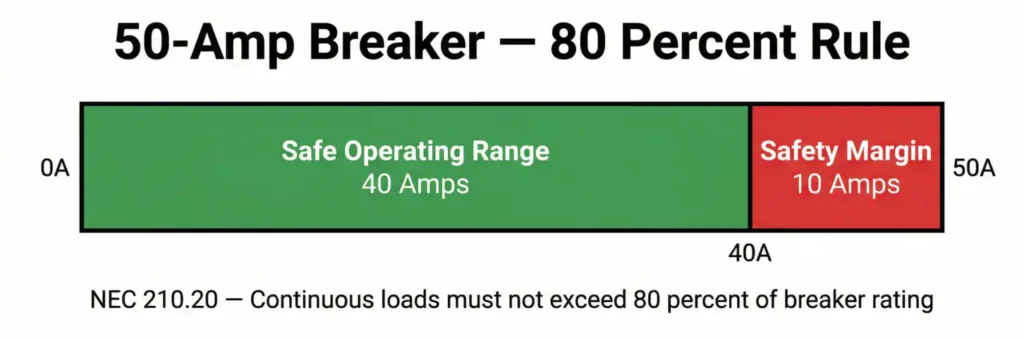
The National Electrical Code (NEC) requires that a continuous load should not exceed 80% of the breaker’s rated capacity. A hot tub heater runs for extended periods, making it a continuous load under NEC definitions.
Here is how you apply the 80% rule:
- If your hot tub draws 40 amps, you need a breaker rated at 40 ÷ 0.80 = 50 amps.
- If your hot tub draws 48 amps, you need a breaker rated at 48 ÷ 0.80 = 60 amps.
This rule exists to prevent the breaker and wiring from operating at their maximum capacity for long periods. Running a circuit at full capacity for hours generates excess heat in the conductors and the breaker itself.
2.2 Common Breaker Sizes for Hot Tubs
| Hot Tub Type | Voltage | Max Amperage Draw | Recommended Breaker Size |
|---|---|---|---|
| Plug-and-play (small) | 120V | 12–15A | 15A or 20A |
| Mid-size spa | 240V | 30–40A | 40A or 50A |
| Full-size hot tub | 240V | 40–50A | 50A or 60A |
| Large hot tub with multiple pumps | 240V | 50–60A | 60A |
Practical Example: A Jacuzzi J-335 hot tub has a 5,500-watt heater and two pumps. The total maximum draw is about 48 amps at 240 volts. Using the 80% rule, you would need a 60-amp breaker for this unit.
3. Voltage Requirements: 120V vs. 240V Hot Tubs
3.1 120-Volt Hot Tubs
These are entry-level, portable spas. They plug into a standard NEMA 5-15R or NEMA 5-20R outlet. No special wiring is needed. The heater is usually rated at 1,000 to 1,500 watts. These tubs heat water slowly and cannot run the heater and jets at the same time.
A 120-volt hot tub uses a 15-amp or 20-amp breaker, depending on the plug type and the circuit capacity.
3.2 240-Volt Hot Tubs
Most permanent hot tubs require a dedicated 240-volt circuit. These tubs have more powerful heaters and can run the heater and pumps simultaneously. They heat water faster and maintain temperature more efficiently.
A 240-volt hot tub needs a dedicated double-pole breaker rated at 40, 50, or 60 amps. The exact size depends on the total load of the spa.
Note: You cannot simply plug a 240-volt hot tub into a standard outlet. It requires hardwired installation by a licensed electrician.
4. Wire Sizing for Hot Tub Circuits
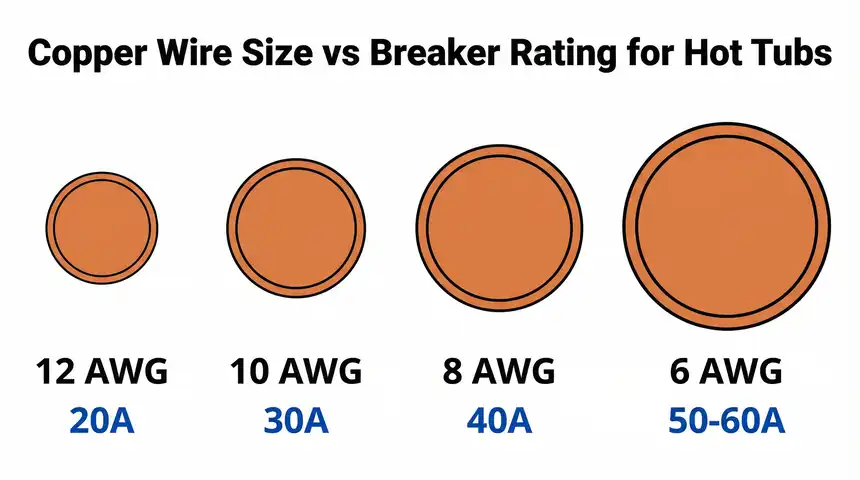
The breaker size and the wire gauge must match. Using undersized wire on a high-amperage circuit is a fire hazard. The NEC provides clear guidelines for conductor sizing based on ampacity.
4.1 Wire Size Chart for Hot Tub Circuits
| Breaker Size | Minimum Wire Gauge (Copper) | Minimum Wire Gauge (Aluminum) |
|---|---|---|
| 20A | 12 AWG | 10 AWG |
| 30A | 10 AWG | 8 AWG |
| 40A | 8 AWG | 6 AWG |
| 50A | 6 AWG | 4 AWG |
| 60A | 6 AWG | 4 AWG |
These sizes are based on NEC Table 310.16 for conductors rated at 60°C or 75°C in a raceway or cable. For longer wire runs (over 50 feet), you may need to increase the wire size by one gauge to account for voltage drop.
Practical Example: You are installing a 50-amp hot tub circuit with a wire run of 80 feet from the main panel. At this distance, 6 AWG copper wire will experience a voltage drop of about 4.5%, which is close to the recommended 3% limit. You should upgrade to 4 AWG copper to reduce voltage drop and improve performance.
4.2 Wire Type
For outdoor hot tub installations, use wire rated for wet or damp locations. Common choices include:
- THWN-2 conductors in conduit
- UF-B (Underground Feeder) cable for direct burial applications
- NM-B (Romex) for indoor runs only (not suitable for outdoor or underground use)
5. GFCI Protection: A Non-Negotiable Requirement
The NEC (Article 680.44) requires Ground-Fault Circuit Interrupter (GFCI) protection for all hot tub and spa circuits. This applies to both 120-volt and 240-volt installations.
A GFCI breaker detects ground faults as small as 4 to 6 milliamps and trips the circuit within milliseconds. This protects users from electric shock, which is especially dangerous around water.
5.1 GFCI Breaker vs. GFCI Outlet
For 240-volt hot tub circuits, GFCI protection is provided at the breaker panel using a GFCI-rated breaker. You cannot use a standard GFCI outlet for a hardwired 240-volt spa.
For 120-volt plug-and-play models, the power cord usually has a built-in GFCI plug or in-line GFCI device. However, many local codes still require the outlet to be GFCI-protected at the panel or at the receptacle.
5.2 Costs
A 50-amp GFCI breaker costs between $80 and $200, depending on the brand and panel compatibility. A 60-amp GFCI breaker costs between $100 and $250. These are more expensive than standard breakers, but they are required by code and are not optional.
Popular brands include Square D, Eaton, Siemens, and GE. Make sure the GFCI breaker is compatible with your main electrical panel.
6. NEC Code Requirements for Hot Tub Electrical Installations
The National Electrical Code (NEC), published by NFPA as NFPA 70, contains specific rules for hot tub and spa installations. Article 680 covers swimming pools, fountains, and similar installations. The sections most relevant to hot tubs are:
6.1 NEC 680.42 — Outdoor Installations
- All outdoor spa and hot tub installations must have a GFCI-protected circuit.
- The hot tub must be connected through a manual disconnect (more on this below).
- All metal parts within 5 feet of the spa must be bonded together using a solid copper conductor (minimum 8 AWG).
6.2 NEC 680.43 — Indoor Installations
- Indoor spas must also have GFCI protection.
- Proper ventilation is required to handle humidity and chemical fumes.
- All receptacles within 6 feet of the inside wall of the spa must be GFCI-protected.
6.3 NEC 680.44 — GFCI Protection for Spas and Hot Tubs
- All supply circuits for spas and hot tubs must have GFCI protection.
- The GFCI device must be listed for the purpose and installed per the manufacturer’s instructions.
6.4 NEC 680.12 — Disconnect Requirements
- A clearly labeled emergency disconnect must be installed within sight of the hot tub and at least 5 feet away from the spa.
- This disconnect must be readily accessible to the user.
6.5 ANSI/NFPA 70 Reference
The NEC is an ANSI-approved standard (ANSI/NFPA 70). It is adopted in all 50 U.S. states, though some jurisdictions may have local amendments. Always check with your local Authority Having Jurisdiction (AHJ) before starting any electrical work.
7. Step-by-Step Hot Tub Breaker Installation Process
This section outlines the general process for installing a breaker and circuit for a 240-volt, 50-amp hot tub. This work should be performed by a licensed electrician or a qualified person familiar with NEC requirements and local codes.
Step 1: Check the Hot Tub Specifications
Read the manufacturer’s installation manual. Note the voltage, amperage, wire size requirements, and any special instructions.
Step 2: Obtain a Permit
Most jurisdictions require an electrical permit for hot tub installations. Contact your local building department before starting work.
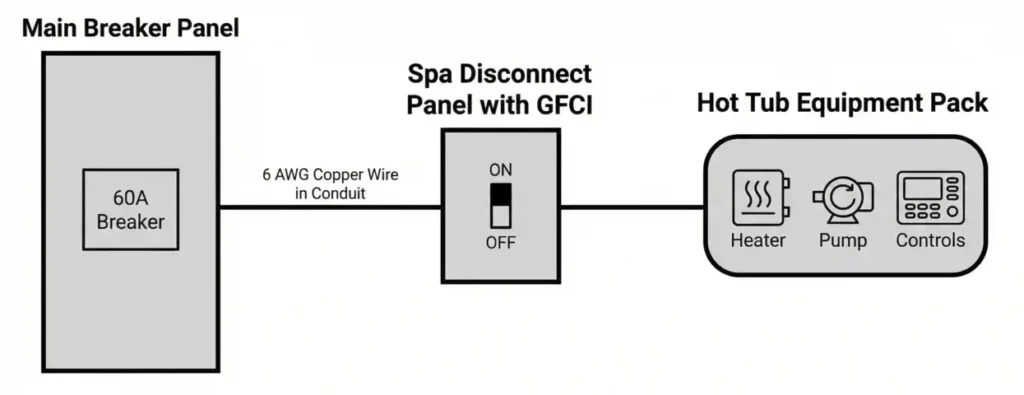
Step 3: Install the Breaker in the Main Panel
- Turn off the main breaker.
- Install a 50-amp or 60-amp double-pole GFCI breaker (or standard breaker if GFCI is at the spa panel).
- Connect the hot (black and red), neutral (white), and ground (green or bare) conductors.
Step 4: Run the Wire
- Use the correct wire gauge (6 AWG copper for 50A or 60A circuits).
- Run the wire through conduit (PVC or metallic) for outdoor or underground sections.
- Maintain proper burial depth for underground runs (minimum 18 inches for PVC conduit per NEC 300.5).
Step 5: Install the Spa Disconnect Panel
- Mount the panel within sight of the hot tub, at least 5 feet away.
- Connect the incoming wires from the main panel.
- Connect the outgoing wires to the hot tub.
Step 6: Connect the Hot Tub
- Follow the manufacturer’s wiring diagram.
- Connect the wires to the equipment pack (control box) of the hot tub.
- Make sure all connections are tight and properly terminated.
Step 7: Test the Circuit
- Turn on the breaker.
- Test the GFCI by pressing the “Test” button. The breaker should trip immediately.
- Reset the GFCI and power up the hot tub.
- Check for proper operation of the heater, pumps, and controls.
Step 8: Schedule an Inspection
- Call your local building department to schedule a final electrical inspection.
- The inspector will verify code compliance, wire sizing, grounding, bonding, GFCI protection, and disconnect placement.
8. Common Mistakes to Avoid
8.1 Using an Undersized Breaker
A breaker that is too small will trip frequently during normal operation. If your hot tub draws 45 amps and you install a 40-amp breaker, it will trip under full load. Always apply the 80% rule.
8.2 Using an Oversized Breaker
A breaker that is too large will fail to protect the wiring. If you install a 60-amp breaker on a circuit wired with 10 AWG conductors (rated for only 30 amps), the wire can overheat before the breaker trips. The breaker size must match the wire gauge.
8.3 Skipping the GFCI
Some homeowners try to save money by using a standard breaker instead of a GFCI breaker. This violates NEC 680.44 and creates a serious electrocution hazard. GFCI protection is mandatory for all hot tub circuits.
8.4 Sharing a Circuit
A hot tub must have a dedicated circuit. Do not connect other loads (lights, outlets, or appliances) to the same breaker. Sharing a circuit increases the risk of overloading and breaker tripping.
8.5 Ignoring Voltage Drop
Long wire runs cause voltage drop, which reduces the performance of the hot tub heater and pumps. For runs longer than 50 feet, calculate voltage drop and upsize the wire if needed. The NEC recommends keeping voltage drop below 3% for branch circuits (NEC 210.19 Informational Note No. 4).
8.6 Improper Bonding
NEC 680.26 requires bonding of all metal parts within 5 feet of the hot tub. This includes metal handrails, metal siding, metal fences, and equipment enclosures. Use a minimum 8 AWG solid copper bonding conductor.
9. Hot Tub Breaker Sizing for Popular Brands
Here is a quick reference for breaker sizes recommended by some popular hot tub manufacturers:
| Brand/Model | Voltage | Max Amps | Recommended Breaker |
|---|---|---|---|
| Jacuzzi J-335 | 240V | 48A | 60A GFCI |
| Hot Spring Limelight Flair | 240V | 40A | 50A GFCI |
| Bullfrog A7L | 240V | 50A | 60A GFCI |
| Sundance Optima 880 | 240V | 50A | 60A GFCI |
| Intex PureSpa (inflatable) | 120V | 12A | 15A or 20A GFCI |
| Lifesmart LS450DX | 120V | 13A | 15A or 20A GFCI |
| Master Spas Twilight 7.2 | 240V | 50A | 60A GFCI |
| Caldera Utopia Cantabria | 240V | 50A | 60A GFCI |
Always verify these numbers with the installation manual that comes with your specific model. Specifications can change between model years.
10. Conclusion
Choosing the right breaker size for your hot tub is a straightforward process once you know the electrical requirements. Most full-sized 240-volt hot tubs need a 50-amp or 60-amp GFCI breaker with 6 AWG copper wire and a dedicated circuit. Smaller 120-volt plug-and-play models work with a standard 15-amp or 20-amp circuit. Always apply the NEC 80% rule to determine the minimum breaker rating for your specific load.
Always consult the hot tub manufacturer’s installation manual, follow NEC and local code requirements, and work with a licensed electrician. Getting a proper electrical permit and passing inspection gives you peace of mind that your installation is safe, legal, and built to last.
11. Frequently Asked Questions (FAQs)
A 30-amp breaker is only appropriate for small hot tubs that draw 24 amps or less (applying the 80% rule). Most full-sized 240-volt hot tubs draw 40 to 50 amps and need a 50-amp or 60-amp breaker. Check your owner’s manual for the correct breaker size.
Yes. NEC 680.44 requires GFCI protection for all spa and hot tub circuits. This applies to both 120-volt and 240-volt installations. A GFCI breaker or GFCI spa panel must be installed.
No. A 240-volt hot tub cannot be plugged into a standard 120-volt household outlet. It requires a dedicated 240-volt circuit that is hardwired to a breaker panel through a disconnect.
An undersized breaker will trip frequently. An oversized breaker will not protect the wiring from overheating. Both situations are dangerous. Always match the breaker size to the hot tub’s load and the wire gauge.
There is no maximum distance specified in the NEC, but longer runs require larger wire to compensate for voltage drop. The disconnect panel must be within line of sight and at least 5 feet from the hot tub per NEC 680.12.
In most jurisdictions, homeowners can pull a permit and do their own electrical work. However, hot tub wiring involves high amperage and water proximity. A licensed electrician is strongly recommended.
Yes. NEC requires that a hot tub have a dedicated branch circuit. No other appliances, lights, or outlets should be connected to the same circuit.
For a 50-amp hot tub circuit, you need a minimum of 6 AWG copper wire. For wire runs longer than 50 feet, consider upgrading to 4 AWG to minimize voltage drop.