
Knob and tube wiring was the standard electrical wiring method used in homes across the United States, Canada, the United Kingdom, and Australia from the 1880s through the 1940s. This system uses ceramic knobs to hold wires along structural framing and ceramic tubes to protect wires where they pass through joists and studs. At the time of installation, knob and tube wiring was considered safe and was installed according to the codes of that era. However, modern electrical demands have far exceeded what this old wiring system was designed to handle.
Today, millions of older homes still contain active knob and tube wiring. Homeowners, electricians, and home inspectors frequently encounter this outdated system during renovations and property transactions. The dangers associated with this wiring are real and well-documented. Fires, electrocution, and insurance complications are common issues linked to aging knob and tube installations.
In this technical guide, we will discuss everything you need to know about knob and tube wiring dangers, including its construction, common failure modes, fire hazards, insurance implications, code violations, inspection methods, and safe replacement options. Practical examples are included throughout to help you apply these concepts in real-world scenarios confidently.
1. What is Knob and Tube Wiring?
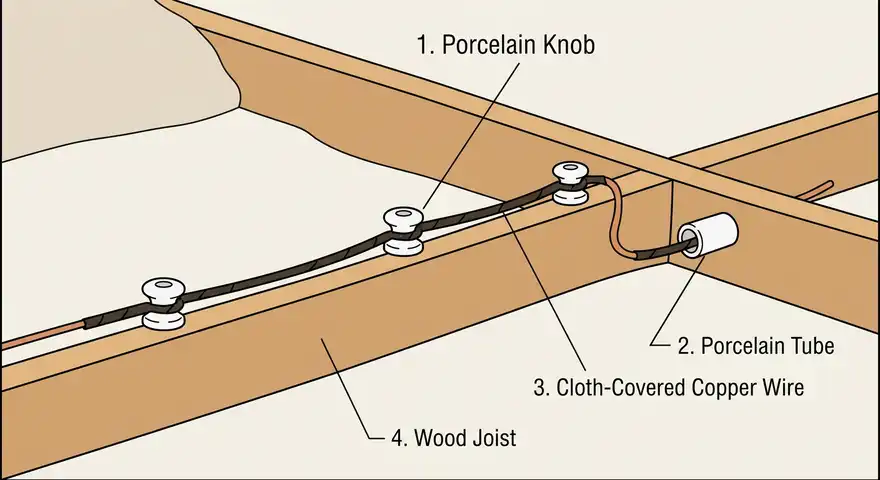
Knob and tube (K&T) wiring is an early electrical wiring system that uses individual copper conductors run through open air spaces within wall cavities, attics, and floor joists. The system gets its name from two components: porcelain knobs and porcelain tubes. The knobs are nailed to wooden framing members and hold the wires in place. The tubes are inserted into holes drilled through structural members to allow wires to pass through safely without contacting wood.
Each circuit in a knob and tube system consists of two separate wires — one hot conductor and one neutral conductor. These wires are run with a deliberate air gap between them. This air gap was part of the original safety design because it allowed heat to dissipate from the conductors.
The wire insulation used in K&T systems was made from rubber or cloth. These materials were adequate for the electrical loads of the early 20th century. Most homes at that time only needed electricity for a few lights and maybe a radio. The system was never designed to support the heavy electrical loads that modern homes demand.
2. How Knob and Tube Wiring was Installed
The installation process for knob and tube wiring followed a specific method. Electricians would drill holes through floor joists and wall studs, then insert porcelain tubes into those holes. The wires were threaded through the tubes to prevent direct contact with wood. Between structural members, the wires were supported by porcelain knobs mounted on the framing.
The hot wire and neutral wire were run separately, often several inches apart from each other. This separation was intentional. It reduced the chance of a short circuit and allowed natural air circulation around the conductors.
Splices in knob and tube wiring were soldered and wrapped with rubber tape, then covered with a layer of friction tape. These splices were made in the open, not hidden inside junction boxes as required by modern electrical codes. This is an important distinction because modern wiring standards under the National Electrical Code (NEC), also known as ANSI/NFPA 70, require all wire splices to be enclosed within approved junction boxes.
A practical example helps illustrate the concern. Imagine a homeowner in a 1920s house who notices an exposed wire splice in the attic. That splice, originally soldered and taped over 100 years ago, may now have deteriorated tape, corroded solder, and exposed copper. This creates a direct fire risk.
3. The Main Reasons Why Knob and Tube Wiring is Dangerous
3.1 Deteriorated Wire Insulation
The rubber and cloth insulation used on knob and tube wiring breaks down over time. After 80 to 100 years, these materials become dry and brittle. They crack, flake off, and eventually expose bare copper conductors. Exposed conductors can make contact with wood framing, insulation material, or other combustible surfaces. This contact can generate heat and start a fire.
In a real-world inspection scenario, an electrician working in the attic of a 1930s home might find long stretches of wire where the rubber insulation has completely disintegrated. The bare copper wire is sitting directly on wooden joists. This is an immediate hazard that requires professional remediation.
3.2 No Ground Wire
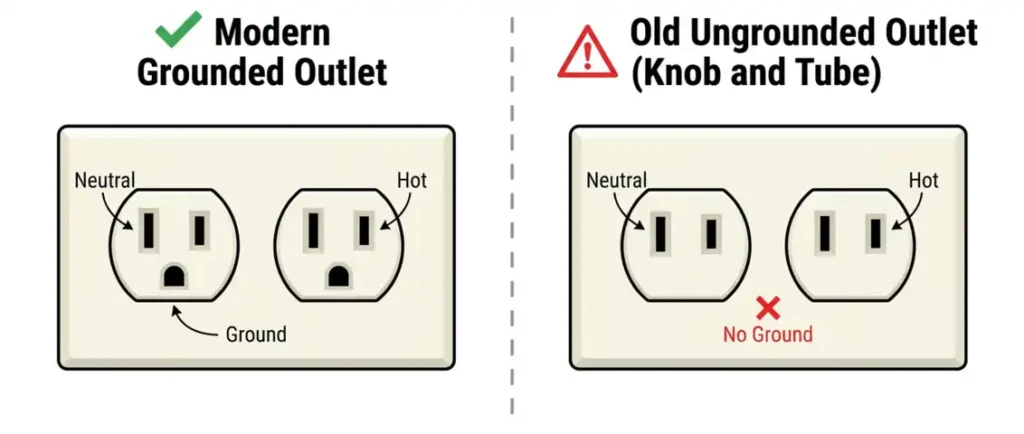
Knob and tube wiring does not include a ground conductor. Modern electrical systems use a three-wire setup: hot, neutral, and ground. The ground wire provides a safe path for fault current to flow back to the electrical panel, which allows the circuit breaker to trip and disconnect power during a fault.
Without a ground wire, electrical faults can energize metal appliance housings, outlet cover plates, and other conductive surfaces. This creates a direct risk of electric shock or electrocution. The absence of a grounding conductor also means that surge protection devices and GFCI (Ground Fault Circuit Interrupter) outlets cannot function as designed.
The NEC (ANSI/NFPA 70) requires equipment grounding conductors in all new installations. Section 250.110 of the NEC mandates grounding for exposed non-current-carrying metal parts of fixed equipment that are likely to become energized. Knob and tube wiring cannot meet this requirement.
3.3 Overloaded Circuits
Knob and tube circuits were designed for 10 to 15 amps of current. A typical circuit in a 1920s home might have been intended to power two or three light fixtures and perhaps one outlet. Modern households routinely plug in air conditioners, space heaters, microwave ovens, hair dryers, and multiple electronic devices.
These modern appliances draw far more current than the original wiring was rated to carry. An overloaded knob and tube circuit will generate excessive heat in the conductors. Because the old insulation is already degraded, this heat buildup creates a serious fire hazard.
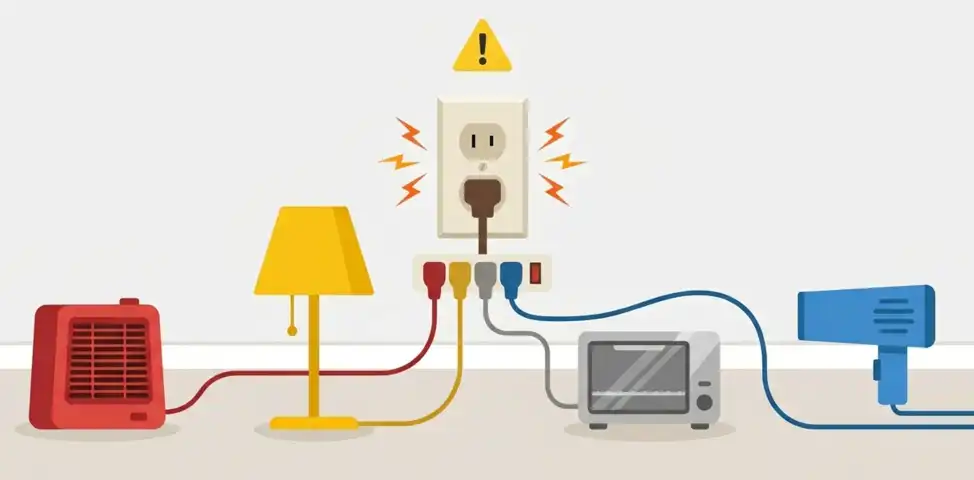
For example, a homeowner using a 1,500-watt space heater on a knob and tube circuit rated for 10 amps at 120 volts is pulling 12.5 amps through that circuit. If other devices are also connected, the total current draw can easily exceed the wire’s safe capacity. The wire heats up, and nearby combustible materials can ignite.
3.4 Improper Modifications Over the Decades
One of the most common dangers with knob and tube wiring comes from amateur modifications made over the years. Previous homeowners, handymen, or unqualified individuals often spliced modern Romex (NM cable) wiring into old knob and tube circuits. These connections are frequently made without proper junction boxes, wire nuts, or appropriate connectors.
Improper splices create high-resistance connections. High-resistance connections generate heat. Heat in contact with aged materials is a recipe for fire.
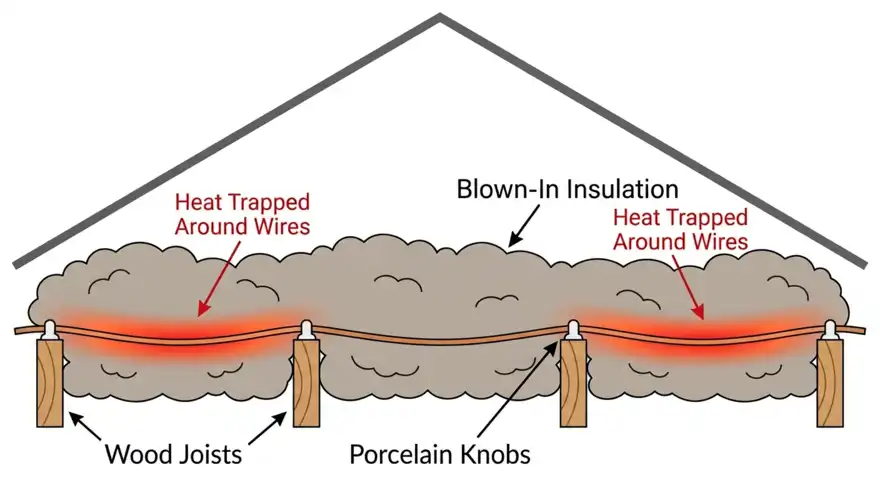
Another common modification involves wrapping knob and tube wiring with building insulation. The original design relied on open air circulation to keep the conductors cool. Covering these wires with fiberglass, cellulose, or blown-in insulation traps heat around the conductors. This is a documented cause of house fires in older homes.
Section 394.12 of the NEC states that knob and tube wiring shall not be used in hollow spaces of walls, ceilings, and attics where such spaces are insulated by loose, rolled, or foamed-in-place insulating material that envelops the conductors.
3.5 Lack of Circuit Protection
Many older homes with knob and tube wiring still use original fuse panels instead of modern circuit breaker panels. Fuse panels are not inherently dangerous if properly maintained. However, a common problem is “over-fusing,” where a homeowner replaces a 15-amp fuse with a 20-amp or 30-amp fuse to prevent frequent fuse blows.
Over-fusing defeats the purpose of overcurrent protection. The wire is rated for 15 amps, but the fuse will not blow until 30 amps flows through the circuit. This allows the wire to heat up to dangerous levels long before the fuse responds.
Modern circuit breaker panels with arc-fault circuit interrupters (AFCIs) and ground-fault circuit interrupters (GFCIs) provide much better protection. AFCI breakers detect arcing faults — the kind of faults that commonly occur in old, damaged wiring. GFCI protection reduces the risk of electrocution. Knob and tube systems do not have these protections in place.
4. Fire Hazards Associated With Knob and Tube Wiring
House fires caused by electrical faults are a leading cause of residential fires in the United States. According to the National Fire Protection Association (NFPA), electrical distribution and lighting equipment is involved in an estimated 34,000 home fires per year. Old and defective wiring is a major contributor to these statistics.
Knob and tube wiring contributes to fire hazards in several specific ways:
- Bare conductors contacting combustible materials. Deteriorated insulation leaves copper wires exposed against wood framing and other combustible surfaces.
- Overheated splices. Old soldered connections develop high resistance over time, generating localized heat.
- Buried wiring under insulation. Thermal insulation prevents heat dissipation, causing conductor temperatures to rise beyond safe limits.
- Overloaded circuits. Modern appliance loads exceed the original circuit ratings.
A practical example of fire risk can be seen in homes that have undergone attic insulation upgrades for energy efficiency. A contractor blows cellulose insulation into the attic to improve thermal performance. That cellulose insulation covers active knob and tube wiring. The wires can no longer dissipate heat through air circulation. Over time, the accumulated heat can ignite the surrounding insulation material.
This scenario is not hypothetical. Fire investigation reports from agencies across the U.S. and Canada have documented this exact sequence of events.
5. Electrical Code Violations and Knob and Tube Wiring
The National Electrical Code (NEC), published as ANSI/NFPA 70, is the primary standard governing electrical installations in the United States. The NEC does not outright ban existing knob and tube wiring. However, it places strict limitations on its use and prohibits new installations.
Here are some relevant NEC provisions:
| NEC Section | Requirement |
|---|---|
| Article 394 | Governs concealed knob and tube wiring installations |
| 394.12 | Prohibits K&T in hollow insulated spaces |
| 394.10 | Limits use to specific building types and conditions |
| 250.110 | Requires equipment grounding (not available in K&T) |
| 210.12 | Requires AFCI protection in dwelling units |
| 210.8 | Requires GFCI protection in wet/damp locations |
Many local jurisdictions have adopted additional restrictions. Some cities require complete removal and replacement of knob and tube wiring before a home can be sold. Others require an electrical safety inspection and certification from a licensed electrician before a property transfer.
In Canada, the Canadian Electrical Code (CEC), published as CSA C22.1, contains similar restrictions on knob and tube wiring. The CEC requires that all electrical installations meet current code standards for safety.
In the United Kingdom, BS 7671 (IET Wiring Regulations) governs electrical installations. Homes with very old wiring systems that do not meet current regulations must be upgraded, and periodic inspection reports (EICRs) will flag unsafe conditions.
6. Insurance Implications of Knob and Tube Wiring
Home insurance is a major concern for owners of properties with knob and tube wiring. Many insurance companies in the United States and Canada will not issue a standard homeowner’s insurance policy for a home with active knob and tube wiring. Others will issue a policy but charge a much higher premium.
The reasoning is straightforward. Insurance companies assess risk based on historical data. Homes with knob and tube wiring have a statistically higher rate of electrical fires. This makes them a higher-risk property to insure.
Some insurance providers will offer coverage if the homeowner obtains an electrical safety inspection from a licensed electrician. The inspection must confirm that the wiring is in serviceable condition and that no code violations exist. However, this is becoming less common as insurers tighten their underwriting standards.
For homeowners planning to sell a property, this creates a practical problem. A buyer may not be able to obtain home insurance until the knob and tube wiring is replaced. This can delay or cancel a home sale. Real estate transactions involving older homes with outdated electrical systems frequently require a full electrical rewiring before closing.
7. Health and Safety Risks Beyond Fire
The dangers of knob and tube wiring extend beyond fire hazards. The absence of a grounding system creates real risks of electric shock and electrocution.
Consider this example. A homeowner plugs a metal-bodied table lamp into a two-prong outlet on a knob and tube circuit. A fault develops inside the lamp, and the hot wire contacts the metal housing. In a modern grounded system, the fault current would flow through the ground wire to the panel, and the breaker would trip immediately. In a knob and tube system with no ground, the lamp housing remains energized. Anyone who touches the lamp while also touching a grounded surface (like a water pipe or a wet floor) could receive a lethal shock.
GFCI outlets can provide some protection in this scenario, but they require a functioning ground reference for full effectiveness. Some jurisdictions allow GFCI outlets to be installed on ungrounded circuits as a safety improvement. However, this is a partial solution, not a permanent fix.
Another health concern involves the materials used in old wiring insulation. Some older installations used asbestos-containing materials as insulation wraps. Disturbing these materials during renovation or inspection can release asbestos fibers into the air. Proper identification and abatement procedures must be followed if asbestos is suspected.
8. How to Identify Knob and Tube Wiring in a Home
Homeowners and home inspectors can identify knob and tube wiring through a visual inspection of accessible areas. The most common places to spot this wiring are in attics, basements, crawl spaces, and unfinished areas.
Here are the telltale signs:
- Porcelain knobs mounted on joists or rafters, holding individual wires.
- Porcelain tubes passing through drilled holes in structural members.
- Two separate wires running parallel but spaced apart, rather than bundled in a single cable.
- Cloth or rubber-wrapped conductors instead of modern plastic-insulated NM cable.
- Open splices wrapped in old tape rather than enclosed in junction boxes.
- Two-prong outlets with no ground slot (this alone does not confirm K&T, but it is a strong indicator in older homes).
A professional home electrical inspection performed by a licensed electrician is the most reliable way to determine the extent and condition of knob and tube wiring in a property. This inspection will identify active circuits, abandoned wiring, improper modifications, and code violations.
9. Options for Replacing Knob and Tube Wiring
The safest course of action for a home with active knob and tube wiring is a complete electrical rewiring. This involves removing the old wiring and installing a new electrical system that meets current NEC or local code requirements.
A complete rewire of a home includes:
- Installing a new electrical panel (100-amp or 200-amp service, depending on the home’s needs).
- Running new NM cable (Romex) or conduit wiring throughout the home.
- Installing grounded three-prong outlets in all rooms.
- Adding GFCI outlets in kitchens, bathrooms, garages, and outdoor locations as required by NEC Section 210.8.
- Adding AFCI protection in bedrooms and other living areas as required by NEC Section 210.12.
- Properly abandoning or removing all old knob and tube wiring.
The cost of a complete home rewire varies depending on the size of the home, local labor rates, and the complexity of the job. In the United States, homeowners can expect to pay between $8,000 and $30,000 or more for a full rewiring project. This is a large expense, but it is a necessary investment in home safety.
A licensed electrician should perform all rewiring work. DIY electrical work on this scale is dangerous, illegal in many jurisdictions, and can void insurance coverage.
10. Practical Tips for Homeowners With Knob and Tube Wiring
If your home still has active knob and tube wiring, here are some practical steps you can take to reduce risk while planning for a full replacement:
- Do not overload circuits. Limit the number of devices and appliances on each circuit. Avoid using high-wattage appliances like space heaters and window air conditioners on K&T circuits.
- Do not add insulation over K&T wiring. If you are planning an insulation upgrade, have the wiring replaced first.
- Do not make DIY modifications. Splicing modern wire into old K&T circuits without proper knowledge and permits is dangerous and illegal.
- Schedule a professional electrical inspection. A licensed electrician can evaluate the condition of your wiring and recommend the safest course of action.
- Talk to your insurance provider. Inform your insurer about the wiring in your home. Ask about their requirements and whether a rewiring project could reduce your premium.
- Check with your local building department. Some municipalities offer incentives, permits, or programs to help homeowners upgrade outdated electrical systems.
11. Conclusion
Knob and tube wiring served its purpose during the early decades of residential electrification. It was a reasonable system for the electrical demands of its time. However, that time has long passed. Today, knob and tube wiring presents clear dangers to homeowners and their families. Deteriorated insulation, lack of grounding, overloaded circuits, and improper modifications all contribute to elevated fire and shock risks.
If you own or are considering purchasing a home with knob and tube wiring, the safest path forward is a complete electrical rewiring performed by a licensed electrician. This upgrade will bring the home into compliance with current electrical codes, improve safety for all occupants, and resolve insurance and resale complications.
12. Frequently Asked Questions (FAQs)
Yes, existing knob and tube wiring is legal in most jurisdictions as long as it is in safe working condition. However, new installations of knob and tube wiring are prohibited under the NEC and most other national electrical codes.
Some insurance companies will provide coverage for homes with knob and tube wiring, but many will not. Those that do may charge higher premiums or require a professional electrical inspection report confirming the wiring is in acceptable condition.
The cost of replacing knob and tube wiring depends on the size of the home, local labor rates, accessibility of the wiring, and the scope of the project. In the United States, a full home rewire generally costs between $8,000 and $30,000. Larger or more complex homes may cost more.
Yes, the NEC allows GFCI outlets to be installed on ungrounded circuits as a safety improvement. The outlet must be labeled “No Equipment Ground”.
Yes, knob and tube wiring is considered a fire hazard, especially in homes where the insulation has deteriorated, circuits are overloaded, modifications have been made improperly, or building insulation has been installed over the wiring.
In most jurisdictions, it is acceptable to disconnect and abandon knob and tube wiring in place, as long as new compliant wiring is installed to serve all circuits. Complete removal is preferable but not always required.
A licensed electrician can perform a circuit trace to determine which knob and tube wires are still carrying current and which have been abandoned. Visual inspection alone may not be sufficient because some abandoned wires may still be connected at the panel.
Yes, active knob and tube wiring generally reduces property value. Buyers factor in the cost of rewiring when making offers. Some buyers will avoid purchasing a home with K&T wiring altogether due to insurance and safety concerns.