
Working with electrical circuits always carries some level of risk. Before touching any wire, conductor, or terminal, you need to confirm whether voltage is present or not. This is where non-contact voltage testers come into the picture. These handheld tools allow electricians, engineers, and technicians to detect the presence of AC voltage without making direct physical contact with a live conductor. They are one of the most widely used safety instruments in the electrical trade today.
Non-contact voltage testers work by sensing the electric field that surrounds an energized conductor. You simply bring the tip of the tester close to a wire, outlet, or cable, and the device alerts you with a light, sound, or vibration if voltage is detected.
In this technical guide, we will discuss everything you need to know about non-contact voltage testers, including their working principle, types, applications, safety ratings, proper usage techniques, limitations, testing methods, and relevant industry standards. Practical examples are included throughout to help you apply these concepts in real-world scenarios confidently.
1. What is a Non-Contact Voltage Tester?
A non-contact voltage tester (NCVT), also called a voltage detector or voltage stick, is a portable electronic device used to detect the presence of alternating current (AC) voltage in conductors, outlets, circuit breakers, switches, and wires. The user does not need to touch the conductor or expose any bare metal. The device senses voltage through insulation, wire jackets, and even wall plates in some cases.
Most non-contact voltage testers are shaped like a pen or marker. They have a sensing tip at one end and indicator lights, a buzzer, or both to alert the user. Some advanced models also include a vibration alert for noisy environments. The tool is powered by small batteries, usually AAA or button cells.
These devices are designed primarily for detecting AC voltage. They do not measure the exact voltage value. Their job is to answer one simple question: Is this wire or terminal energized or not? For actual voltage measurement, you would still need a digital multimeter or a contact-type voltage tester.
The popularity of non-contact voltage testers comes from their speed and convenience. An electrician working on a residential panel, for example, can quickly scan multiple breakers and wires in seconds. This makes the tool a first line of defense before performing any hands-on work.
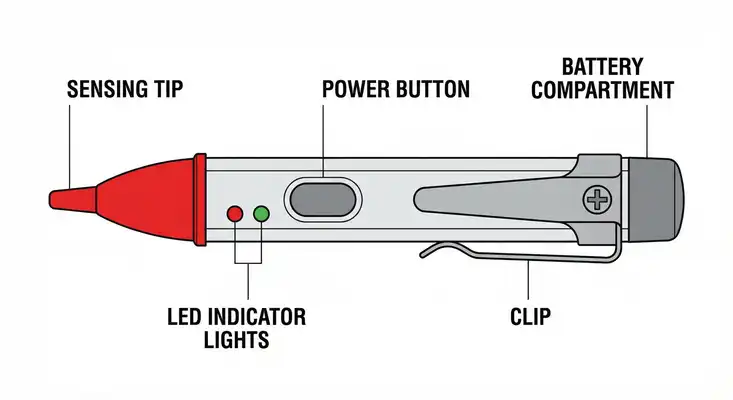
2. How Do Non-Contact Voltage Testers Work?
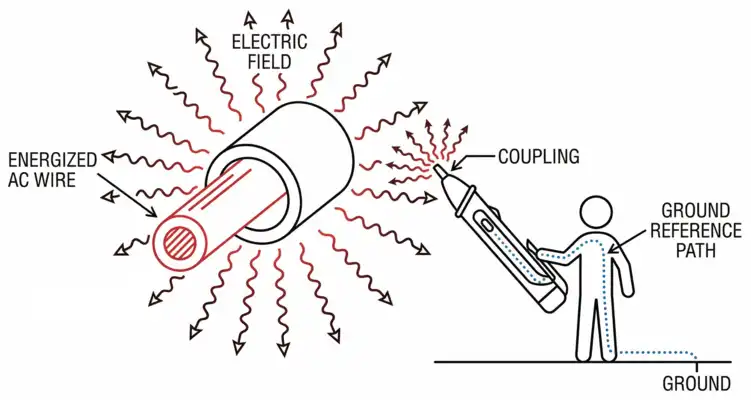
The operating principle behind a non-contact voltage tester is capacitive sensing. Every energized AC conductor produces an oscillating electric field around it. The sensing tip of the NCVT acts as one plate of a capacitor. The energized conductor acts as the other plate. The insulation or air gap between them acts as the dielectric.
The oscillating electric field from the AC conductor induces a tiny displacement current through this capacitive coupling. The internal circuitry of the tester amplifies this small signal. Once the signal exceeds a preset threshold, the tester activates its alert — a glowing LED, an audible beep, or both.
Here is a simplified breakdown of the process:
- An AC conductor carries alternating voltage, producing an electric field around it.
- The user brings the NCVT’s sensing tip near the conductor.
- The electric field couples capacitively with the sensor.
- The internal amplifier circuit detects and processes the induced signal.
- If the signal exceeds the detection threshold, the tester alerts the user.
The tester requires a return path to ground to complete the sensing circuit. In most cases, the user’s body serves as this ground reference. The user holds the tester, and the body’s natural capacitance to ground completes the circuit. This is why some testers may not work correctly if you are wearing thick rubber gloves or standing on a perfectly insulated surface.
Practical Example: Suppose you are about to replace a light switch in your home. Before removing the faceplate, you hold the NCVT near the switch. The tester beeps and the tip glows red. This tells you the circuit is still live. You go to the breaker panel, flip the correct breaker, come back, and test again. This time, no beep, no glow. Now you know it is safe to proceed.
3. Types of Non-Contact Voltage Testers
Non-contact voltage testers come in several varieties. Each type is suited for different tasks and environments.
3.1 Standard Pen-Type NCV Testers
These are the most common models. They look like a thick pen or marker. The tip is the sensor, and the body contains the circuitry and batteries. They detect AC voltage in a fixed range, such as 50V to 1000V AC. Most electricians carry one of these in their pocket at all times.
These models usually have a single sensitivity level. They light up and beep when voltage is detected. They are best for everyday tasks like checking outlets, switches, and wires in residential and commercial settings.
3.2 Adjustable Sensitivity NCV Testers
Some models offer adjustable sensitivity settings, often labeled as low and high sensitivity. On the low setting, the tester only reacts when very close to a strong voltage source. On the high setting, it can detect voltage through thicker insulation or at a greater distance.
Adjustable sensitivity is useful in environments with many bundled cables. On low sensitivity, you can isolate a single energized wire from a group. On high sensitivity, you can scan walls to find hidden wiring.
3.3 Dual-Range NCV Testers
Dual-range testers can distinguish between different voltage levels. For example, one model might indicate low voltage (12V–50V AC) with a yellow LED and standard voltage (50V–1000V AC) with a red LED. This gives the user more information than a simple on-off indication.
3.4 NCV Testers with Built-In Flashlight
Many modern models include a small LED flashlight at the tip. This is very practical for working inside dark electrical panels, crawl spaces, or attics. The flashlight function is independent of the voltage detection function.
3.5 NCV Testers Integrated into Multimeters or Clamp Meters
Several digital multimeters and clamp meters now include a built-in non-contact voltage detection feature. The top of the meter body acts as the sensing tip. This reduces the number of tools a technician needs to carry.

4. How to Use a Non-Contact Voltage Tester Correctly
Using an NCVT seems simple, but there is a correct procedure that you should follow every time.
Step 1: Inspect the Tester
Before each use, visually inspect the tester for damage. Check for cracked housings, corroded battery contacts, or a missing battery cap. A damaged tester may give false readings.
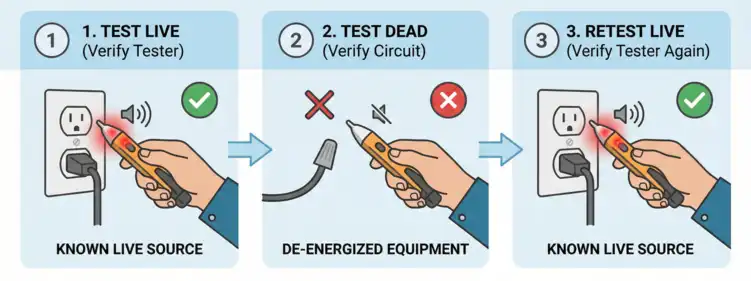
Step 2: Verify the Tester on a Known Live Source
This step is often skipped but is extremely important. Before trusting the tester, hold it near a source you know is energized — a live outlet you have not turned off, for example. Confirm that the tester beeps and lights up. This proves the tester is working correctly.
Step 3: Test the Target Conductor or Equipment
Hold the sensing tip near the wire, outlet, breaker, or terminal you want to test. Move the tip slowly along the conductor. If the tester alerts you, voltage is present. If there is no alert, the conductor appears to be de-energized.
Step 4: Verify the Tester Again on the Known Live Source
After testing, go back to the known live source and confirm the tester still works. This step rules out the possibility that the tester’s battery died or a malfunction occurred during your test. This process is called the “Live-Dead-Live” test method.
Step 5: Follow Up with a Contact Tester (Recommended)
For high-risk tasks or lockout/tagout situations, confirm the absence of voltage using a contact-type voltage tester or multimeter. The NCVT serves as a quick check, not an absolute guarantee.
Practical Example: An industrial electrician is about to work inside a motor control center (MCC). She first tests her NCVT on a known energized receptacle nearby. The tester beeps. She then tests the MCC bucket she will be working on. No alert. She goes back to the receptacle and tests again. The tester beeps again. She now has reasonable confidence that the bucket is de-energized. She follows up with a CAT III-rated multimeter for final confirmation before touching anything.
5. Common Applications of Non-Contact Voltage Testers
Non-contact voltage testers are used in a wide range of applications across residential, commercial, and industrial electrical work.
5.1 Residential Electrical Work
Home electricians and DIY homeowners use NCV testers to check outlets, light switches, and fixture wiring before starting repairs or replacements. The tool is fast and requires no setup.
5.2 Commercial Building Maintenance
Facility maintenance teams use these testers daily to check lighting circuits, HVAC electrical connections, and office power outlets. The pen-type form factor makes it easy to carry on a tool belt.
5.3 Industrial Electrical Maintenance
In factories and plants, electricians use NCV testers to quickly scan motor wiring, control panels, and junction boxes. The tool helps speed up troubleshooting by identifying which circuits are still energized.
5.4 Electrical Inspections
Home inspectors and code compliance officers use NCV testers to verify wiring conditions in buildings. They can quickly check if outlets are wired correctly and if circuits are active.
5.5 Locating Hidden Wiring
On high sensitivity settings, some NCV testers can detect wiring behind drywall. This helps contractors avoid drilling or nailing into live wires during renovations.
5.6 Checking Extension Cords and Power Strips
You can run the tester along an extension cord to see if it is energized. If the tester alerts along part of the cord and then stops, you may have found a break in the conductor.
6. Safety Ratings and Industry Standards
Non-contact voltage testers are safety tools, so they must meet specific standards. Using a tester that does not meet proper ratings can be dangerous.
6.1 IEC 61243-3
The international standard IEC 61243-3 covers non-contact voltage detectors for voltages ranging from 1 kV to 36 kV (used in utility-level applications). For low-voltage NCV testers used by most electricians, manufacturers often reference IEC 61010-1 for general safety requirements of electrical measurement equipment.
6.2 CAT Ratings (Measurement Categories)
Every voltage tester should have a CAT (Category) rating printed on it. The CAT rating indicates the level of transient overvoltage protection the device can handle. The four categories are:
- CAT I — Electronic equipment and low-energy circuits.
- CAT II — Single-phase receptacle outlets, plug-in loads.
- CAT III — Distribution-level circuits, including panel boards and bus bars.
- CAT IV — Origin of installation, utility connections, outdoor overhead lines.
For most residential and commercial electrical work, you need a tester rated at least CAT III 600V or CAT IV 300V. A CAT II-rated tester should not be used inside a breaker panel.
6.3 UL Listing and CE Marking
In the United States and Canada, look for testers that are UL Listed (Underwriters Laboratories). In Europe, look for the CE mark. These certifications confirm that the device has been tested and meets the relevant safety standards.
6.4 ANSI/NFPA 70E
The National Fire Protection Association’s standard ANSI/NFPA 70E (Standard for Electrical Safety in the Workplace) covers safe work practices around electrical hazards. This standard requires workers to verify the absence of voltage before working on de-energized equipment. A non-contact voltage tester can be used as a preliminary check, but ANSI/NFPA 70E recommends confirming with a contact-type voltage tester as well.
6.5 OSHA Regulations
The Occupational Safety and Health Administration (OSHA) requires employers to provide proper testing equipment and training. Under 29 CFR 1910.333, workers must verify that circuits are de-energized before beginning work. Non-contact voltage testers help meet this requirement, though they should not be the sole verification method for lockout/tagout (LOTO) procedures.
7. Limitations and False Readings
Non-contact voltage testers are helpful, but they are not perfect. You must understand their limitations to use them safely.
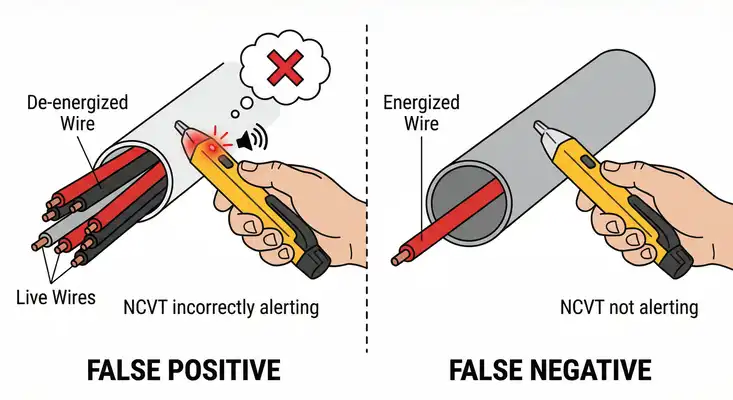
7.1 False Positives (Phantom Voltage Detection)
A false positive occurs when the tester indicates voltage is present, but the conductor is actually de-energized. This can happen when the tested wire runs alongside other energized wires. The electric field from the adjacent live wires can induce a signal in the de-energized wire, causing the tester to alert.
Practical Example: A neutral wire bundled tightly with a hot wire inside a conduit may cause the tester to beep even though the neutral itself is not carrying hazardous voltage relative to ground.
7.2 False Negatives (Failure to Detect Voltage)
A false negative is far more dangerous. It occurs when the tester fails to alert even though the conductor is energized. Causes include:
- Dead batteries — The most common cause. Always check batteries before use.
- Shielded cables — Metal conduit, shielded cable, or metallic armor can block the electric field from reaching the sensor.
- Thick insulation — Very thick wire insulation or multiple layers of material can reduce the electric field strength below the detection threshold.
- DC voltage — Standard NCV testers detect AC only. They will not alert on a DC circuit.
- Low voltage — If the voltage is below the tester’s minimum detection threshold, it will not respond.
- No ground reference — If the user is perfectly insulated from ground (for example, wearing lineman’s rubber gloves and standing on a rubber mat), the capacitive return path may be interrupted.
7.3 Not Suitable for DC Voltage Detection
Most non-contact voltage testers are designed for AC voltage only. Solar panel circuits, battery systems, and automotive wiring carry DC voltage. A standard NCVT will not detect DC voltage. Some specialized models can sense DC, but they are less common and more expensive.
7.4 Not a Replacement for a Multimeter
An NCVT tells you if voltage is present or absent. It does not tell you the exact voltage level, frequency, or waveform. For detailed measurements, you need a digital multimeter.
8. How to Select Right Non-Contact Voltage Tester
Choosing the right NCVT depends on your specific needs and work environment. Here are the main factors to consider.
8.1 Voltage Detection Range
Check the minimum and maximum AC voltage the tester can detect. A range of 50V to 1000V AC covers most residential and commercial applications. If you work with low-voltage systems (such as 24V HVAC controls), look for a tester with a lower detection threshold.
8.2 CAT Rating
Match the CAT rating to your work environment. For panel-level work, choose at least CAT III 600V. For utility-level work, choose CAT IV 300V or higher.
8.3 Alert Type
Consider whether you need audible, visual, or vibration alerts. In noisy environments like construction sites or factories, a tester with vibration and bright LED alerts is more practical than one with only a beep.
8.4 Sensitivity Adjustment
If you work in environments with many cables close together, adjustable sensitivity is very helpful. It lets you narrow down exactly which wire is energized.
8.5 Durability and Build Quality
Look for testers with a sturdy housing and an IP (Ingress Protection) rating for dust and moisture resistance. A tester rated IP67 can handle dusty and wet conditions.
8.6 Battery Life and Type
Some testers use standard AAA batteries, and others use button cells. AAA batteries are easier to find and replace. Check the expected battery life as well.
8.7 Brand Reputation and Warranty
Stick with well-known electrical test equipment brands such as Fluke, Klein Tools, Milwaukee, Greenlee, and Amprobe. These companies have established reputations for accuracy and safety. A good warranty (typically 2 to 5 years) is also a positive indicator of quality.
9. Testing and Maintaining Your Non-Contact Voltage Tester
Like all safety tools, your NCVT needs regular care and testing to remain reliable.
9.1 Battery Replacement
Replace batteries as soon as the low battery indicator activates. Some testers will give unpredictable readings when battery power is low. Do not wait for the tester to stop working completely.
9.2 Self-Test Feature
Many modern NCV testers include a self-test function that runs automatically when you turn the device on. The tester checks its internal circuitry and confirms it is operational. Look for models with this feature.
9.3 Live-Dead-Live Testing Protocol
As discussed earlier, always perform the live-dead-live test before and after each use. This is the most reliable way to confirm your tester is functioning properly during a work session.
9.4 Storage
Store the tester in a dry, clean location. Avoid leaving it in extreme heat or cold, which can degrade the battery and internal components. Many testers come with a protective cap for the sensing tip — use it.
9.5 Calibration
Most pen-type NCV testers do not require formal calibration. However, if your workplace has a quality management system (such as ISO 9001), check whether your test instruments need periodic verification. Some higher-end models from manufacturers like Fluke offer calibration services.
10. Non-Contact Voltage Testers vs. Contact Voltage Testers
It is worth comparing NCV testers with contact-type voltage testers to understand when each tool is appropriate.
| Feature | Non-Contact Voltage Tester | Contact Voltage Tester |
|---|---|---|
| Physical contact required | No | Yes |
| Speed of testing | Very fast | Moderate |
| Accuracy | Indication only (presence/absence) | Measures actual voltage value |
| Safety level | High (no exposed contacts) | Requires proper probe technique |
| Works through insulation | Yes | No (needs bare contact points) |
| DC voltage detection | Usually no | Yes |
| False positive risk | Moderate | Low |
| False negative risk | Moderate | Low |
| Cost | $15–$50 typical | $20–$100 typical |
The best practice is to use both tools together. Use the NCVT for a quick initial check. Follow up with a contact-type tester or multimeter for final confirmation.
11. Practical Scenarios and Examples
11.1 Scenario 1: Homeowner Replacing an Outlet
A homeowner wants to replace a damaged electrical outlet. She turns off the circuit breaker labeled “Kitchen.” She then uses her non-contact voltage tester on the outlet. The tester beeps and glows red. She realizes she turned off the wrong breaker. She goes back to the panel, finds the correct breaker, and flips it off. She tests again — no alert this time. She then uses a plug-in outlet tester to double-check. Safe to proceed.
11.2 Scenario 2: Electrician Troubleshooting a Dead Circuit
An electrician is called to a commercial office because one circuit is not working. He opens the panel and uses an NCVT to check the breaker. The tester does not alert on the suspected breaker. He checks adjacent breakers, and they all trigger the tester. He confirms the breaker has tripped. He resets it and tests again — the tester now alerts. The circuit is restored.
11.3 Scenario 3: Industrial Maintenance Before Lockout/Tagout
A maintenance technician needs to perform LOTO on a 480V motor starter. She follows her company’s LOTO procedure, de-energizes the circuit, and applies her lock and tag. She then uses an NCVT as a preliminary check — no alert. She follows up with a CAT III 600V rated multimeter to verify zero voltage across all phases and phase-to-ground. Only after both tests confirm zero energy does she begin work.
12. Conclusion
Non-contact voltage testers are among the most practical and widely used tools in the electrical trade. They provide a fast and safe way to check for the presence of AC voltage without touching any conductor or terminal. Their pen-shaped design makes them easy to carry, and their simple operation makes them accessible to both professionals and homeowners.
However, these testers have real limitations. False positives, false negatives, inability to detect DC voltage, and interference from shielded cables are all factors that users must keep in mind. The live-dead-live testing protocol is a non-negotiable habit that every user should practice. For any task involving lockout/tagout or high-risk electrical work, always follow up with a properly rated contact-type tester or digital multimeter.
13. Frequently Asked Questions (FAQs)
Most standard non-contact voltage testers are designed to detect AC voltage only. They rely on the oscillating electric field produced by alternating current. DC voltage does not produce an oscillating field, so standard NCV testers will not detect it. Some specialized models can detect DC, but they are not as common.
NCV testers are reliable screening tools, but they should not be your only method of verification. False positives and false negatives can occur due to shielded cables, dead batteries, or adjacent live wires. Always follow the live-dead-live testing protocol and confirm with a contact-type tester or multimeter for high-risk tasks.
This is likely a false positive caused by capacitive coupling from nearby energized wires. If the de-energized wire runs alongside live wires in the same conduit or cable bundle, the electric field from the live wires can induce a signal in the dead wire. Try using a lower sensitivity setting if your tester has one.
Yes, as long as the tester is rated for that voltage level. Check the voltage range printed on the tester. It should indicate a maximum rating of at least 600V or 1000V AC.
Replace batteries whenever the low battery indicator appears. As a best practice, replace them at least once a year even if the indicator has not activated.
No. Metal conduit acts as a Faraday cage and blocks the electric field from reaching the tester’s sensor. You will need to access the conductors at a junction box, panel, or terminal point where they emerge from the conduit.
There is no difference. “Tick tracer” is an informal name for non-contact voltage testers. The name comes from the ticking or beeping sound many models make when they detect voltage.