
A dishwasher is one of the most common household appliances found in kitchens across North America, Europe, and Australia. It uses a combination of hot water, detergent, and electrical energy to clean dishes automatically. But from an electrical standpoint, one question comes up frequently among homeowners, electricians, and electrical engineers: does a dishwasher need a dedicated circuit?
The short answer is yes. A dishwasher does require a dedicated circuit in most jurisdictions. But the reasoning behind this requirement goes deeper than just following a code rule.
In this technical guide, we will discuss everything you need to know about dishwasher dedicated circuits, including the electrical code requirements, circuit sizing, wire gauge selection, breaker ratings, GFCI protection, installation best practices, common mistakes, and relevant ANSI/NEC standards. Practical examples are included throughout to help you apply these concepts in real-world scenarios confidently.
1. What Is a Dedicated Circuit?
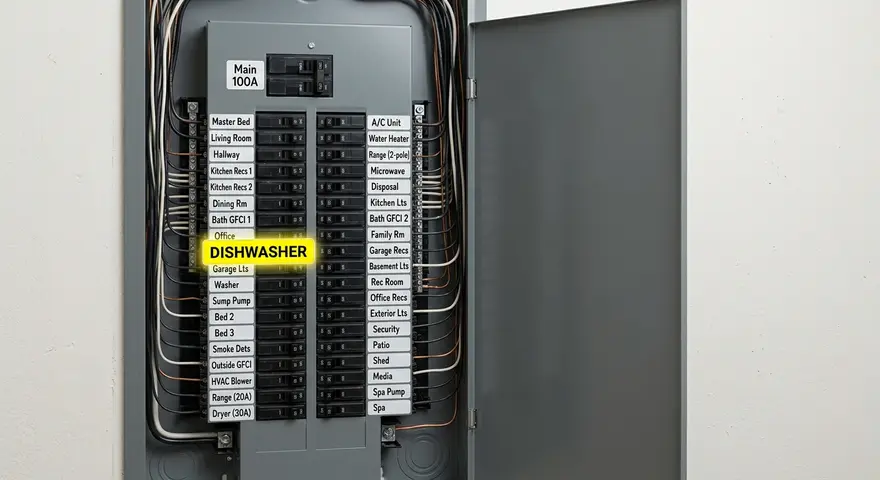
A dedicated circuit is an electrical circuit that serves only one appliance or piece of equipment. It has its own circuit breaker in the electrical panel and does not share wiring with any other outlet, light fixture, or device. The circuit runs directly from the breaker panel to the appliance.
This is different from a general-purpose circuit, which may power several outlets and light fixtures in a room. For example, a 15-amp general-purpose circuit in a bedroom might serve a lamp, a phone charger, a ceiling fan, and a TV. All of these devices share the same wires and the same breaker.
A dedicated circuit, on the other hand, is reserved. If your dishwasher is on a dedicated 20-amp circuit, nothing else draws power from that circuit. This prevents overloading and allows the appliance to operate at its full rated current without interference from other loads.
2. Why Does a Dishwasher Need a Dedicated Circuit?
A dishwasher draws a notable amount of current during its wash and dry cycles. A standard residential dishwasher uses between 10 and 15 amps during operation. Some models with built-in water heaters or heated drying features can draw even more.
If a dishwasher shares a circuit with other kitchen appliances such as a garbage disposal, a countertop microwave, or a toaster, the combined current draw can exceed the breaker’s rating. This causes the breaker to trip, which is both inconvenient and a sign of an unsafe condition.
Here is a practical example. Suppose you have a 20-amp circuit shared between a dishwasher and a garbage disposal. The dishwasher draws 12 amps during its heated dry cycle. The garbage disposal draws 8 amps when grinding food waste. If both run at the same time, the total load is 20 amps. That is right at the breaker limit. Any small spike in current will trip the breaker. Over time, repeated overloading can cause the wiring to overheat, degrading the insulation and increasing the risk of electrical fire.
A dedicated circuit avoids this problem entirely.
3. NEC Code Requirements for Dishwasher Circuits
The National Electrical Code (NEC), published by the National Fire Protection Association (NFPA) as NFPA 70, is the primary electrical code followed in the United States. It sets the rules for residential and commercial electrical installations.
3.1 NEC Article 210.52(B) — Kitchen Receptacles
The NEC requires that kitchen countertop receptacles be served by at least two 20-amp small-appliance branch circuits. These circuits are intended for portable countertop appliances like blenders, toasters, and coffee makers. The dishwasher is not permitted to be connected to these small-appliance branch circuits.
3.2 NEC Article 422.12 — Central Heating Equipment (Appliance Circuits)
The NEC requires that certain fixed appliances be on individual branch circuits. A dishwasher, being a permanently installed or cord-and-plug connected fixed appliance, falls under this category in practical application.
3.3 NEC 210.23(A) — Permissible Loads on Branch Circuits
According to NEC 210.23(A), a single appliance that is fastened in place should not exceed 50% of the branch circuit rating if the circuit also supplies other loads. This rule alone makes it impractical to put a dishwasher on a shared circuit. A dishwasher drawing 12 amps on a 20-amp circuit already uses 60% of the circuit capacity, which violates this rule if other loads are present.
3.4 ANSI/NFPA 70 Reference
The NEC is formally designated as ANSI/NFPA 70. All of the above articles fall under this standard. Local jurisdictions may adopt the NEC with amendments, so always check your local code as well.
4. What Size Circuit Does a Dishwasher Need?
Most dishwashers in the United States require a 120-volt, 20-amp dedicated circuit. This is the standard recommendation from nearly all dishwasher manufacturers, including Bosch, Whirlpool, GE, KitchenAid, Samsung, and LG.
4.1 Wire Gauge
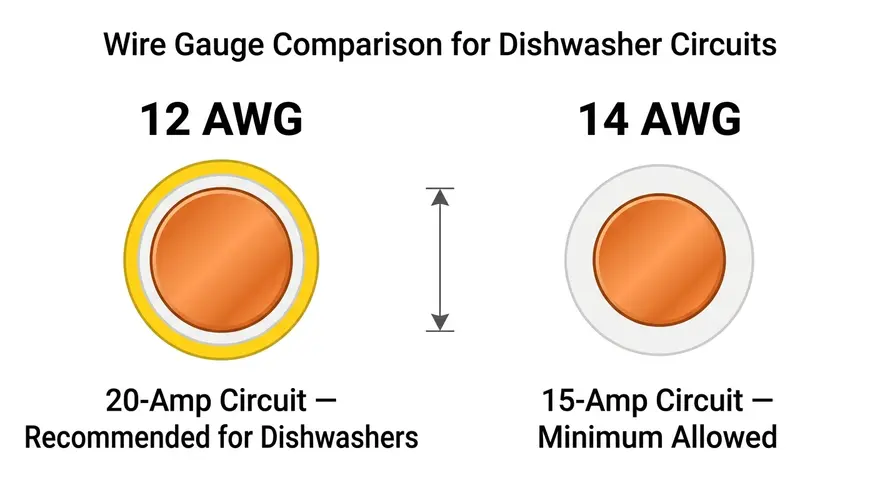
For a 20-amp circuit, the NEC requires a minimum wire size of 12 AWG (American Wire Gauge) copper conductors. Using 14 AWG wire on a 20-amp circuit is a code violation and a safety hazard.
Here is a quick reference table:
| Circuit Rating | Minimum Wire Size (Copper) | Typical Use |
|---|---|---|
| 15 Amp | 14 AWG | Lighting, general outlets |
| 20 Amp | 12 AWG | Kitchen appliances, dishwasher |
| 30 Amp | 10 AWG | Dryer, large appliances |
4.2 Breaker Size
The circuit breaker for a dishwasher circuit should be a 20-amp single-pole breaker. Do not use a 15-amp breaker with 12 AWG wire for a dishwasher, even though it is technically allowed by code in some configurations. The dishwasher’s startup current can cause nuisance tripping on a 15-amp breaker.
5. GFCI Protection Requirements for Dishwashers
The 2020 edition of the NEC introduced an important change regarding dishwasher circuits. NEC 210.8(D) now requires GFCI (Ground Fault Circuit Interrupter) protection for dishwashers in dwelling units.
Before the 2020 NEC, GFCI protection was required for kitchen receptacles within 6 feet of a sink, but the dishwasher was often hardwired and considered exempt by many inspectors. That is no longer the case.
5.1 Why GFCI for a Dishwasher?
A dishwasher uses both water and electricity in close proximity. A ground fault can occur if water leaks onto electrical components or if the insulation on internal wiring becomes damaged. GFCI protection detects ground faults as small as 4 to 6 milliamps and disconnects the circuit within milliseconds. This protects people from electric shock.
5.2 How to Provide GFCI Protection
You can provide GFCI protection for a dishwasher circuit in several ways:
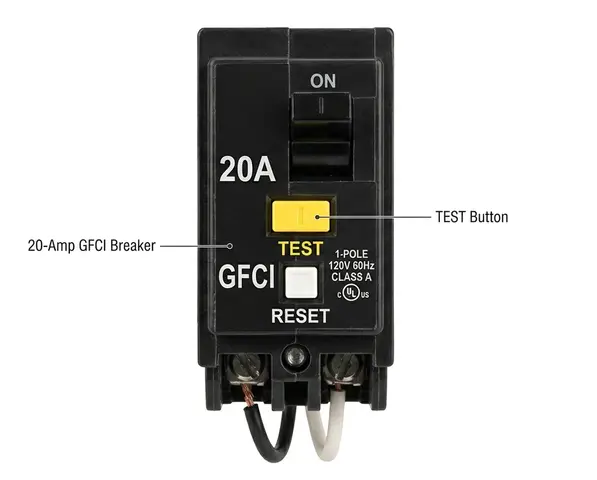
- GFCI Circuit Breaker — Install a 20-amp GFCI breaker in the panel. This is the most common and cleanest method for a hardwired dishwasher.
- GFCI Receptacle — If the dishwasher is cord-and-plug connected, you can install a GFCI receptacle under the kitchen sink or in the cabinet space near the dishwasher.
- Dead-Front GFCI Device — This is a GFCI device without receptacle slots, used for hardwired appliance connections.
6. Hardwired vs. Cord-and-Plug Connection for Dishwashers
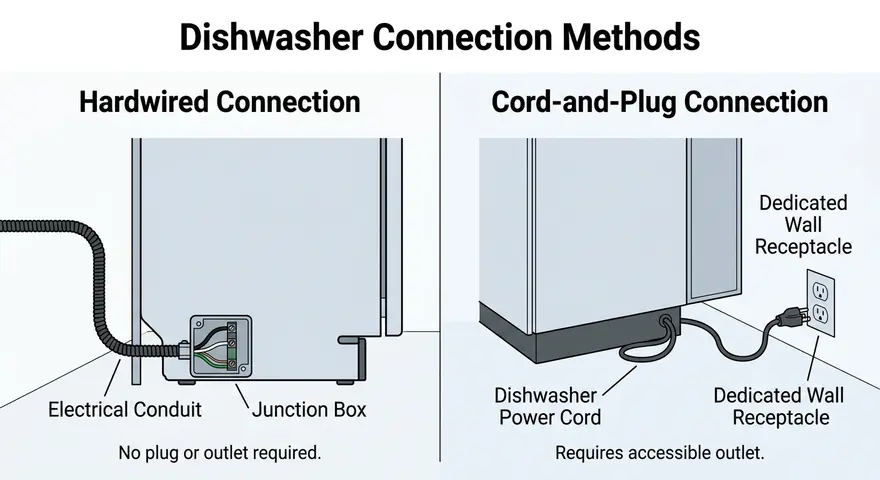
Dishwashers can be connected to the electrical circuit in two ways: hardwired or cord-and-plug.
6.1 Hardwired Connection
A hardwired dishwasher is connected directly to the circuit wiring using a junction box. The circuit cable (typically 12/2 NM-B with ground) runs from the panel to a junction box located behind or under the dishwasher. The dishwasher’s supply wires are connected to the circuit wires using wire nuts inside the junction box.
This method is clean and permanent. However, it makes the dishwasher harder to disconnect for service or replacement.
6.2 Cord-and-Plug Connection
Many modern dishwashers come with a power cord or accept an optional power cord kit. The cord plugs into a standard 20-amp receptacle installed under the counter near the dishwasher. This receptacle must be accessible without moving the dishwasher.
The cord-and-plug method is becoming more popular because it simplifies installation and removal. It also makes GFCI protection easier to implement using a GFCI receptacle.
7. How to Install a Dedicated Circuit for a Dishwasher
Here is a step-by-step overview of installing a dedicated dishwasher circuit. This section is intended for educational purposes. Always hire a licensed electrician for actual electrical work.
Step 1: Turn Off the Main Breaker
Safety first. De-energize the panel before working inside it.
Step 2: Run the Cable
Run a length of 12/2 NM-B (Romex) cable from the electrical panel to the dishwasher location. The cable should be routed through the wall, floor, or crawl space as appropriate. Secure the cable with staples or clamps per NEC Article 334.
Step 3: Install the Receptacle or Junction Box
If using a cord-and-plug connection, install a 20-amp receptacle in an accessible location near the dishwasher (under the counter, inside the adjacent cabinet). If hardwiring, install a metal or plastic junction box.
Step 4: Connect the Wires
Connect the black (hot) wire to the brass terminal, the white (neutral) wire to the silver terminal, and the bare copper (ground) wire to the green grounding screw.
Step 5: Install the Breaker
Install a 20-amp single-pole breaker (or a 20-amp GFCI breaker for GFCI protection) in the electrical panel. Connect the black wire to the breaker, the white wire to the neutral bus bar (or to the GFCI breaker’s neutral pigtail), and the ground wire to the grounding bus bar.
Step 6: Test the Circuit
Turn on the breaker and verify voltage at the receptacle or junction box using a multimeter. Confirm 120 volts between hot and neutral, and between hot and ground.
8. Electrical Load Calculation Example
Let us walk through a load calculation to show why a dedicated 20-amp circuit is appropriate for a dishwasher.
Given:
- Dishwasher rated at 1,800 watts (maximum)
- Supply voltage: 120 volts
Current Calculation:
\(I=\dfrac{P}{V}=\dfrac{1800W}{120V}=15 \text{ amps}\)
NEC 210.23(A) Check:
For a single appliance fastened in place on a circuit that also supplies other loads, the appliance should not exceed 50% of the branch circuit rating.
50% of 20 amps = 10 amps.
Our dishwasher draws 15 amps. This exceeds 10 amps. Therefore, the dishwasher cannot share the circuit with other loads.
On a dedicated circuit, the continuous load rule (NEC 210.20) applies if the dishwasher runs for more than 3 hours. In that case, the load should not exceed 80% of the breaker rating.
80% of 20 amps = 16 amps.
Our dishwasher draws 15 amps, which is below 16 amps. So a 20-amp dedicated circuit is properly sized.
9. Conclusion
A dishwasher does need a dedicated circuit. This is not just a recommendation — it is a code requirement in most jurisdictions that have adopted the NEC. A 20-amp, 120-volt dedicated circuit with 12 AWG copper wiring and GFCI protection is the standard setup for residential dishwasher installations. This configuration protects the appliance, the wiring, and the people in the home.
10. Frequently Asked Questions (FAQs)
Yes. The NEC and most local codes require that a dishwasher be installed on its own dedicated 20-amp, 120-volt circuit. This prevents overloading and allows the appliance to run safely without tripping the breaker.
A standard residential dishwasher requires a 20-amp single-pole circuit breaker. Some older models may work on a 15-amp circuit, but a 20-amp circuit is the current standard and is recommended by most manufacturers.
A 20-amp dishwasher circuit requires 12 AWG copper wire. The cable type is usually 12/2 NM-B (Romex) for residential installations. Using 14 AWG wire on a 20-amp circuit is a code violation.
Some older codes and local amendments allowed this, but the modern best practice is to install each appliance on its own dedicated 20-amp circuit.
Yes, under the 2020 NEC (and later editions), GFCI protection is required for dishwasher circuits in dwelling units. This can be provided by a GFCI circuit breaker or a GFCI receptacle.
Yes. Both hardwired and cord-and-plug connections are permitted under NEC 422.16(B). If hardwired, a junction box must be accessible. If cord-and-plug connected, the cord must be 3 to 4 feet long and the receptacle must be accessible.