
Auto re-closing is a protection scheme used in electrical power systems for transmission and distribution lines. When a circuit breaker trips on a fault, the auto re-close relay sends a close command to the circuit breaker after a preset time delay. This time delay is called the dead time.
The breaker closes back onto the line. If the fault has cleared, the system returns to normal. However, if the fault is still present, the protection relays detect it again and trip the breaker. Depending on the scheme, the breaker may attempt to close once, twice, or three times before it is locked out permanently.
The locked-out state means the breaker will not attempt any more re-close operations. A manual reset is to be done by the operator after lock-out.
1. Why Auto Re-closing is Used?
In power systems, electrical faults are regular phenomenon. Lightning strikes, tree branches touching lines, bird contacts, temporary insulation failures, etc., happens all the time on transmission and distribution networks. Most of these faults are temporary in nature and appear for a fraction of a second and then disappear on their own.
If a circuit breaker trips due to such a temporary fault and stays open, the entire line remains dead. That means unnecessary power outages for consumers.
The auto re-closing feature is used to deal with such temporary fault and it automatically closes the breaker after it has tripped due to a fault. Auto re-closing gives the fault a short time to clear on its own and then closes the breaker again. If the fault was temporary, the line restores itself. If the fault is permanent, the breaker trips again and stays open.
2. How Auto Re-closing Works? Step by Step
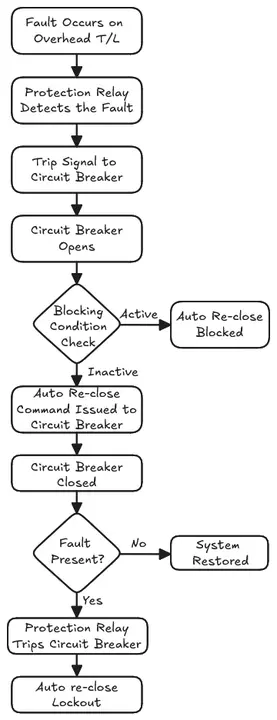
Step 1 — Fault occurs
Suppose a temporary single-phase to ground fault occurs on a 132 kV overhead transmission line due to a lightning strike.
Step 2 — Protection relay operates
The distance relay or overcurrent relay detects the fault and sends a trip signal to the circuit breaker.
Step 3 — Breaker trips
The circuit breaker opens and makes the line de-energised. The arc at the fault location extinguishes.
Step 4 — Dead time begins
The auto re-close relay starts its dead time timer. The dead time is set between 0.3 seconds to 1 second for high-speed auto re-closing. For time delayed auto re-closing the dead time is set from 30 to 60 seconds.
Step 5 — Re-close command issued
After the dead time expires, the auto re-close relay sends a close signal to the circuit breaker.
Step 6 — Breaker closes
The circuit breaker closes and makes the transmission line energized.
Step 7a — Fault cleared
If the fault is cleared, the protection relay sees no fault and the system returns to normal. The auto re-close relay resets after a reclaim time (explained below).
Step 7b — Fault still present
If the fault still persists, the protection relay detects the fault again and trips the circuit breaker to de-energize the line. The auto re-close relay may attempt a second closing shot or lock out permanently depending on the settings.
3. Timing Parameters in Auto Re-closing
3.1 Dead Time
The time gap between the breaker tripping on fault and the issuing of auto re-close command is called the dead time. During the dead time, the arc at the fault location extinguishes and the ionised air de-ionises.
For high-voltage transmission lines, the dead time is set around 0.3 to 1 second. For distribution lines, the dead time is longer and set between 5 to 30 seconds to allow the fault to clear and the line to de-energize properly.
If the dead time is kept too short, the line may still have ionised air particles at the fault location. This leads to re-strike and failed re-closing.
3.2 Reclaim Time
After a successful auto re-close, the time that an auto re-close relay needs to reset itself before it can initiate another re-close command is called the reclaim time.
The reclaim time is set between 25 to 60 seconds. If another fault occurs within the reclaim time, the relay treats it as a new incident and may lock out instead of attempting another re-close.
3.3 Operating Time of the Re-close Relay
The time taken by an auto re-close relay to process a trip signal and issue a close command to the circuit breaker is called the operating time of the auto re-close relay. The operating time is very small and is included within the dead time.
4. Types of Auto Re-closing
4.1 Single-Shot Auto Re-closing
In single-shot auto re-closing scheme, the circuit breaker closes only once after tripping due to fault. If the fault is still present, the breaker trips and locks out. This is the most commonly used auto re-close scheme in power system.
Single-shot auto re-closing is the preferred scheme in Extra High Voltage transmission lines because repeated re-closing onto a permanent fault at very high voltage levels can damage equipment and may destabilize the power grid.
4.2 Multi-Shot Auto Re-closing
In multi-shot auto re-closing, the circuit breaker makes two or three re-close attempts before locking out. Each successive dead time is longer than the previous one. A flow-chart showing multi-shot auto re-closing scheme is provided below.
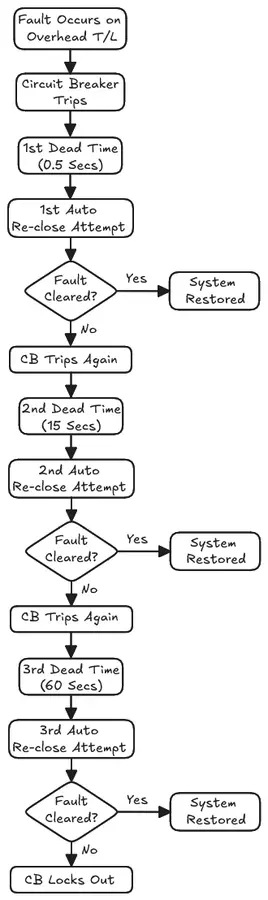
Example of dead time in a three-shot auto re-close scheme is:
- First re-close after 0.5 seconds
- Second re-close after 15 seconds
- Third re-close after 60 seconds
- Lock out if the fault persists
Multi-shot auto re-closing is the preferred scheme in 11 kV and 33 kV distribution networks where temporary faults are frequent and the system can tolerate multiple operations.
4.3 High-Speed Auto Re-closing (HSAR)
In high-speed auto re-closing scheme, the dead time is very short and it is less than 1 second. It is used on high voltage transmission lines where maintaining system stability is a priority.
This scheme is mainly used on 132 kV and above transmission lines.
4.4 Delayed Auto Re-closing (DAR)
In delayed auto re-closing scheme, the dead time is longer and may be from a few seconds to several minutes. The longer dead time gives sufficient time for fault clearance.
Delayed auto re-closing scheme is commonly used in distribution feeders (11 kV, 22 kV, 33 kV).
5. Single-Phase vs Three-Phase Auto Re-closing
5.1 Three-Phase Auto Re-closing
In three-phase re-closing, all three phases of a circuit breaker trip together and re-close together. This is the standard scheme used on most of the systems.
It is simple in design and works on breakers with a single-pole operating mechanism. It is suitable for both single-phase and three-phase faults.
5.2 Single-Phase Auto Re-closing (SPAR)
On high-voltage transmission lines, 70 to 80% of faults are single-phase to ground faults. The single-phase auto re-closing scheme trips only the faulted phase instead of tripping all the three phases. The remaining two healthy phases remains energized.
After the dead time, the faulted phase re-closes. If the fault has cleared, all three phases are now in service. If the fault still persists, all three phases trip and the breaker locks out or the scheme switches automatically to three-phase auto re-closing depending upon settings.
Advantages of single-phase re-closing:
- System continues to transfer power on two phases during the dead time
- Better for system stability on long transmission lines
- Reduces stress on generators and interconnections
For using single phase auto re-closing scheme, single-pole operated circuit breakers are needed and each phase must have its own independent trip and close mechanism.
6. Check Conditions Before Auto Re-closing
On transmission systems, certain check conditions must be satisfied before the breaker is allowed to auto re-close. They are detailed below.
6.1 Voltage Check
The relay checks whether the line-side voltage or the bus voltage is at an acceptable level. If voltage is absent on one side, it indicates that the system is healthy and ready for energization.
6.2 Synchronism Check (Sync Check)
On interconnected transmission systems, before auto re-closing, the voltages on both sides of the breaker are compared for voltage magnitude, phase angle, and frequency. If they are within acceptable limits, the auto re-close command is issued.
This check prevents closing a breaker out of synchronism that may cause severe mechanical stress on generators and transformers.
6.3 Breaker Ready Check
The auto re-close relay also checks whether the circuit breaker is mechanically ready, the spring is charged or the hydraulic pressure is adequate before issuing the close command.
6.4 No Busbar Fault
If a busbar protection relay has operated, the auto re-close is blocked and re-closing onto a live busbar fault is extremely dangerous.
7. Auto Re-closing Blocking Conditions
There are situations where auto re-closing must be blocked.
1. Transformer faults
Faults detected by differential protection relay or Buchholz relay on a transformer should never trigger auto re-closing. Transformer faults are almost always permanent and internal. Re-closing would cause further damage to the transformer.
2. Busbar faults
As mentioned above, busbar faults require full investigation before any breaker is closed.
3. Manual trip
If an operator manually trips a breaker for maintenance or isolation, the auto re-close relay must be blocked. Re-closing a manually tripped breaker can endanger workers.
4. Breaker failure
If the breaker fail protection has operated, auto re-closing must be blocked.
5. Multiple consecutive trips
If the breaker has tripped multiple times and used up all its re-close shots, the relay locks out. No further re-closing until a manual reset is done.
8. Advantages of Auto Re-closing
- Restores power supply quickly after temporary faults
- Reduces the need for operator intervention in remote locations
- Improves system reliability and availability
- Maintains grid stability by reducing the duration of interruptions
9. Limitations and Risks
Re-closing onto a permanent fault: If the fault is permanent like a broken conductor, failed insulator, or damaged cable, the re-close operation stresses the equipment again and can worsen the damage. Therefore, it is important to limit the number of auto re-close shots.
Effect on generators: High-speed re-closing on transmission lines connected to generators may cause mechanical torque on the generator shaft. This must be studied during the design stage.
Out-of-phase re-closing: If sync check conditions are not applied during configuration of auto re-closing, re-closing out of phase can cause damage to transformers, generators, and busbars.
10. Conclusion
Auto re-closing is an standard protection scheme used in modern power system that automatically closes a tripped circuit breaker after a preset dead time. The auto re-closing allows temporary faults on overhead lines to clear without any manual intervention.
An auto re-closing scheme uses dead time, reclaim time, and lockout logic to control re-close operations as discussed above.
11. Frequently Asked Questions (FAQs)
Auto re-closing scheme closes a circuit breaker automatically after it has tripped due to a fault. It is designed to restore power supply quickly after temporary faults without needing any manual intervention.
In auto re-closing, dead time is the time between the circuit breaker tripping and the auto re-close relay issuing the close command.
In single-shot auto re-closing, a circuit breaker attempts to close only once after tripping. If the fault persists, the breaker locks out. In multi-shot auto re-closing, the circuit breaker makes two or three auto re-close attempts before locking out.
Reclaim time is the period after a successful auto re-close during which the relay resets and readies itself for the next operation.
A transformer fault detected by differential protection or Buchholz relay are internal and permanent faults. Re-closing a breaker onto an internal transformer fault can cause further damage, fire, or destruction. Hence, auto re-closing is always blocked for transformer protection operations.
A single-phase auto re-closing scheme trips and auto re-close the faulted phase only instead of all the three phases.
A synchronism check (sync check) is a combination of conditions that is verified before the auto re-close relay issues a close command to the circuit breaker. It checks whether the voltage magnitude, phase angle, and frequency on both the sides of the breaker are within acceptable limits.
Auto re-closing is not recommended for underground cable feeder as cable faults are mostly permanent and caused by insulation breakdown, mechanical damage, or water ingress.