
Isolators and circuit breakers are two separate switching devices used in electrical power system and each of them has a different role in a substation. An isolator disconnects a de-energized circuit section to allow safe maintenance while a circuit breaker interrupts current under normal load and fault conditions using arc quenching mechanisms.
Both the isolator and circuit breaker work together in substations and switchgear panels.
1. What is an Isolator?
An isolator is a mechanical switching device. Isolator is responsible for disconnecting a section of the electrical circuit from the rest of the system so that maintenance or repair work can be done safely.
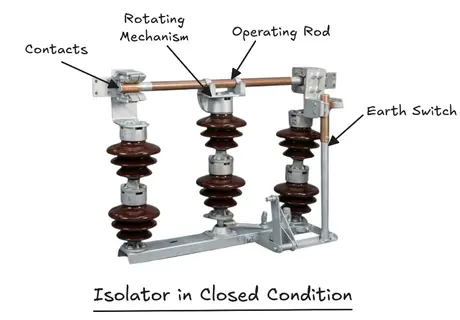
The image above shows a outdoor isolator in closed condition. The contacts carry current in the closed position. To open the isolator, the operating rod is turned, which activates the rotating mechanism and separates the contacts. This creates a visible air gap.
It is important to note that an isolator is not designed to break current. It is operated only when the circuit is already de-energized and no current is flowing through it.
For example, in a 132 kV substation, before a maintenance crew works on a transformer, the circuit breaker is first opened to interrupt the load current. After the circuit is interrupted, the isolator is opened and creates a visible physical air gap. This air gap gives the maintenance team a physical and visual confirmation that the section is isolated from the live system.
2. What Is a Circuit Breaker?
A circuit breaker is an automatic switching device. It is designed to make and break electrical circuits under normal load as well as fault conditions.
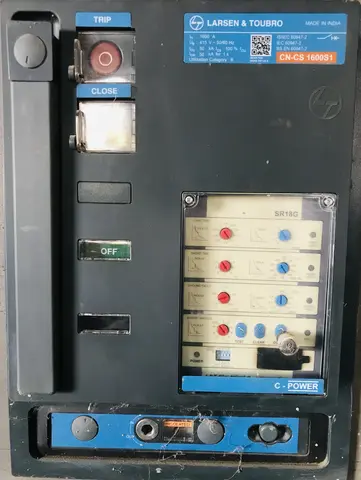
A circuit breaker can interrupt normal load current as well as very high fault currents like short circuit currents. An electrical protection system including protective relays acts to open the contacts of a circuit breaker to stop fault current flow before any equipment gets damaged.
Suppose a cable in a factory develops a short circuit. The fault current can be several times the rated current in kA range. The circuit breaker detects this through protection relays and opens within milliseconds. This stops the fault from spreading to other parts of the system or damaging transformers and generators.
A circuit breaker does not create a visible air gap like an isolator does. You cannot always tell just by looking whether it is open or closed without checking the indicator or position mechanism.
3. Main Difference Between Isolator and Circuit Breaker
3.1 Function
An isolator is a no-load switching device. It is used to isolate a part of the circuit after the circuit has been de-energized. It cannot interrupt fault current or load current.
A circuit breaker is a load and fault switching device. It can open and close circuits under normal load as well as under fault conditions.
3.2 Operating Condition
An isolator must only be operated when no current is flowing in the circuit. Operating an isolator under load will cause arcing at the contacts and can damage the device and cause a serious accident to the operator.
A circuit breaker is specifically built to operate under current. It has arc-quenching mechanisms that safely extinguish the arc formed when the contacts open.
3.3 Arc Quenching
Circuit breakers have arc quenching media. This could be oil, air, SF6 gas, or vacuum depending on the type. These media absorb or extinguish the arc that forms when current is interrupted.
Isolators have no arc quenching mechanism. Their contacts are not designed to handle arcing. Therefore, they should never be operated under load.
3.4 Operating Sequence
The standard operating sequence for an isolator and a circuit breaker is:
- Switching OFF: Open the circuit breaker first, then open the isolator.
- Switching ON: Close the isolator first, then close the circuit breaker.
This sequence protects the isolator from arcing. If you open the isolator before the circuit breaker, you are asking the isolator to break current.
3.5 Application in the System
Circuit breakers are placed at points in the system where protection is required like at feeders, busbars, transformers, and generators.
Isolators are placed on either side of a circuit breaker and also on busbars to allow isolation of specific equipment for maintenance.
3.6 Automation
Circuit breakers are connected to protection relay systems and can operate automatically without any human input. When a relay detects a fault, it trips the circuit breaker automatically.
Isolators are manually operated devices in most cases. In modern substations, motor-operated isolators are used, but they require manual initiation as they can not trip automatically on fault detection.
3.7 Visible Isolation
Isolators provide a visible air gap between contacts when open. This is a safety requirement in many electrical safety standards. The maintenance crew can physically verify that the circuit is open.
On the other hand, circuit breakers do not provide a visible air gap. Their contacts are enclosed inside a chamber.
3.8 Voltage and Current Ratings
Circuit breakers are rated for breaking capacity, the maximum fault current they can interrupt safely. This is expressed in kA (kiloamperes).
Isolators are rated for voltage and normal load current, but not for fault current interruption. They have no breaking capacity in the fault current sense.
3.9 Cost
Circuit breakers are more expensive than isolators. Isolators are always used alongside circuit breakers and can not be used as a replacement to the circuit breaker even if they are cheaper.
| Parameter | Isolator | Circuit Breaker |
|---|---|---|
| Primary Function | Isolation during maintenance | Protection and switching |
| Operates Under Load | No | Yes |
| Fault Current Interruption | No | Yes |
| Arc Quenching | No | Yes |
| Automatic Operation | No (mostly manual) | Yes |
| Visible Air Gap | Yes | No |
| Cost | Lower | Higher |
4. Conclusion
Isolators and circuit breakers serve different purposes in a power system and neither device can replace the other. An isolator provides visible disconnection of a dead circuit section. A circuit breaker handles switching and protection under live conditions.
The correct operating sequence, circuit breaker first, isolator second — must always be followed to prevent arc damage and accidents. Knowing the difference between these two devices is necessary for anyone working in electrical switchgear, substations, or power distribution systems.
5. Frequently Asked Questions (FAQs)
No. An isolator cannot interrupt fault current or load current. It has no arc quenching ability. Using it instead of a circuit breaker would result in contact damage, arc flash, or equipment failure.
A circuit breaker can interrupt current, but it does not always provide a visible open gap. For safe isolation during maintenance, an isolator should always be used after opening the circuit breaker.
The contacts will arc. At high voltages, this arc can be destructive it can melt contacts, cause a phase-to-phase fault, damage the isolator permanently, or injure the operator
Both are no-load devices. An isolator disconnects the circuit from the live system. An earthing switch connects the isolated section to earth to discharge any residual voltage.
An MCB (Miniature Circuit Breaker) is a circuit breaker. It can interrupt fault current and operates automatically when the current exceeds its rated value. It is not an isolator.
A circuit breaker is more expensive.