
A hydrometer is an instrument used to measure the specific gravity or relative density of a liquid. It is made from a graduated glass or plastic tube with a weighted bulb at the bottom. The bulb floats when a liquid in inserted in the hydrometer tube. The depth to which the bulb sinks in a liquid measures the density of that liquid relative to water. This reading is called specific gravity (SG).
Water has specific gravity of 1.000. Liquids denser than water will push the hydrometer bulb up and gives a higher reading. Liquids less dense than water will let the bulb sink deeper and gives a lower specific gravity reading.
In lead acid battery, the liquid under test is sulfuric acid electrolyte. The concentration of the electrolyte changes as the battery charges and discharges.
1. Working Principle of a Hydrometer
The hydrometer works on the basis of Archimedes’ Principle. It states that any object placed in a liquid experiences an upward buoyant force equal to the weight of the liquid it displaces.
The mathematical formula for Buoyant Force is given by:
\(\text{Buoyant Force} = \rho \times g \times V\)
Where:
- \(\rho\) = density of the liquid
- \(g\) = acceleration due to gravity
- \(V\) = volume of liquid displaced
The hydrometer is designed to displace the same weight of liquid because its own weight is fixed. Therefore, in a denser liquid, the hydrometer displaces a smaller volume and floats higher. In a less dense liquid, it displaces a larger volume and sinks lower.
The graduated scale on the tube is calibrated so that the specific gravity can be read directly at the liquid surface level.
2. Types of Hydrometers
2.1 Battery Hydrometer (Syringe Type)
Syringe type hydrometer is the commonly used hydrometer in electrical work. It consists of a rubber bulb, a transparent barrel, and a floating indicator inside the barrel as shown in the figure below.
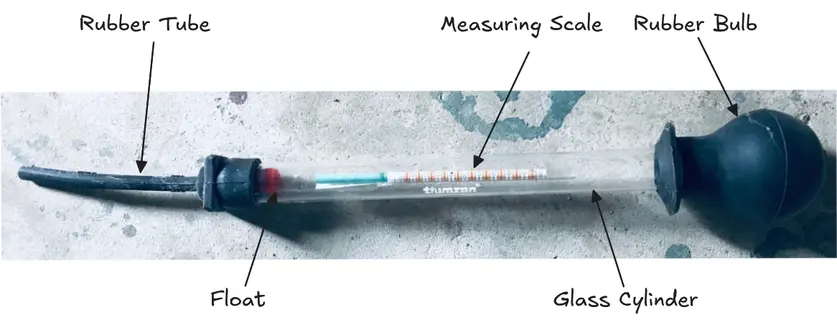
To draw electrolyte into the barrel, squeezed the bulb, insert the tube into the battery cell, and then release the bulb. The float rises and reads the specific gravity on the scale.
This type of hydrometer is used to test lead-acid batteries in vehicles, backup power systems, and industrial UPS systems.
2.2 Thermohydrometer
A thermohydrometer combines a thermometer with a hydrometer. Temperature affects the density of liquids. A thermohydrometer takes both the temperature and specific gravity readings at once and the applies temperature correction to get an accurate specific gravity value.
2.3 Lactometer
Lactometer is also a type of hydrometer that is used in the dairy industry to test milk density. It is not relevant to electrical industry but uses the same Archimedes’ Principle to test density of milk.
2.4 Alcoholmeter
Alcoholmeter is used to measures alcohol concentration in liquids. It is also not relevant to electrical industry but uses the same Archimedes’ Principle to test alcohol concentration.
3. Hydrometer Scale and Readings
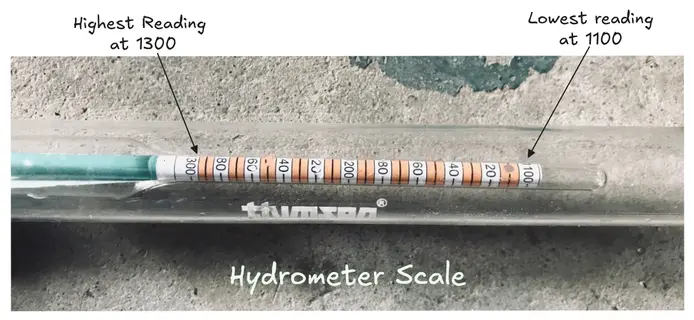
A battery hydrometer scale ranges from 1.100 to 1.300. Some hydrometer models show color-coded zones like green for charged condition, white or yellow for partially discharged, and red for fully discharged.
| Specific Gravity | Battery State |
|---|---|
| 1.265 – 1.280 | Fully charged |
| 1.200 – 1.265 | Partially charged |
| 1.150 – 1.200 | Low charge |
| Below 1.150 | Discharged or faulty |
4. Why Specific Gravity Changes in a Lead-Acid Battery
In a lead-acid battery, the electrolyte is a mixture of sulfuric acid \((H_2SO_4)\) and distilled water \((H_2O)\). The hydrometer measures the concentration of this sulfuric acid.
During discharge, the sulfuric acid in the electrolyte reacts with the active material on both the positive and negative plates. This reaction produces lead sulfate \((PbSO_4)\) and releases electrical energy. Since the acid is consumed in the reaction, the electrolyte becomes diluted and the specific gravity of the electrolyte drops.
During charging, the external current reverses this reaction. Lead sulfate \((PbSO_4)\) breaks down and sulfuric acid is released back into the electrolyte. The acid concentration rises again and the specific gravity increases.
5. How to Use a Battery Hydrometer
Step 1: Safety First
Sulfuric acid is corrosive. Wear rubber gloves and safety glasses before opening any battery. Work in a ventilated area as batteries produce hydrogen gas during charging.
Step 2: Check the Battery Temperature
The standard reference temperature for hydrometer readings is 25°C (77°F). If the electrolyte temperature is different, temperature correction must be applied.
General thumb rule for correction is:
- Add 0.004 to the reading for every 10°C above 25°C
- Subtract 0.004 from the reading for every 10°C below 25°C
For example: If your reading is 1.250 and the electrolyte temperature is 35°C, the corrected value is 1.250 + 0.004 = 1.254.
Step 3: Draw the Electrolyte
Insert the hydrometer tube into the battery cell through the vent cap opening. Squeeze the rubber bulb, then slowly release it to draw electrolyte into the barrel. Draw enough of electrolyte so the float moves freely. Also, do not overfill as the float will hit the top.
Step 4: Read the Scale
Hold the hydrometer at eye level. Read the scale at the bottom of the meniscus (the curved surface of the liquid). Record the value.
Step 5: Return the Electrolyte
Squeeze the bulb to push the electrolyte back into the same cell through the vent cap opening. Do not mix electrolyte between cells.
Step 6: Test All Cells
A 12V lead-acid battery has 6 cells. Test each one of the cells separately. Record all the readings.
Step 7: Analyze the Results
If all the cells read between 1.265 and 1.280, the battery is in good condition. If one cell reads lower than the others (For example, on cell reads 1.150 while the others are at 1.260), then that cell is faulty and the battery needs replacement.
6. Practical Example: Testing a Substation Battery Bank
Battery banks in electrical substations provide backup power for circuit breakers, protection relays, and communication systems. These battery banks are of 48V or 110V DC systems made of connecting multiple lead-acid cells in series.
During routine maintenance, a technician tests each cell with a hydrometer.
Example readings from a 6-cell 12V battery:
| Cell | Specific Gravity | State |
|---|---|---|
| Cell 1 | 1.270 | Good |
| Cell 2 | 1.265 | Good |
| Cell 3 | 1.260 | Good |
| Cell 4 | 1.255 | Fair |
| Cell 5 | 1.145 | Bad |
| Cell 6 | 1.268 | Good |
In the above table, cell no. 5 shows specific gravity far below the rest of the cells. This indicates that the cell is either shorted or sulfated. Even though the other cells are in good condition, this one unhealthy cell will reduce the overall battery bank reliability and the cell should be replaced.
The cell-by-cell analysis as shown above is only possible using a hydrometer. A voltmeter on a fully charged battery may not be able to catch a weak cell.
7. Summary
A hydrometer is used to measure the specific gravity of lead-acid battery electrolyte to determine the state of charge of each individual cell. As discussed above in detail, a hydrometer works on Archimedes’ Principle and gives specific gravity readings from 1.100 to 1.300.
A voltmeter cannot replace hydrometer test. Regular hydrometer testing on flooded lead-acid batteries in substations, UPS systems, and industrial applications helps identify weak or failing cells before they cause system failures.
8. Frequently Asked Questions (FAQs)
The ideal specific gravity for a fully charged lead-acid battery should be between 1.265 and 1.280 at 25°C.
No. Sealed or valve-regulated lead-acid (VRLA) batteries and AGM batteries do not have removable vent caps. The electrolyte cannot be accessed with a hydrometer.
For flooded lead-acid batteries in standby applications the test should be done in every 3 to 6 months as part of routine maintenance.
Specific gravity reading of 1.100 means the cell is severely discharged or the electrolyte has been heavily diluted.
Yes. Sulfuric acid will burn skin and eyes on contact. Always wear chemical-resistant gloves and safety glasses.