
A lead-acid battery is an electrochemical device that stores electrical energy in chemical form and releases it as direct current (DC). It was invented by French physicist Gaston Planté in 1859. It uses lead dioxide \(PbO_2\) as the positive plate, sponge lead (Pb) as the negative plate, and diluted sulfuric acid \(H_2SO_4\) as the electrolyte.
The battery works through reversible chemical reactions. This means you can discharge it to use energy and then recharge it to restore that energy.
A standard single cell of a lead-acid battery produces about 2 volts. So a 12V car battery has six cells connected in series.
1. Basic Construction of a Lead-Acid Battery
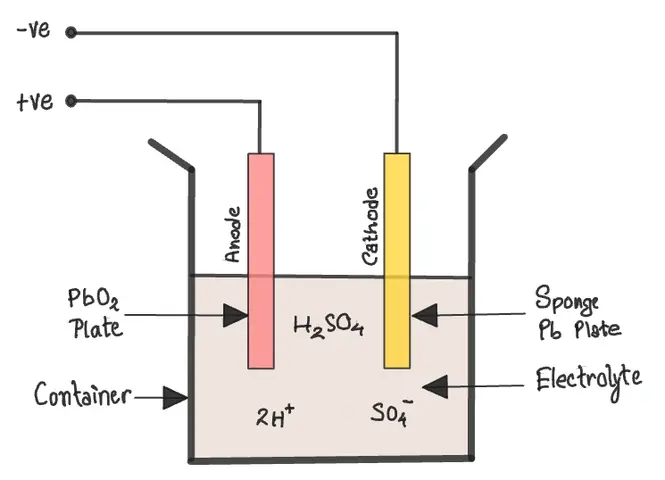
The diagram below shows the internal construction of a lead-acid battery cell. It clearly identifies the \(PbO_2\) plate (anode), the sponge lead plate (cathode), the electrolyte \((H_2SO_4)\), and the container. Refer to this diagram as you read through each component described below.
1.1 Positive Plate
The positive plate is made of lead dioxide \(PbO_2\). It has a dark brown color. Lead dioxide acts as the oxidizing agent during discharge. In the diagram above, the positive plate is shown in pink/red and labeled as the anode, connected to the positive (+ve) terminal at the top.
1.2 Negative Plate
The negative plate is made of sponge lead (Pb). It has a gray color. Sponge lead has a porous structure, which increases the surface area and improves the reaction rate. In the diagram, the negative plate is shown in yellow and labeled as the cathode, connected to the negative (−ve) terminal at the top.
1.3 Electrolyte
The electrolyte is a diluted solution of sulfuric acid \(H_2SO_4\) and distilled water. The specific gravity of a fully charged battery electrolyte is around 1.265 to 1.280. A hydrometer is used to measure this specific gravity and determine the state of charge. The diagram shows \(H_2SO_4\) filling the container around both plates, with \(2H^{+}\) and \(SO_4^{2^{-}}\) ions labeled at the bottom of the cell.
1.4 Separators
Separators are placed between the positive and negative plates to prevent direct contact (short circuit). They allow ion flow through the electrolyte. Separators are made from materials like microporous rubber, glass fiber, or polyethylene.
1.5 Container
All plates and electrolyte are housed in a hard rubber or polypropylene container. This container must be acid-resistant and strong enough to handle mechanical stress and thermal expansion.
1.6 Terminals
Terminals are the external connection points. The positive terminal is usually marked with (+) or red color. The negative terminal is marked with (-) or black color. The diagram shows both terminals at the top of the cell,+ve on the left and −ve on the right, connected to the respective plates through external leads.
2. How a Lead-Acid Battery Works
2.1 During Discharge
During discharge, the battery supplies current to an external load. The chemical reaction at both plates converts chemical energy into electrical energy.
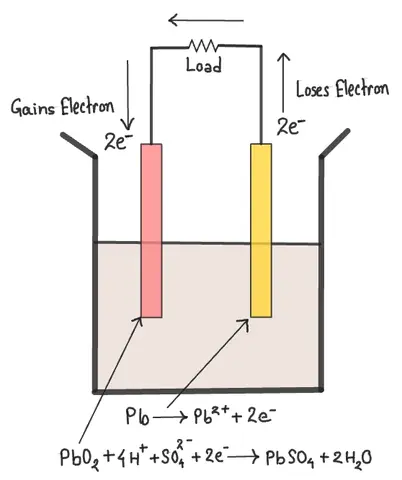
The diagram below shows the discharge process. The negative plate (sponge lead) loses electrons and the positive plate gains electrons. Current flows through an external load (resistor) connected at the top. Both reactions are labeled clearly on the diagram.
At the negative plate (anode):
\(Pb \rightarrow Pb^{2^{+}} + 2e^{-}\)
The sponge lead loses electrons (oxidation).
At the positive plate (cathode):
\(PbO_2 + 4H^+ + SO_4^{2^{-}} + 2e^{-} \rightarrow PbSO_4 + 2H_2 O\)
Lead dioxide gains electrons (reduction).
Both plates convert to lead sulfate \(PbSO_4\) during discharge. The sulfuric acid concentration decreases, and water is produced. This is why the specific gravity drops as the battery discharges.
2.2 During Charging
During charging, an external power source forces current through the battery in the reverse direction.
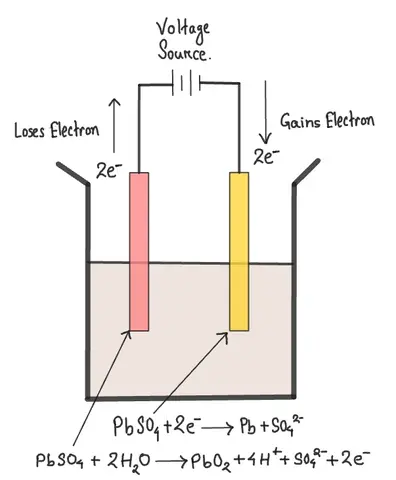
The diagram below shows the charging process. A voltage source is connected at the top. The direction of electron flow reverses compared to discharge. The negative plate now gains electrons and the positive plate loses electrons. Both reactions are labeled at the bottom of the diagram.
At the positive plate:
\(PbSO_4 + 2H_2O \rightarrow PbO_2 + 4H^{+} + SO_4^{2^{-}} + 2e^{-}\)
At the negative plate:
\(PbSO_2 + 2e^{-} \rightarrow Pb + SO_4^{2^{-}}\)
Lead sulfate on both plates breaks down. The positive plate returns to PbO₂, the negative plate returns to sponge lead, and sulfuric acid is restored. The specific gravity rises back to normal levels.
The overall cell reaction can be written as:
Discharge:
\(Pb + PbO_2 + 2H_2SO_4 \rightarrow 2PbSO_4 + 2H_2O\)
Charge:
\(2PbSO_4 + 2H_2O \rightarrow Pb + PbO_2 + 2H_2SO_4\)
3. Types of Lead-Acid Batteries
3.1 Flooded (Wet Cell) Battery
This is the traditional type. The plates are submerged in liquid electrolyte. These batteries require regular maintenance — you need to check the electrolyte level and add distilled water periodically.
Example: Most car batteries and large industrial batteries are flooded lead-acid batteries.
Advantages:
- Lower cost
- Good cycle life with proper maintenance
- Widely available
Disadvantages:
- Requires maintenance
- Risk of acid spills
- Must be installed in an upright position
3.2 VRLA Battery (Valve-Regulated Lead-Acid)
VRLA batteries are sealed. They do not require water refilling. They use a one-way pressure valve that releases gas only if internal pressure exceeds a safe limit. There are two sub-types:
3.2.1 AGM (Absorbent Glass Mat) Battery
In AGM batteries, the electrolyte is absorbed into a fiberglass mat between the plates. There is no free liquid inside. AGM batteries are used in motorcycles, UPS systems, and stop-start vehicles.
Advantages:
- Spill-proof
- Low internal resistance
- Good high-current performance
- Can be mounted in different orientations
3.2.2 Gel Battery
In gel batteries, the electrolyte is mixed with silica to form a gel. This gel stays in place and does not flow. Gel batteries are common in solar energy storage, wheelchairs, and marine applications.
Advantages:
- Very good deep discharge recovery
- Works well in high-temperature environments
- Spill-proof
Disadvantages:
- Sensitive to high charging voltages
- Higher cost than AGM or flooded types
4. Electrical Parameters of Lead Acid Battery
4.1 Voltage
A single lead-acid cell has a nominal voltage of 2V. Batteries are built with multiple cells to achieve higher voltages:
- 6V battery = 3 cells
- 12V battery = 6 cells
- 24V battery = 12 cells
4.2 Capacity
Battery capacity is measured in ampere-hours (Ah). A 100Ah battery can theoretically supply 5A for 20 hours (at the 20-hour discharge rate, C/20).
Capacity depends on discharge rate. If you discharge faster, the actual capacity delivered is lower. This is described by Peukert’s Law.
Peukert’s Law:
\(C_p = I^k \times t\)
Where:
- \(C_p\) = Peukert capacity (Ah)
- \(I\) = discharge current (A)
- \(k\) = Peukert exponent (1.1 to 1.3 for lead-acid)
- \(t\) = time (hours)
4.3 Internal Resistance
Lead-acid batteries have relatively low internal resistance, which makes them suitable for high-current applications like engine cranking. As a battery ages, internal resistance increases, which reduces performance.
4.4 Specific Gravity
Specific gravity of the electrolyte is a direct indicator of state of charge:
| State of Charge | Specific Gravity |
|---|---|
| 100% (Fully Charged) | 1.265 – 1.280 |
| 75% | 1.225 |
| 50% | 1.190 |
| 25% | 1.155 |
| 0% (Discharged) | 1.120 or below |
4.5 Self-Discharge Rate
Lead-acid batteries lose charge even when not in use. The self-discharge rate is about 3-5% per month at room temperature. Temperature affects this the self discharge rate. Higher temperatures increase self-discharge.
5. Charging Methods for Lead-Acid Batteries
5.1 Constant Voltage (CV) Charging
In this method, the charger maintains a fixed voltage. The current starts high and gradually decreases as the battery charges. This is the most common method used in automotive alternators.
5.2 Constant Current (CC) Charging
In this method, the charging current is held constant. Voltage rises gradually. This method is simple but can overcharge if not monitored carefully.
5.3 CC-CV Charging (Two-Stage Charging)
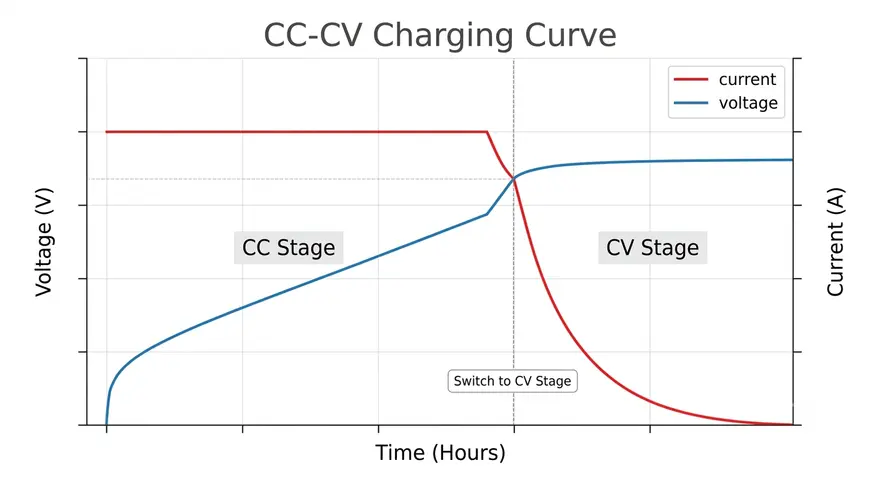
This is the most practical method for lead-acid batteries. The charger first applies constant current until the voltage reaches the set limit (14.4V for a 12V battery). Then it switches to constant voltage. This protects the battery from overcharging.
5.4 Float Charging
Float charging is used to maintain a fully charged battery over a long period. The charger holds the battery at a fixed voltage lower than the full charge voltage (around 13.6V for a 12V battery). This compensates for self-discharge without overcharging.
6. Conclusion
A lead-acid battery uses lead dioxide as the positive plate, sponge lead as the negative plate, and diluted sulfuric acid as the electrolyte. A single cell produces 2 volts. Multiple cells are connected in series to get higher voltages like 6V, 12V, or 24V.
During discharge, both plates convert to lead sulfate and the acid concentration drops. During charging, the reaction reverses — plates return to their original materials and acid concentration rises. Specific gravity measured by a hydrometer tells you the state of charge directly.
7. Frequently Asked Questions (FAQs)
A single lead-acid cell produces a nominal voltage of 2 volts. A 12V battery contains six cells connected in series.
Sulfation is the formation of hard lead sulfate crystals on the battery plates. It happens when the battery stays in a discharged state for a long time. Sulfation reduces the active plate area, which decreases the battery’s capacity and its ability to accept a charge.
You measure the specific gravity of the electrolyte using a hydrometer. A fully charged battery has a specific gravity of around 1.265–1.280. A discharged battery falls to 1.120 or below. You can also measure the open-circuit voltage — a fully charged 12V battery should read about 12.6–12.8V.
Yes. A solar charge controller (either PWM or MPPT type) is placed between the solar panel and the battery.
Overcharging causes excess gassing — hydrogen and oxygen are produced rapidly. Water in the electrolyte is lost. In flooded batteries, this means you need to add water more frequently. In VRLA batteries, if pressure builds beyond what the valve can release, the battery can swell or rupture.
Float charging is a low-level constant voltage charge that keeps the battery fully charged over a long period without overcharging it.