
Frequency and wavelength measures two different properties of a waveform. Frequency counts the number of wave cycles that passes through a fixed point in one second and is measured in Hertz (Hz). However, wavelength is used to measure the physical distance between two identical points on a wave such as crest to crest. Wavelength is measured in meters.
The main differences between frequency and wavelength are discussed in the sections below.
1. What is Frequency?
In simple terms, frequency is the measure of how many times a wave repeats itself in one second. It measures the number of complete cycles a wave completes in a given time period. The unit for frequency is Hertz (Hz), named after Heinrich Hertz.
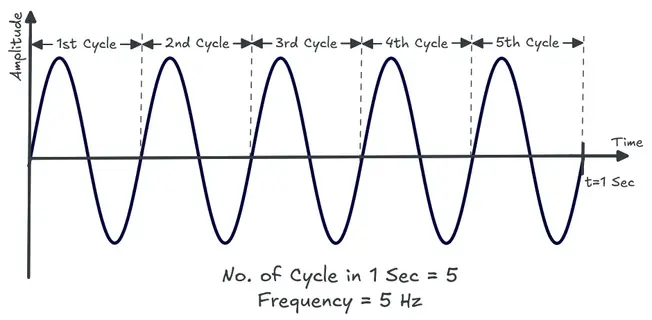
If a waveform completes 50 cycles in one second, then its frequency is 50 Hz. Radio stations broadcast at specific frequencies. For example, an FM radio station broadcasting at 101.5 MHz means the radio waves oscillate 101.5 million times per second.
Frequency of a waveform remains constant regardless of the medium it travels through. A sound wave with a frequency of 440 Hz stays at 440 Hz whether it travels through air, water, or any other medium.
2. What is Wavelength?
As discussed in above, the physical distance between two identical points on a wave is called wavelength. The identical points could be two consecutive peaks (crests) or two consecutive troughs. Wavelength is measured in the units of length such as meters, centimeters, or nanometers.
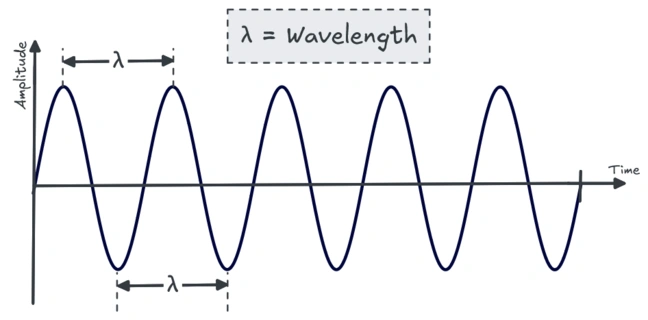
Wavelength of an waveform changes depending on the medium through which it travels. Light traveling through air has a different wavelength than the same light traveling through glass or water.
3. The Relationship Between Frequency and Wavelength
The relationship between frequency and wavelength can be expressed using the following formula:
\(\text{Speed} = \text{Frequency} \times \text{Wavelength}\)
Or also written as:
\(\boxed{v = f \times \lambda}\)
Here,
- \(v =\) Speed of the waveform
- \(f =\) Fequency, and
- \(\lambda =\) Wavelength
For electromagnetic waves traveling through vacuum, the speed is constant at approximately 3 × 10⁸ meters per second. This means frequency and wavelength have an inverse relationship. As frequency increases, wavelength decreases. As frequency decreases, wavelength increases.
3.1 Practical Example
Let us take a radio wave broadcasting at 100 MHz.
To calculate its wavelength:
\(v = f \times \lambda\)
\(\Rightarrow \lambda = \dfrac{v}{f}\)
Where,
\(v= 3 \times 10^8 \,m/s\) (Speed of Light)
\(f = 100 MHz = 100 \times 10^6 Hz\)
Substituting these values:
\(\lambda = \dfrac{3 \times 10^8 m/s}{100 \times 10^6 Hz} = 3 \text{ meters}\)
Now consider a higher frequency signal at 1000 MHz. The wavelength will be:
\(\lambda = \dfrac{3 \times 10^8 m/s}{1000 \times 10^6 Hz} = 0.3 \text{ meters}\)
The wavelength has dropped to 0.3 meters from 3 meters, ten times smaller than before. This numerical comparison shows the inverse relationship between frequency and wavelength. As frequency increases, wavelength decreases by the same proportion as speed of the wave is constant. This relationship is true for every type of electromagnetic wave including radio signals, microwaves, or visible light.
4. Difference Between Frequency and Wavelength
| Parameter | Frequency | Wavelength |
|---|---|---|
| Definition | Number of wave cycles per second | Distance between two identical points on a wave |
| Unit | Hertz (Hz) | Meters (m) |
| Symbol | f | \(\lambda\) (lambda) |
| Dependence on medium | Stays constant | Changes with medium |
| Relationship with wave speed | Directly proportional | Inversely proportional |
| Measurement | Time-based | Distance-based |
5. Frequency and Wavelength of Different Waves
AM Radio: AM radio signals operates at frequencies between 530 kHz to 1700 kHz. This gives wavelengths from 176 meters to 565 meters. The long wavelengths allow AM signals to travel long distances and bend around obstacles.
WiFi (2.4 GHz): WiFi operates at 2.4 GHz frequency. Using the above formula, wavelength will be 12.5 centimeters. The shorter wavelength means WiFi signals cannot travel far and get blocked more easily by obstacles.
Visible Light: Visible lights operates at frequencies around from \(4 \,to\, 8 \times 10^14\) Hz. This gives wavelengths in the range of 380-700 nanometers.
6. Conclusion
Frequency and wavelength measure different properties of the same wave. Frequency counts cycles per second (Hz) and stays fixed across mediums, while wavelength measures the distance of one wave cycle and changes with the medium. Frequency and wavelength is inversely proportional to each other at constant speed.
7. Frequently Asked Questions (FAQs)
Frequency is the measurement of how many wave cycles occurs per second while wavelength is the measure the physical distance between two identical points on a wave.
No, frequency stays constant when a wave changes medium. Only wavelength and wave speed changes based on the properties of the new medium.
Use the formula λ = v / f, where v is the wave speed and f is the frequency. For electromagnetic waves in a vacuum, v equals the speed of light (3 × 10⁸ m/s).
Frequency and wavelength are inversely proportional when wave speed stays constant. As one increases, the other must decrease to keep the speed the same.
Yes, this happens when the waves travel at different speeds through different media. For example, light has the same frequency in air and water, but its wavelength changes because its speed changes in water.