
The core insulation test is one of the most important diagnostic procedures in transformer maintenance and commissioning. As transformers age and operate under various electrical stresses, the insulation that protects the core laminations from grounding paths gradually deteriorates. This test identifies insulation weakness before it escalates into catastrophic failure that may result in equipment damage, power outages, and huge financial losses.
In this technical guide we will discuss every aspect of the core insulation test, from basic principles, testing procedures, standards, acceptance criteria, and practical testing methods.
What is a Core Insulation Test?
The core of a transformer consists of stacked laminations made of steel or silicon steel, which are designed to minimize eddy current losses while carrying magnetic flux. These laminations must remain electrically isolated from each other and from the transformer tank’s grounded structure. When moisture, contamination, or thermal stress compromises this isolation, current can leak between the laminations and to ground, creating a potential path for fault current.
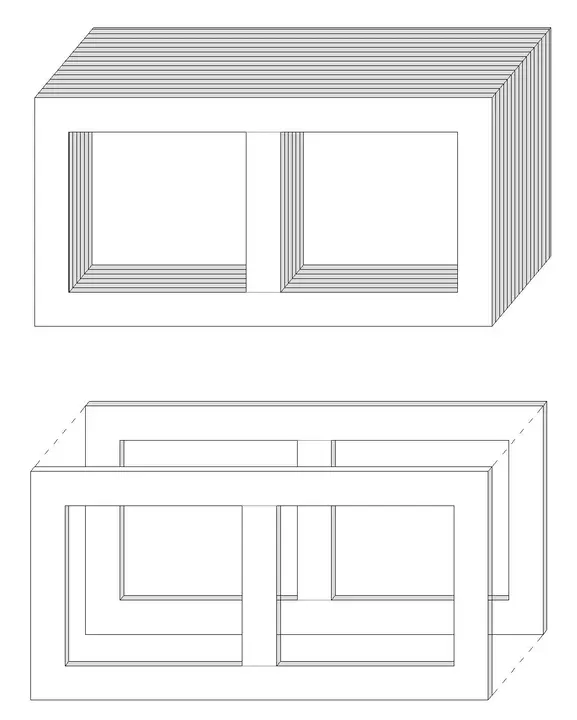
The core insulation test detects these degraded conditions by measuring the electrical resistance between the core and ground.
Why is the Core Insulation Test Important?
- Prevents Electrical Faults: Detects degradation or breakdown of insulation before the transformer is energized in service.
- Ensures Operational Safety: Reduces the risk of accidents due to insulation failure, protecting both personnel and equipment.
- Monitors Transformer Health: Provides early warning of insulation aging, deformation, or contamination from moisture and dust.
When to Perform Core Insulation Tests
New transformers should undergo core insulation testing before being commissioning. This commissioning test serves several purposes:
- Detection of Manufacturing Defects: Manufacturing flaws in core lamination coating, inadequate core paper insulation, or improper core assembly can result in resistance values well below 10 GΩ. Early detection prevents failures during initial operation.
- Baseline Establishment: The commissioning test result establishes the baseline for future comparison. As transformers age, gradual resistance decline is normal. Comparing future tests to the commissioning baseline helps identify accelerated deterioration.
- Verification of Transportation Integrity: Transformers subjected to vibration and rough handling during shipping may develop latent insulation damage. The commissioning test verifies that transportation did not compromise core insulation.
Principles of Core Insulation Testing
The core insulation test operates on a fundamental principle: applying a DC voltage across the insulation path and measuring the resulting current (or more practically, the insulation resistance).
The measured resistance value directly indicates insulation condition. A high resistance (measured in gigaohms or thousands of megaohms) means the insulation is in excellent condition and successfully blocking current flow. A low resistance (below 1000 megaohms) suggests deterioration that requires immediate investigation and corrective action.
An important phenomenon during insulation testing is the change in resistance over time. When voltage is first applied, the insulation resistance may appear low as polarization currents flow through the material. However, as these polarization currents decay (typically over 1-10 minutes), the resistance reading increases and stabilizes.
This time-dependent behavior has led to the development of the polarization index (PI) test, where resistance is measured at specific time intervals (typically at 1 minute and 10 minutes). The ratio of the 10-minute reading to the 1-minute reading provides additional diagnostic information:
- PI > 2.0: Excellent insulation condition
- PI 1.5-2.0: Good condition, acceptable for continued operation
- PI 1.0-1.5: Marginal condition, increased monitoring recommended
- PI < 1.0: Poor condition, immediate attention required
Core Insulation Test Procedures
Required Testing Equipment:
- A high-quality insulation resistance meter (megohmmeter or megger) with minimum 1000V DC output capability
- Test leads and adapters suitable for connection to core lamination and ground terminals
- Personal protective equipment including safety glasses, insulating gloves, and steel-toed boots
- Grounding sticks and discharge resistors for safe de-energization
Safety Precautions:
- Ensure the transformer is de-energized and properly grounded before work begins
- Lock and tag all disconnect switches in the open position
- Use a multimeter to verify zero voltage between all energized parts and ground
- Ground the transformer tank and all accessible conductive parts
- After testing, discharge any residual charge through high-resistance grounding devices
- Never perform this test on energized equipment under any circumstances
- Ensure the test area is dry and free of conductive debris
Step-by-Step Testing Procedure
Step 1: Transformer Preparation
Begin by safely de-energizing the transformer and verifying zero voltage with an appropriate test instrument. Remove all external connections, including transformer breakers and grounding devices (except the main tank ground). Allow the transformer to cool to ambient temperature for at least 30 minutes before testing, as temperature affects resistance readings.
Step 2: Access Terminal Block
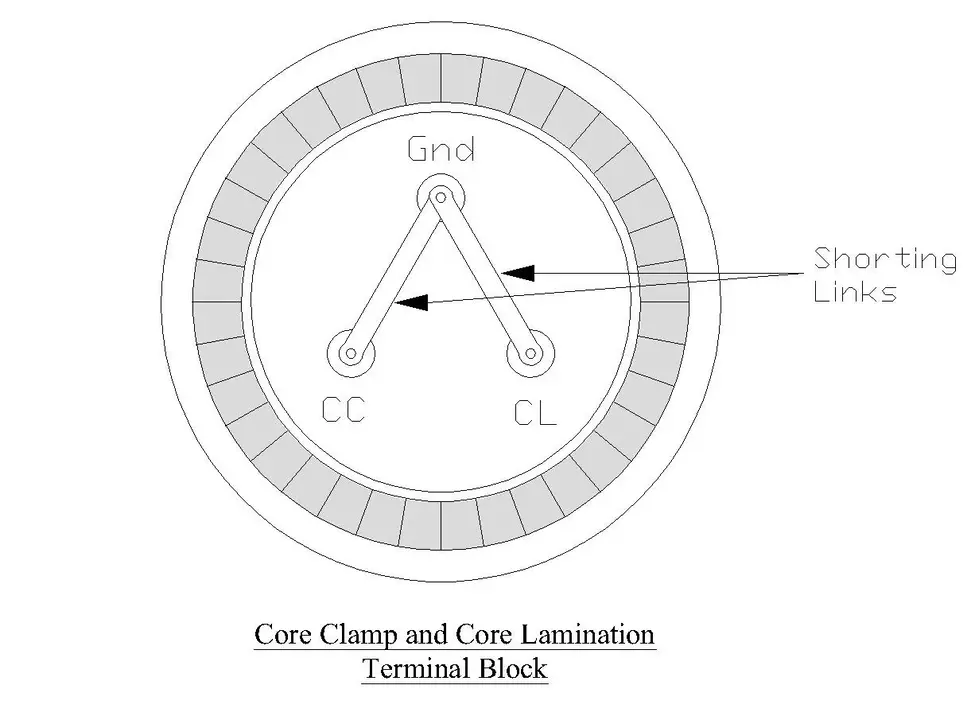
Carefully remove the cover from the transformer’s terminal block, typically located at the top of the unit. This exposes the internal wiring that connects the core and core clamp to external terminals. Handle this step carefully to avoid damaging seals or disturbing internal connections.
Step 3: Identify and Disconnect Core Points
Locate the following terminals:
- CL (Core Lamination): The electrical connection to the core laminations
- CC (Core Clamp): The electrical connection to the core clamp structure
- G (Ground): The main ground connection to the transformer tank
Modern transformer designs may connect the core clamp to ground directly (solid bond), while in others it connects through a resistor. Identify which configuration your transformer uses by consulting the nameplate or technical documentation.
Remove any links or connections that bond the core to ground. This is essential for accurate testing.
Step 4: Temperature Recording
Record the current oil temperature using a thermometer or the transformer’s built-in temperature indicator. Temperature affects insulation resistance (higher temperature = lower resistance). Standard acceptance criteria assume 20°C reference temperature, so temperature correction may be necessary.
Step 5: Apply Test Voltage
Connect the positive lead of the megohmmeter to the core terminal (CL) and the negative lead to the ground terminal (G). Begin with the 1000V DC test voltage range.
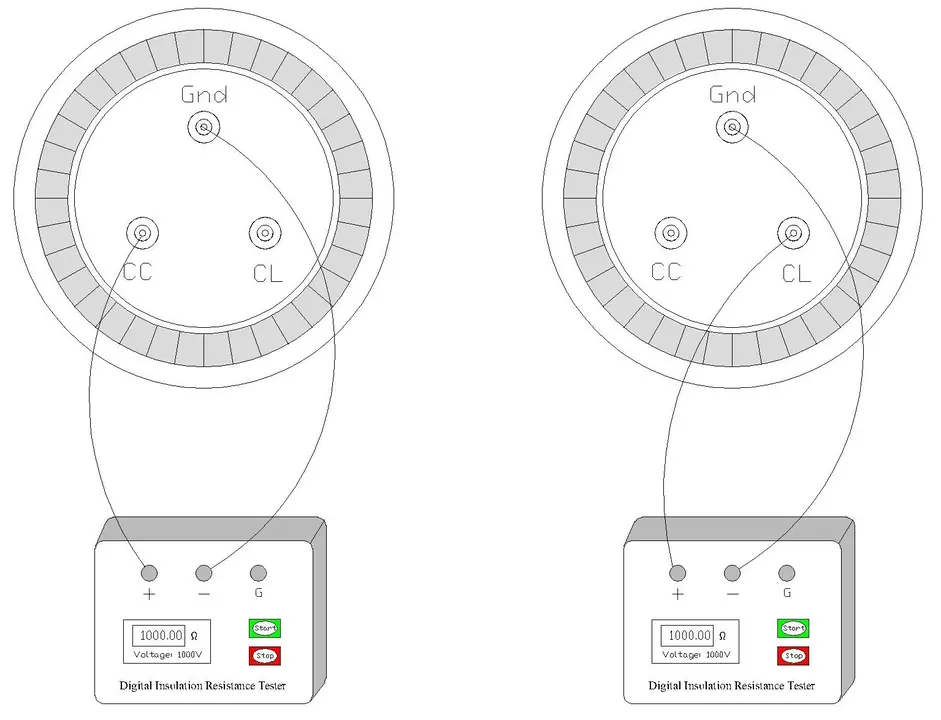
For transformer installations with a core clamp, perform the test in two configurations:
- CL to G: Core laminations to tank ground
- CC to G: Core clamp to tank ground
Step 6: Record Measurements at Intervals
Start the test and record resistance readings at standardized time intervals:
- At 1 minute: Note the resistance value
- At 10 minutes: Record the second reading
If using a polarization index measurement, calculate:
\(\text{PI} = \frac{\text{Resistance at 10 minutes}}{\text{Resistance at 1 minute}}\)
Step 7: Test Termination and Safe Discharge
Once complete, switch the megohmmeter to the “Discharge” or “Ground” function to safely dissipate any residual charge stored in the transformer’s capacitance. Alternatively, apply a grounding rod across the measured points for 30 seconds to discharge the unit.
Allow several minutes before removing test leads to ensure complete discharge.
Step 8: Document and Analyze Results
Record all measurements, including:
- Test date and time
- Oil temperature
- Applied voltage
- Resistance at 1 minute
- Resistance at 10 minutes
- Calculated polarization index
- Any deviations from expected values
- Environmental conditions during testing
Acceptance Criteria and Standards
The minimum acceptable core insulation resistance for most power transformers is 1000 megaohms (1 GΩ) at 1.0 kV DC and referenced to 20°C. This value assumes oil-immersed transformers with typical designs. However, several factors modify this baseline:
Temperature Correction: Insulation resistance changes with temperature, roughly halving for every 10°C increase above the reference temperature. The standard correction formula is:
\(R_{20} = R_{measured} × 2^{\frac{(20 – T_{measured})}{10}}\)
Where:
- \(R_{20}\) = Resistance corrected to 20°C
- \(R_{measured}\) = Actual measured resistance
- \(T_{measured}\) = Oil temperature in °C
For example, if you measure 500 MΩ at 50°C, the corrected value would be:
\(R_{20} = 500 \times 2{^\frac{(20-50)}{10}} = 500 \times 2^{(-3)} = 500 \times 0.125 = 62.5 \text{MΩ}\)
This represents marginal insulation that may require further investigation despite the high field reading.
Standards and Specifications
IEC 60076 Series: The International Electrotechnical Commission standard IEC 60076 specifies minimum core insulation resistance values for different transformer ratings:
- For transformers rated below 100 kVA: Minimum 1000 MΩ
- For large power transformers: Minimum 1000 MΩ (may be higher for specialized designs)
- Initial commissioning test: Minimum 10 GΩ or higher
IEEE C57.12.90: The Institute of Electrical and Electronics Engineers standard specifies that:
- Core insulation resistance should not be less than the acceptance value specified in the transformer design
- The standard baseline is 1000 MΩ at 20°C
- Transformers with a history of satisfactory operation may be re-rated at slightly lower values if deterioration is gradual and predictable
Manufacturer Specifications: Always consult the transformer’s nameplate and technical documentation, as manufacturers may specify higher resistance thresholds based on design features and intended application.
Interpretation Results
1. Very High Resistance (>10 GΩ)
This is typically an excellent result, indicating fresh, well-maintained insulation. However, extremely high readings sometimes indicate an open circuit in the test connection, so verify proper probe placement.
2. Acceptable Range (1-10 GΩ)
The insulation is in good condition. Continue periodic monitoring but no immediate action is required.
3. Marginal Range (500 MΩ – 1 GΩ)
This indicates mild deterioration, possibly from age or environmental moisture. Recommend:
- Increased monitoring frequency (quarterly instead of annual)
- Oil analysis to detect dissolved gases and moisture
- Investigation of operating conditions and possible sources of degradation
4. Poor Range (<500 MΩ)
This signals significant insulation breakdown requiring immediate action:
- Remove the transformer from service if safety is compromised
- Conduct comprehensive oil analysis including dissolved gas analysis (DGA)
- Inspect the core region for visible contamination or damage
- Consider core baking or other remedial actions
Maintenance and Periodic Inspection
1. Annual Testing
For transformers in regular service, annual core insulation testing provides early warning of deterioration. Compare results to baseline and previous year data to identify trends.
2. Post-Maintenance Testing
If the transformer undergoes maintenance including:
- Core clamp removal or reinstallation
- Core replacement or repair
- Oil filtration or flushing operations
…then core insulation testing should be repeated to confirm that maintenance procedures did not damage the insulation.
3. Post-Overload or Fault Testing
After the transformer experiences an overload condition, thermal fault, or external short circuit, perform core insulation testing to assess any heat-related insulation damage. Overheating can degrade insulation rapidly, and early detection enables corrective action.
Predictive Monitoring Programs
Integrate core insulation testing into a predictive maintenance program combining with the following tests:
- Oil analysis: DGA, moisture content, acid number
- Winding insulation tests: Resistance and polarization index
- Core insulation tests: Regular baseline comparison
- Thermal monitoring: Temperature trending
- Frequency response analysis: Winding deformation detection
Conclusion
The core insulation test is an essential part of transformer maintenance and commissioning. By verifying the insulation integrity between the core and earth, electrical engineers can significantly enhance the safety, reliability, and performance of transformer operations. Regular testing, combined with proper maintenance, ensures that transformers operate effectively and trouble-free for years.