
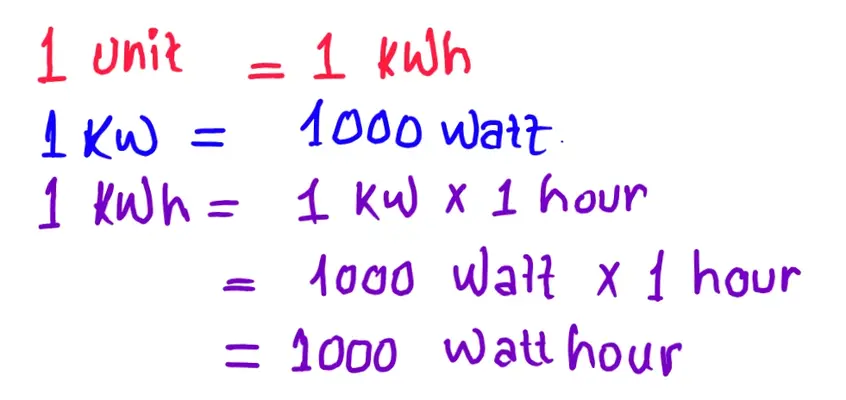
1 unit of electricity equals 1 kilowatt-hour (kWh). This is the standard measurement used by electricity boards and utility companies across the world to calculate your bill.
In simple terms, 1 kWh means you have used 1000 watts of power for 1 hour. So if you run a device that consumes 1000 watts for 60 minutes, you have consumed exactly 1 unit of electricity.
1. How to Calculate 1 Unit of Electricity
The formula is straightforward:
\(\text{Units consumed} = \dfrac{(\text{Power in watts} \times \text{Time in hours})}{1000}\)
Let’s break this down with a simple example. Say you have a 100-watt bulb running for 10 hours. Here’s the calculation:
\(\text{Units consumed} =\dfrac{100\times 10}{1000} = 1 \text{ unit}\)
This means a 100-watt bulb running continuously for 10 hours consumes exactly 1 unit of electricity.
2. Practical Examples for Better Understanding
Let’s look at some common household appliances and how long they take to consume 1 unit of electricity.
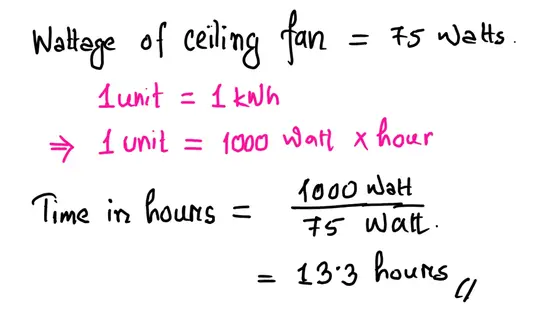
Ceiling Fan (75 watts): A regular ceiling fan running for about 13 hours will consume 1 unit of electricity.
LED TV (100 watts): If you watch TV for 10 hours straight, you use 1 unit.
Refrigerator (150 watts): Running for about 7 hours will use up 1 unit. Since refrigerators run all day, they consume several units daily.
Washing Machine (500 watts): A 2-hour wash cycle will consume 1 unit of electricity.
Air Conditioner (1500 watts): An AC running for 40 minutes uses close to 1 unit. This is why AC usage adds up quickly on your bill.
Microwave Oven (1000 watts): Running for 1 hour straight will consume 1 unit.
These examples show why appliances with higher wattage cost more to run, even if used for shorter periods.
3. Why Electricity is Measured in kWh and Not Watts
Watts measure the rate at which electricity is used. But your bill needs to measure total consumption over time, not just the rate. That’s why kilowatt-hour makes more sense as a billing unit.
Think of it like distance and speed. Speed alone doesn’t tell you how far you traveled. You need to multiply speed by time to get distance. Similarly, watts alone don’t tell you your total consumption. You need to multiply watts by hours used to get kWh, or units.
4. How Electricity Companies Read Your Meter
Your electricity meter tracks the total units consumed in your home. Every appliance running in your house adds to this count based on its wattage and usage time.
At the end of your billing cycle, the meter reading shows the total units consumed. This number is then multiplied by the rate per unit (which varies by location and provider) to calculate your bill amount.
For example, if your area charges $0.15 per unit and you consumed 300 units in a month, your bill would be $45 before taxes and other charges.
5. Conclusion
1 unit of electricity simply means 1 kilowatt-hour, or the energy used by a 1000-watt device running for 1 hour. This simple formula helps you calculate your electricity consumption and understand your monthly bills better.
Next time you check your electricity bill, you will know exactly what those units represent and how your daily appliance usage adds up to that final number.
6. Frequently Asked Questions (FAQs)
1000 watts running for 1 hour equals 1 unit of electricity, which is the same as 1 kilowatt-hour (kWh).
Multiply the wattage of the appliance by the number of hours it runs, then divide by 1000. This gives you the total units consumed.
No, the cost per unit varies by country, state, and electricity provider. Rates depend on local government policies and infrastructure costs.
Air conditioners, water heaters, and washing machines generally consume more units due to their higher wattage compared to fans, bulbs, or chargers.
Yes, 1 unit of electricity and 1 kilowatt-hour (kWh) mean the same thing. Both terms are used interchangeably in electricity billing.