
Time period and frequency are two terms that come up again and again in electrical engineering, physics, and signal processing. Students often mix them up because they are connected by a simple formula, but they describe different properties of a wave or a repeating event.
This post breaks down both terms, shows how they relate to each other, and explains the difference with examples you can relate to.
1. What is Time Period
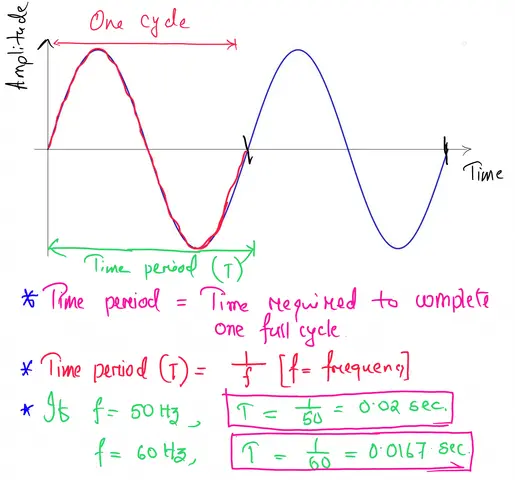
Time period is the amount of time taken to complete one full cycle of a repeating event. In electrical circuits, this repeating event is usually an alternating current or voltage waveform. If a wave completes one full oscillation in 0.02 seconds, then its time period is 0.02 seconds. The symbol used for time period is “T” and it is measured in seconds.
Think of a pendulum swinging back and forth. The time it takes to go from one extreme, back to the other extreme, and return to the starting point is its time period. In AC circuits, the same idea applies to the voltage or current wave as it moves through one complete cycle, starting from zero, rising to a peak, falling to a negative peak, and returning to zero again.
2. What is Frequency
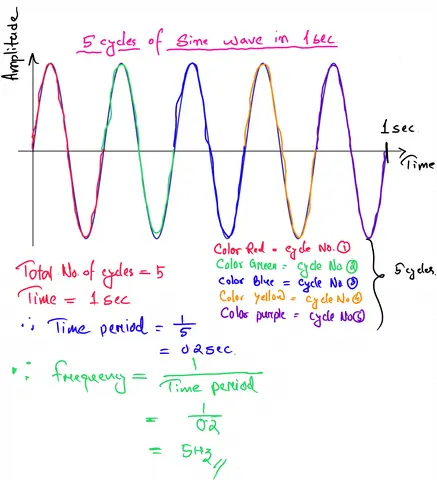
Frequency tells you how many complete cycles occur in one second. If a wave repeats itself 50 times every second, its frequency is 50 Hz. The unit for frequency is Hertz (Hz), named after Heinrich Hertz, who made early contributions to the study of electromagnetic waves. The symbol for frequency is “f“.
Household electricity in many countries runs at a frequency of 50 Hz or 60 Hz. This means the current changes direction and completes a full cycle either 50 or 60 times every second. A higher frequency means more cycles are packed into one second, while a lower frequency means fewer cycles happen in that same time frame.
3. The Relationship Between Time Period and Frequency
Time period and frequency are inversely related. The formula that connects them is:
\(f = \dfrac{1}{T}\)
or
\(T = \dfrac{1}{f}\)
This means if you know one value, you can calculate the other.
For example, if the time period of a wave is 0.02 seconds, the frequency is 1 divided by 0.02, which gives 50 Hz. Similarly, if the frequency of a signal is 60 Hz, the time period is 1 divided by 60, which gives approximately 0.0167 seconds.
This inverse relationship is one of the reasons students get confused. As frequency goes up, time period goes down, and as frequency goes down, time period goes up. A wave with a short time period has a high frequency, and a wave with a long time period has a low frequency.
4. Differences Between Time Period and Frequency
Time period measures the duration of a single cycle, while frequency measures how many cycles happen in one second.
Time period is expressed in seconds, while frequency is expressed in Hertz.
Time period tells you about the length of one event, while frequency tells you about the rate at which that event repeats.
Another way to look at it: time period answers the question “how long does one cycle take?” Frequency answers the question “how many cycles happen every second?” Both describe the same wave but from different angles.
| Basis of Comparison | Time Period | Frequency |
|---|---|---|
| Definition | Time taken to complete one full cycle | Number of cycles completed in one second |
| Symbol | T | f |
| Unit | Seconds (s) | Hertz (Hz) |
| Formula | T = 1/f | f = 1/T |
| Nature of Value | Decreases as frequency increases | Increases as time period decreases |
| What It Represents | Duration of one cycle | Rate of repetition of cycles |
| Example | 0.02 seconds for a 50 Hz supply | 50 Hz for a 0.02 second time period |
| Measuring Instrument | Oscilloscope (measures duration between points on a wave) | Frequency counter or oscilloscope (measures cycles per second) |
5. Practical Example for Better Clarity
Consider a simple AC power supply with a frequency of 50 Hz, which is standard in many parts of Asia, Europe, and Africa. Using the formula T = 1/f, the time period works out to 0.02 seconds. This means the AC waveform completes one full cycle every 0.02 seconds, and this cycle repeats 50 times in one second.
Now compare this to a supply running at 60 Hz, common in North America. The time period here is 1/60, which is about 0.0167 seconds. The cycle is shorter here compared to the 50 Hz supply, since the wave has to complete more cycles within the same one-second window.
Another example can be taken from sound waves. A musical note with a frequency of 440 Hz (commonly used as a tuning reference) completes 440 cycles every second, and each cycle lasts about 0.00227 seconds. Musicians and audio engineers rely on this relationship to tune instruments and design audio equipment.
6. Why This Distinction Matters in Electrical Engineering
Engineers need to know both values when designing circuits, transformers, and power systems. Time period helps in calculating the timing of switching operations, while frequency is used to match equipment ratings with power grid standards. A mismatch between frequency ratings, for example using a 60 Hz-rated device on a 50 Hz supply, can cause motors to run slower or transformers to overheat.
In signal processing, both terms help describe how fast a signal oscillates and how long each oscillation lasts. This becomes important when working with filters, oscillators, and communication systems where precise timing is required.
7. Conclusion
Time period and frequency serve as two sides of the same coin when describing periodic waveforms. One tells you how long a cycle lasts, and the other tells you how many cycles occur per second. Grasping this relationship helps students and professionals work confidently across power systems, communication circuits, and digital electronics.
8. Frequently Asked Questions
Time period is the time taken for one complete cycle, measured in seconds. Frequency is the number of cycles completed in one second, measured in Hertz.
The formula is f = 1/T or T = 1/f, where f stands for frequency and T stands for time period.
Using T = 1/f, the time period would be 1/100, which equals 0.01 seconds.
These frequencies were standardized based on early power generation technology and equipment design. Different countries adopted different standards, and both work well for household appliances and industrial equipment.
Yes. Some signals, especially slow-changing ones like certain sensor outputs or mechanical oscillations, can have a time period longer than one second, which means their frequency would be less than 1 Hz.