
The main difference between a single phase system and a three phase system is that a single phase system uses only one alternating voltage waveform with two conductors while the three phase system uses three alternating voltage waveforms with three or four conductors. In a three phase system each voltage waveform is displaced by 120 electrical degrees.
A three phase system delivers 1.732 times more power for the same conductor size and current rating. Single phase system is used for residential loads while three phase system is used for industrial motors, heavy machinery, and large-scale power distribution where higher power capacity and smoother load delivery is required.
1. What is Single Phase System?
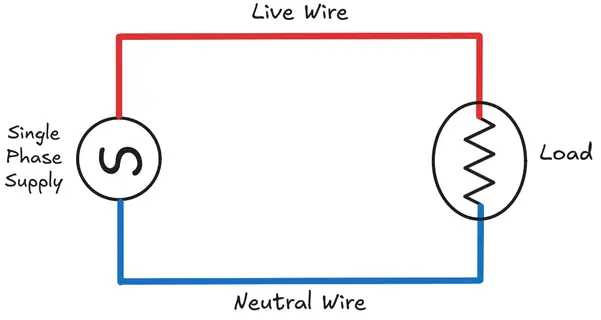
A single phase system is a two-wire AC power system that has one live (phase) wire and one neutral wire. It has only one voltage waveform. The voltage in this system rises and falls in a single sine wave cycle. The standard frequency of this waveform is 50 Hz or 60 Hz.
In the United States, the standard single phase voltage is 120V or 240V at 60 Hz. In the UK and most of Europe, the standard single phase voltage is 230V at 50 Hz.
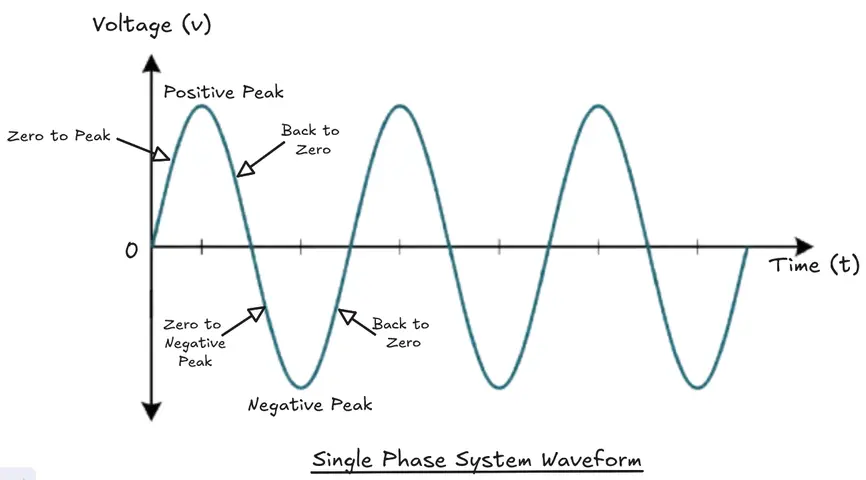
The power delivery in single phase is not constant. The voltage waveform goes from zero to peak, back to zero, then to negative peak, and back to zero again. This cycle repeats 50 or 60 times per second. As a result, the instantaneous power in a single phase system fluctuates.
2. What is Three Phase System?
The three phase system uses three live conductors. Each conductor carries an AC voltage waveform and is offset from the others by 120 electrical degrees. Therefore, a three phase system has three sine waves running at the same time instead of a single sine wave. Each voltage waveform is three phase system is one-third of a cycle apart.
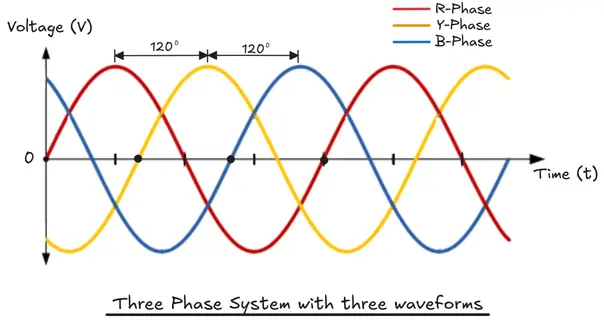
Because of this arrangement, when one phase is at zero, another phase is rising and the third phase is falling. Because of this, the total power delivery is smoother and nearly constant at all times.
The three phases of a three phase power system are labeled as Phase A, Phase B, and Phase C (or R, Y, B). The system can have three wires or four wires depending on whether a neutral wire is required.
The standard three phase voltage is 415V line-to-line (480V in the US) with 230V between any phase and neutral.
3. Differences Between \(1\phi\) and \(3\phi\) System
3.1 Number of Conductors
As discussed above a single phase systems use 2 wires, one phase and another for neutral. However, a three phase systems use 3 or 4 wires for the three phases and a neutral if required.
3.2 Voltage and Power Delivery
Single phase system delivers power in one continuous fluctuating wave. However, three phase delivers power through three overlapping waveforms. Because of the three fluctuating waveforms, three phase power is smoother and has no dips to zero.
The power formula for single phase is:
\(P = V \times I \times cos\phi\)
The power formula for three phase is:
\(P = \sqrt{3} \times V \times I \times cos\phi\)
The higher power capacity of a three phase system is because of the \(\sqrt{3}\) factor (approximately 1.732). For the same voltage and current ratings, a three phase system can deliver 1.73 times more power than a single phase system.
3.3 Efficiency of Power Transmission
As shown above, a three phase system transmits more power using less conductor material. For the same amount of power, a three phase system uses only 75% of the copper that a single phase system would need. This makes a three phase system more economical for high-power applications.
3.4 Frequency and Phase Angle
Both single phase and three phase systems operate at the same frequency of 50 Hz or 60 Hz depending upon the region. However, the phase angle between the voltages is different.
There is no phase displacement in a single phase system as there is only one phase. However, in a three phase system, each phase is displaced by 120 electrical degrees from the other.
3.5 Power Factor
In single phase systems, the power factor has a very high impact on efficiency of the system. If the power factor drops because of an inductive loads, the system becomes inefficient.
In three phase systems, the load is spread across three phases. Because of the balanced supply and load, a slightly lower power factor does not impact the system and maintains a better overall efficiency.
3.6 Waveform and Ripple
Single phase system has a single sinusoidal waveform. After rectification (converting AC to DC), single phase system produces a pulsating DC waveform with ripple.
However, a three phase system produces a smoother DC output with very low ripple after rectification. Because of this, three phase rectifiers are preferred in variable frequency drives (VFDs) and industrial DC power supplies.
3.7 Load Balancing
In a single phase system, all the load is on one circuit only. There is no concept of load balancing across phases.
However, in a three phase system, loads can be distributed across all the three phases. This reduces the neutral current and improves the overall system stability.
An unbalanced three phase system where one phase carries more load than the others can cause overheating and inefficiency.
4. Where \(1\phi\) and \(3\phi\) System is Used
4.1 Single Phase Applications
- Residential homes (lighting, fans, small appliances)
- Small commercial shops
- Rural areas where load demand is low
- Single phase air conditioners (up to 1.5 to 2 tons)
- Small water pumps (fractional HP)
4.2 Three Phase Applications
- Industrial plants and manufacturing units
- Large commercial buildings
- Electric motors above 1 HP (in most industrial settings)
- Data centers
- Electric furnaces and welding machines
- Large HVAC chillers
- Power distribution from substations
5. Conclusion
Single phase system is suitable for low-power residential and light commercial applications. On the other hand, three phase system is standard for high-power industrial and commercial loads because of higher power delivery, self-starting motor capability, lower conductor losses, and constant power output.
For power transmission, three phase is the always preferred system.
6. Frequently Asked Questions (FAQs)
No, a standard three phase motor cannot run on single phase supply directly.
This is called single phasing. If one phase fails in a three phase motor circuit, the motor will attempt to run on two phases. This causes excessive current in the remaining phases, overheating, and eventually motor burnout if protection relays do not trip the circuit in time.
Three phase power uses the √3 multiplier in its power formula. For the same line voltage and current, three phase delivers 1.732 times more power.
A single phase panel has one hot busbar (or two for split-phase 240V systems). A three phase panel has three hot busbars. Three phase panels are physically larger and have breakers arranged in three columns. You can also use a multimeter — measuring between busbars in a three phase panel will show the line-to-line voltage (415V or 480V).
In a balanced three phase system, the neutral wire carries very little current. This is because the currents in all three phases cancel each other out when the system is balanced. The neutral becomes more loaded when the system is unbalanced — meaning different amounts of current flow in each phase. The neutral wire also provides the return path for single phase loads tapped from the three phase system.