
A whole house surge protector also called as Type 1 or Type 2 SPD (Surge Protective Device) is a hardwired electrical device connected directly to the electrical panel or meter box.
The purpose of a whole house surge protector is to clamp down on voltage spikes that come in from the utility line. These spikes may be caused by lightning, grid switching operations, transformer issues, etc.
The device doesn’t block electricity flow during normal operation. It only activates when the voltage crosses a set threshold. Once the voltage spike passes, it goes back to standby mode.
1. How Does a Whole House Surge Protector Work?
The core component inside a whole house surge protectors is a Metal Oxide Varistor, commonly called a MOV. Some surge protectors also use Silicon Avalanche Diodes (SAD) or Gas Discharge Tubes (GDT), but MOV is the most commonly used component in residential SPDs.
A MOV has a non-linear resistance characteristics. At normal voltage levels, it has very high resistance and current cannot flow through it. When voltage spikes above its clamping threshold, its resistance drops very sharply. As the resistance drops it conducts the excess current and diverts the same to the ground wire.
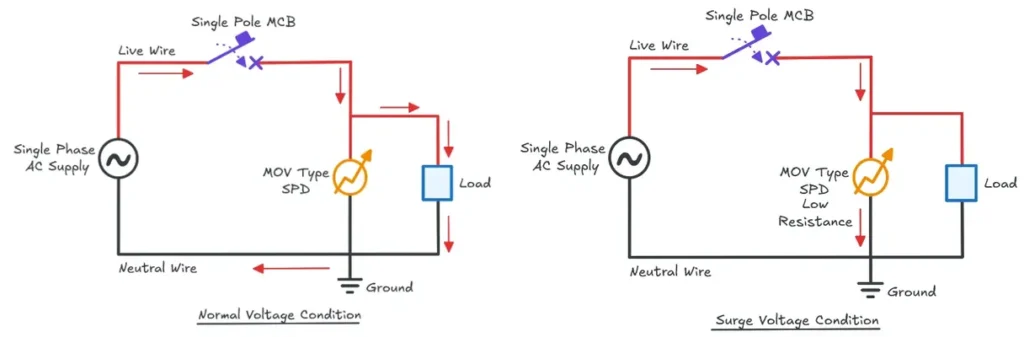
The energy diversion during voltage spikes from the live line to the ground happens in nanoseconds. The speed is important factor because even a brief overvoltage event can damage sensitive household electronics.
The energy absorbed by the surge protector during a surge event degrades the MOV over time. Because of this, whole house surge protectors have an indicator light or audible alarm that tells when the MOV has reached the end of its service life.
2. Types of Surge Protectors: Type 1, Type 2, and Type 3
The IEC 61643 standard and the UL 1449 standard define different types of SPDs based on where they are installed in the electrical system.
2.1 Type 1 SPD
Type 1 SPDs are installed before the main circuit breaker usually between the utility meter and the service entrance. These types of SPDs can handle direct lightning currents and very high-energy transients. They have higher discharge capacity ratings and can be in the range of 25 kA to 100 kA.
These type of SPDs are installed by the utility company or a licensed electrician.
2.2 Type 2 SPD
Type 2 SPDs are the most common types of SPDs used for residential installations. They are installed inside the main panel or in a sub-panel.
A type 2 SPD protects against surges that have already passed through the service entrance. The discharge rating of a type 2 SPD range from 20 kA to 80 kA per phase.
2.3 Type 3 SPD
Type 3 SPDs are plug-in or hardwired devices installed close to the load. They have lower discharge capacity compared to type 1 and type 2 SPDs.
For full protection, the correct approach is to use a Type 1 or Type 2 at the panel level, and supplement with Type 3 devices at sensitive equipment.
3. Whole House Surge Protector Ratings
Surge Current Rating (kA): The maximum surge current in kiloamperes (kA) that a whole house surge protector can handle in a single event is called the surge current rating.
Clamping Voltage: The voltage level at which the device starts to conduct and divert the surge current is called the clamping voltage. A lower clamping voltage means the device starts protecting sooner. For 120V circuits, a clamping voltage should be under 400V.
Response Time: Response time measures how fast the device reacts to a surge event. Most MOV-based surge protectors respond in under 1 nanosecond.
Protection Modes: A quality unit should protect Line-to-Neutral (L-N), Line-to-Ground (L-G), and Neutral-to-Ground (N-G). This covers all pathways a surge can travel.
SCCR (Short Circuit Current Rating): The maximum fault current the device can handle safely is the short circuit current rating. The panel’s available fault current should not exceed the SPD’s SCCR.
4. Where to Install and Whole House Surge Protector?
Installing a whole house surge protector is not a DIY job. It requires to work inside the main electrical panel which carries live voltage even when the main breaker is off because the service entrance wires remain energized. Therefore, installation of whole house surge protector should be done only by a licensed electrician.
However, it helps to know the process so you can have an informed conversation with your electrician and verify the installation was done correctly.
Breaker-Mounted Installation: Some SPDs install in two adjacent slots in the panel, similar to a double-pole breaker. The device has leads that connect to the two hot bus bars and a ground/neutral connection. These are common for Type 2 SPDs.
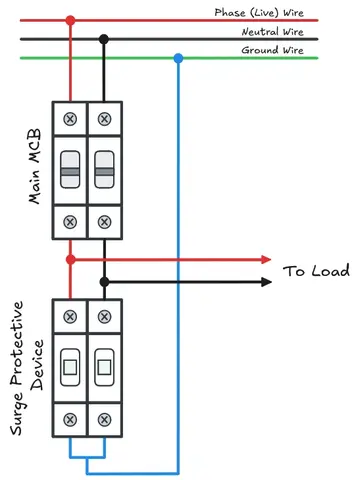
Bolt-On or Hardwired Installation: Some SPD units mount externally on the side or top of the panel and connect via wires to the bus bars and ground bar. This is common for Type 1 SPDs and higher-capacity Type 2 units.
Meter Socket Installation: Type 1 SPDs connects into a meter-side socket adapter, sitting between the utility meter and the panel. These require utility approval in many areas.
The connection leads from the SPD to the bus bars should be kept as short as possible ideally under 12 inches. Longer leads introduce inductance that slows down the device’s response and reduces its effectiveness.
5. Cost and Return on Investment
A whole house surge protector unit costs between $50 and $300 depending on the capacity and the brand. Installation cost adds another $50 to $100.
Compare that to replacing an HVAC control board ($300–$600), a refrigerator compressor ($400–$900), or a smart TV ($500–$2000). A single surge event can damage multiple appliances simultaneously.
Modern homes have many electronic devices including smart thermostats, variable-speed HVAC systems, EV chargers, solar inverters, home automation hubs, etc. All of these have sensitive electronics that are vulnerable to surges.
The upfront cost of a whole house SPD is always less than the cost of one surge-related appliance replacement.
6. How Long Does a Whole House Surge Protector Last?
MOV-based SPD devises degrade with each surge they absorb. There’s no fixed service life because it depends entirely on how many surge events the device has handled and how large those surges were.
Most manufacturers rate their devices for total energy absorption expressed in joules. Once that limit is reached, the MOV fails either going open circuit or short circuit. Some devices have indicator lights and alarms to signal the end of life.
In a region with frequent lightning or grid instability, a SPD device may need replacement in every 3–5 years. In a stable grid area with few electrical disturbances, it could last more than 10 years.
7. Does a Whole House Surge Protector Protect Against Lightning Strikes?
A whole house surge protector can handle the induced surge from nearby lightning. If lightning strikes a power line near your home, the resulting voltage spike traveling through the utility line will be blocked or reduced by the SPD.
A direct lightning strike to your home is a different situation. A direct strike carries tens of thousands of amperes. No residential SPD is rated to fully absorb a direct strike. Some energy will get through regardless of the device installed.
For proper lightning protection a dedicated lightning protection system with lightning rods, down conductors, and grounding electrodes is required. These two systems are complementary and not interchangeable.
8. Grounding of Whole House Surge Protectors
A whole house surge protector device diverts excess energy to the ground. If the ground path has high impedance due to a corroded ground rod, poor connections, or inadequate grounding electrode system the surge energy has nowhere to go and the protection is reduced or ineffective.
Before installing a whole house SPD, it is mandatory to verify the grounding system. In older homes built before modern grounding standards, the grounding system may need to be updated before a whole house SPD can work effectively.
9. How to Choose Whole House Surge Protectors?
Some practical guidelines for selecting a whole house surge protector is given below:
- The device should be rated for at least 40 kA surge current capacity. Higher rating for than that is better.
- The clamping voltage should be under 400V for 120V circuits.
- It should have UL 1449 4th Edition listing.
- The devise should protect in all the three modes: L-N, L-G, and N-G.
- The device’s voltage rating should match to the service voltage.
- SCCR should be appropriate for your panel’s available fault current.
Some well-regarded brands include Eaton, Leviton, Siemens, Square D (Schneider Electric), and Intermatic. All make UL-listed whole house SPDs in various capacities
10. Conclusion
A whole house surge protector is a hardwired SPD installed at the main electrical panel to intercept voltage transients before they reach branch circuits. It uses Metal Oxide Varistors to clamp overvoltage events by diverting the excess surge current to ground.
Type 1 and Type 2 devices are the standard for residential panel-level installation.
11. Frequently Asked Questions (FAQs)
Some plug-in panel-mounted SPD devices are designed for easier installation. However, working inside a main electrical panel involves live conductors at the service entrance that cannot be de-energized without utility intervention. Therefore, this work requires a licensed electrician.
No. A surge protector has nothing to do with power outages. It only addresses overvoltage events.
Most SPD units have an indicator light that stays on during normal operation and goes off or changes color when the device has reached end of life. Some also have audible alarms.
Yes. A whole house SPD reduces surge energy but doesn’t eliminate all of it. High-frequency transients and lower-level surges can still pass through. For sensitive equipment like computers, home theater systems, and medical devices, adding a quality plug-in SPD at the outlet provides an additional layer of protection.
A Type 2 SPD connects to the hot bus bars in the panel, plus the neutral bar and ground bar.