
Conductivity is one of the most fundamental properties in electrical engineering. It tells us how easily electric current can flow through a material. Every time you switch on a light, charge your phone, or run an industrial motor, conductivity is at work behind the scenes.
This property is not just limited to metals. Semiconductors, electrolytes, and even some biological materials have measurable conductivity values. Engineers use this information to design circuits, select materials, prevent electrical failures, and build efficient power systems.
In this technical guide, we will discuss everything you need to know about conductivity, including its definition, formula, units, types, measurement methods, temperature effects, and relevant industry standards. Practical examples are included throughout to help you apply these concepts in real-world scenarios confidently.
1. What is Conductivity?
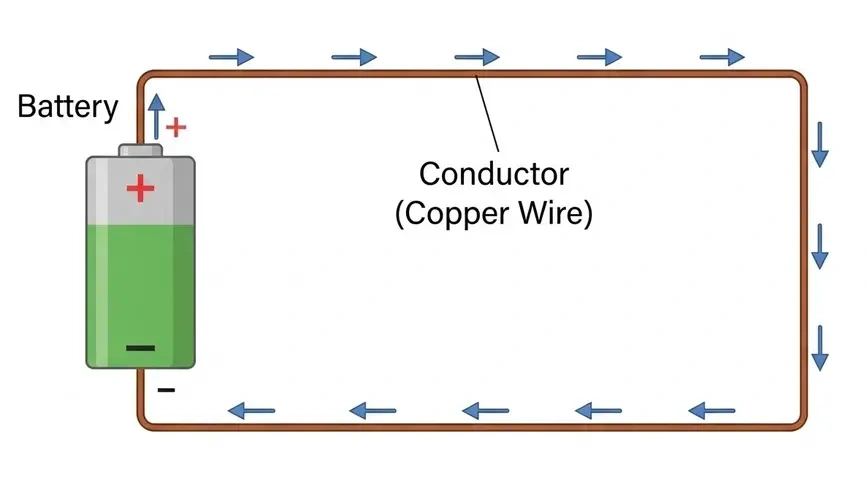
Conductivity, also called electrical conductivity, is a measure of how well a material allows electric current to flow through it. A material with high conductivity allows electrons to move freely and easily. A material with low conductivity resists the movement of electrons.
Think about a garden hose. If the hose has a wide opening and no blockages, water flows through quickly. If the hose is narrow and partially blocked, water struggles to flow. Electrical conductivity works in a similar way. The material is like the hose, and the electric current is like the water.
The SI unit of conductivity is Siemens per meter (S/m). Sometimes you will also see it expressed in mho per meter (℧/m), where “mho” is just “ohm” spelled backwards. Both units mean the same thing.
Conductivity is represented by the Greek letter σ (sigma). This symbol appears in formulas, textbooks, datasheets, and engineering standards around the world.
2. The Formula for Conductivity
The relationship between conductivity and resistivity is straightforward. Conductivity is simply the reciprocal of resistivity.
\(\sigma = \dfrac{1}{\rho}\)
Where:
- \(\sigma\) = Electrical conductivity (S/m)
- \(\rho\) = Electrical resistivity (Ω·m)
You can also express conductivity in terms of the physical dimensions of a conductor using this formula:
\(\sigma = \dfrac{L}{R\times A}\)
Where:
- \(L\) = Length of the conductor (meters)
- \(R\) = Resistance of the conductor (Ohms)
- \(A\) = Cross-sectional area of the conductor (m²)
2.1 Practical Example
Suppose you have a copper wire that is 2 meters long with a cross-sectional area of 1 × 10⁻⁶ m² and a resistance of 0.034 Ohms.
\(\sigma = \dfrac{L}{R\times A}\)
\(\sigma = \dfrac{2}{(0.034 \times 1 \times 10^{-6})}\)
\(\sigma = \dfrac{2}{(3.4 \times 10^{-8})}\)
\(\sigma \approx 5.88 \times 10^7 \) S/m
This value is very close to the standard conductivity of copper, which is approximately \(5.96 \times 10^7\) S/m.
3. Conductance vs Conductivity: What Is the Difference?
Many students confuse conductance with conductivity. These are related but not the same.
Conductance (G) is a property of a specific component or object. It tells you how easily current flows through that particular object. The unit of conductance is Siemens (S).
Conductivity (σ) is a property of a material itself. It does not depend on the shape or size of the object. The unit is Siemens per meter (S/m).
The relationship between them is:
\(G = \sigma\times \dfrac{A}{L}\)
Where \(A\) is the cross-sectional area and \(L\) is the length.
3.1 Simple Example
Imagine two copper rods. One is short and thick. The other is long and thin. Both are made of the same copper, so they have the same conductivity. But the short, thick rod will have a higher conductance because its geometry makes it easier for current to flow through it.
Conductance is about the object. Conductivity is about the material.
4. Conductivity vs Resistivity
Conductivity and resistivity are two sides of the same coin. Resistivity measures how strongly a material opposes the flow of current. Conductivity measures how easily it allows current to flow.
\(\sigma = \dfrac{1}{\rho}\)
A high conductivity means low resistivity, and vice versa.
Here is a comparison table of common materials:
| Material | Conductivity (S/m) | Resistivity (Ω·m) |
|---|---|---|
| Silver | 6.30 × 10⁷ | 1.59 × 10⁻⁸ |
| Copper | 5.96 × 10⁷ | 1.68 × 10⁻⁸ |
| Aluminum | 3.77 × 10⁷ | 2.65 × 10⁻⁸ |
| Iron | 1.00 × 10⁷ | 1.00 × 10⁻⁷ |
| Silicon (intrinsic) | 4.40 × 10⁻⁴ | 2.30 × 10³ |
| Glass | ~10⁻¹² | ~10¹² |
| Rubber | ~10⁻¹⁵ | ~10¹⁵ |
From this table, you can clearly see that metals like copper and silver have very high conductivity. Insulators like rubber and glass have extremely low conductivity. Silicon sits in between, which is why it is called a semiconductor.
5. Types of Conductivity Based on Material
5.1 Metallic Conductivity (Electronic Conductivity)
Metals conduct electricity through the movement of free electrons. In a metal like copper, the outermost electrons of each atom are not tightly bound. They can move freely throughout the material. This is called electronic conductivity or metallic conductivity.
Copper, silver, aluminum, and gold are classic examples. They all have high conductivity because they have a large number of free electrons available to carry charge.
5.2 Semiconductor Conductivity
Semiconductors have conductivity values that fall between metals and insulators. At room temperature, a pure semiconductor like silicon has relatively few free charge carriers. As temperature increases, more electrons gain enough energy to move freely, and conductivity goes up.
Semiconductors can also have their conductivity adjusted by adding impurities. This process is called doping. Adding phosphorus to silicon (n-type doping) increases conductivity by introducing extra electrons. Adding boron to silicon (p-type doping) creates “holes” that also carry current.
This controllable conductivity is what makes semiconductors so useful in transistors, diodes, and integrated circuits.
5.3 Ionic Conductivity
Some materials conduct electricity not through electrons but through ions. An ion is an atom that carries an electric charge. In liquids like saltwater or battery electrolytes, positive and negative ions move in opposite directions when a voltage is applied. This movement constitutes an electric current.
This is called ionic conductivity. It is common in electrolytes used in batteries, fuel cells, and electrochemical sensors.
Example: In a lead-acid car battery, sulfuric acid acts as the electrolyte. The movement of ions through this acid is what allows the battery to deliver current.
5.4 Superconductivity
Some materials, when cooled below a specific temperature called the critical temperature, lose all electrical resistance completely. Their conductivity becomes theoretically infinite. This phenomenon is called superconductivity.
Practical superconductors are used in MRI machines, particle accelerators, and experimental power transmission systems. Materials like niobium-titanium alloy become superconducting below about 9.2 K (−263.95°C).
6. Factors That Affect Electrical Conductivity
6.1 Temperature
For most metals, conductivity decreases as temperature increases. This happens because higher temperatures cause the atoms in the material to vibrate more. These vibrations get in the way of moving electrons and increase resistance.
Example: Copper has a conductivity of about 5.96 × 10⁷ S/m at 20°C. At 100°C, this value drops because of increased atomic vibrations.
For semiconductors, the opposite is true. Higher temperatures generate more charge carriers, which increases conductivity.
6.2 Material Type and Atomic Structure
Each material has a unique atomic structure. Materials with many free electrons, like silver and copper, have high conductivity. Materials where electrons are tightly bound to atoms, like glass or ceramic, have very low conductivity.
The position of an element in the periodic table gives a rough idea of its conductivity. Metals in groups 1, 2, and transition metals generally have good conductivity.
6.3 Impurities and Alloying
Adding impurities to a pure metal reduces its conductivity. This is because impurity atoms disrupt the regular crystal structure of the metal. Disruptions scatter electrons and reduce their free movement.
Example: Pure copper has a conductivity of about 5.96 × 10⁷ S/m. Brass (an alloy of copper and zinc) has a conductivity of only about 1.5 × 10⁷ S/m. The zinc atoms in brass scatter electrons and reduce conductivity.
6.4 Physical Dimensions and Cross-Sectional Area
The dimensions of a conductor affect its resistance but not its conductivity. Remember, conductivity is a material property. However, a larger cross-sectional area means lower resistance and therefore higher conductance for a given conductor.
This is why high-power cables use thicker conductors. Thicker conductors have lower resistance and can carry more current without overheating.
6.5 Crystal Defects and Grain Boundaries
In real-world metals, the crystal structure is not perfect. There are dislocations, vacancies, and grain boundaries. These imperfections scatter electrons and reduce conductivity compared to a theoretically perfect crystal.
That is why highly refined, high-purity copper (often called OFC, or Oxygen-Free Copper) is used in high-performance audio cables and precision instruments. It has fewer impurities and defects, giving it slightly higher conductivity.
7. Conductivity and Ohm’s Law
Ohm’s Law states that V = I × R, where V is voltage, I is current, and R is resistance. Conductivity connects directly to this law through the concept of resistivity and resistance.
The resistance of a conductor is calculated as:
\(R = \rho \times \dfrac{L}{A}\)
Since \(\rho = \dfrac{1}{\sigma}\), this becomes:
\(R = \dfrac{L}{(\sigma \times A)}\)
So if you know the conductivity of a material and the dimensions of the conductor, you can calculate its resistance. And from resistance, you can use Ohm’s Law to find current and voltage.
7.1 Practical Example
You need to run a 10-meter copper cable (σ = 5.96 × 10⁷ S/m) with a cross-sectional area of 2.5 mm² = 2.5 × 10⁻⁶ m². What is the resistance?
\(R = \dfrac{L}{(\sigma \times A)}\)
\(R = \dfrac{10}{(5.96 × 10⁷ × 2.5 × 10⁻⁶)}\)
\(R = \dfrac{10}{(149)}\)
\(R \approx 0.067\) Ω
This is the resistance of your cable. At a current of 10 A, the voltage drop across it would be:
\(V = I \times R = 10 \times 0.067 = 0.67\) V
This is a useful calculation when designing circuits where voltage drop must be kept within acceptable limits.
8. How to Measure Conductivity
8.1 Method 1: Two-Probe Method
This is the simplest method. A voltage is applied across a sample, and the current is measured. Using Ohm’s Law, resistance is calculated. Then, using the dimensions of the sample, conductivity is calculated.
Limitation: This method includes the contact resistance between the probes and the material, which can cause errors in measurements on low-resistance materials.
8.2 Method 2: Four-Probe Method (Kelvin Method)
This is the standard method for measuring the conductivity of solid materials. Two outer probes supply current. Two inner probes measure the voltage drop across a portion of the sample. Since no current flows through the voltage probes, contact resistance does not affect the measurement.
ANSI/ASTM B193 specifies this four-probe method for measuring the resistivity of electrical conductors.
Practical Setup:
- Place four equally spaced probes on the surface of the material sample.
- Connect the outer two probes to a calibrated current source. Supply a known current I.
- Connect the inner two probes to a high-impedance voltmeter. Measure the voltage V.
- Calculate resistance: R = V / I
- Calculate resistivity: ρ = R × A / L
- Calculate conductivity: σ = 1 / ρ
8.3 Method 3: Eddy Current Method
This non-contact method uses alternating electromagnetic fields to induce eddy currents in the material. The strength of these currents depends on the conductivity of the material. An instrument called an eddy current meter or conductivity meter reads the result directly.
This method is commonly used for testing metals on production lines, aircraft maintenance, and quality control checks.
8.4 Method 4: Inductive Method (for Liquids and Electrolytes)
For measuring the conductivity of liquids like water, coolants, or battery electrolytes, an inductive sensor is often used. This avoids direct contact with the liquid and prevents contamination.
Industrial conductivity meters for water treatment plants and chemical plants use this approach.
9. Conductivity in Power Systems
In power systems, conductivity matters at every level, from the generator terminals to the customer’s socket.
9.1 Transmission Lines
Power is transmitted over long distances using overhead conductors. The most common conductor is ACSR (Aluminum Conductor Steel Reinforced). Aluminum provides conductivity (about 61% IACS), while the steel core provides mechanical strength. The choice of aluminum over copper saves significant weight and cost over hundreds of kilometers.
9.2 Transformer Windings
Transformer windings are made from copper or aluminum. Copper is preferred in most power transformers because of its higher conductivity. Higher conductivity means lower winding resistance, which means lower copper losses (I²R losses) in the transformer. This directly improves transformer efficiency.
9.3 Grounding Systems
Grounding conductors must have high conductivity to allow fault currents to flow safely to ground during a fault. IEEE Std 837 and IEEE Std 80 both address the conductivity requirements of grounding conductors and connections.
9.4 Busbars in Switchgear
Busbars carry large amounts of current in switchgear panels, substations, and distribution boards. They are usually made from copper with conductivity close to 100% IACS. The conductivity of the busbar determines its current-carrying capacity and temperature rise under load.
10. Thermal Conductivity and Its Relationship to Electrical Conductivity
In metals, thermal conductivity and electrical conductivity are closely linked. This relationship is described by the Wiedemann-Franz Law:
\(\dfrac{k}{\sigma} = L \times T\)
Where:
- \(k\) = Thermal conductivity (W/m·K)
- \(\sigma\) = Electrical conductivity (S/m)
- \(L\) = Lorenz number (2.44 × 10⁻⁸ W·Ω/K²)
- \(T\) = Absolute temperature (Kelvin)
This law tells us that good electrical conductors tend to also be good thermal conductors. Copper and aluminum are used in heat sinks partly because of this property.
11. Conclusion
Conductivity is a foundational concept in electrical engineering. It governs everything from the wire gauge you choose for a circuit to the semiconductor material selected for a transistor. A solid grasp of conductivity helps engineers make better decisions about materials, cable sizing, thermal management, and circuit performance.
12. Frequently Asked Questions (FAQs)
The SI unit of electrical conductivity is Siemens per meter (S/m). It is represented by the symbol σ (sigma). Older literature sometimes uses the unit mho per meter (℧/m), which means the same thing.
Silver has a slightly higher conductivity than copper (6.30 × 10⁷ S/m vs 5.96 × 10⁷ S/m). However, silver is much more expensive. Copper offers very high conductivity at a fraction of the cost. For large-scale wiring applications, copper provides the best balance of performance and cost.
Yes. For metals, conductivity decreases as temperature increases. For semiconductors, conductivity increases as temperature increases. For insulators, the change is negligible at normal operating temperatures.
Conductance (G, measured in Siemens) is the property of a specific object or component. Conductivity (σ, measured in S/m) is the property of the material itself, independent of its shape or size. A short, wide rod and a long, thin rod made of the same material will have the same conductivity but different conductance values.
IACS stands for the International Annealed Copper Standard. It sets annealed copper as the reference material at 100% conductivity. All other conductor materials are rated as a percentage of this value. For example, the 1350 aluminum alloy used in overhead lines is rated at about 61% IACS. This makes it easy to compare different conductor materials on a common scale.
Pure water is a very poor conductor of electricity. Its conductivity is approximately 5.5 × 10⁻⁶ S/m at 25°C. Water becomes a better conductor when salts, minerals, or other ionic substances are dissolved in it. Seawater, for example, has a conductivity of about 5 S/m, which is about one million times higher than pure water.
Doping introduces impurity atoms into the silicon crystal lattice. These atoms either donate free electrons (n-type doping) or create holes (p-type doping). Both electrons and holes act as charge carriers. Adding a small amount of dopant can increase the conductivity of silicon by several orders of magnitude.
Superconductivity is a state where a material loses all electrical resistance below a specific temperature called the critical temperature. The conductivity becomes theoretically infinite.