
Yes, 12 AWG and 14 AWG copper wire can be used on the same branch circuit in some situations. The important factor is the circuit breaker protecting the conductors. For a common residential circuit, mixing 12 AWG and 14 AWG copper wire is generally acceptable on a 15-amp circuit. A 14 AWG copper conductor should not be protected by a 20-amp breaker under the NEC small-conductor rule.
The reason is simple. The circuit breaker must provide overcurrent protection that is suitable for the conductors in the circuit. NEC 240.4(D) limits 14 AWG copper to 15 amps and 12 AWG copper to 20 amps under the small-conductor rules.
This article explains how mixed wire sizes work, what the NEC says, and what to do if you find both 12 AWG and 14 AWG wire on an existing circuit.
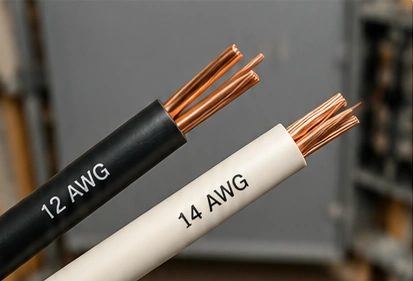
1. Quick Answer
You can generally mix 12 AWG and 14 AWG copper conductors on a 15-amp branch circuit, assuming the conductors and installation meet all applicable code requirements.
For example, a circuit could have 12 AWG copper cable from the electrical panel to a junction box and 14 AWG copper cable from that junction box to another outlet. If the circuit is protected by a 15-amp breaker, the 14 AWG conductor is within its 15-amp protection limit.
A 20-amp breaker is different. If a branch circuit contains 14 AWG copper conductors, you should not simply use a 20-amp breaker because another section of the circuit contains 12 AWG wire. NEC 240.4(D) lists 15 amps as the maximum overcurrent protection for 14 AWG copper under the applicable small-conductor rule.
2. Why Wire Gauge Matters
Wire gauge describes the size of a conductor. A smaller AWG number means a larger conductor. Therefore, 12 AWG wire is larger than 14 AWG wire.
A larger conductor can generally carry more current than a smaller conductor under the same conditions. The actual allowable ampacity still depends on factors such as conductor material, insulation, temperature, installation conditions, and applicable correction or adjustment factors.
For common copper branch-circuit wiring, 14 AWG copper is limited to 15 amps and 12 AWG copper is limited to 20 amps under the NEC small-conductor provisions.
3. Can You Mix 12 and 14 Gauge Wire on a 15-Amp Circuit?
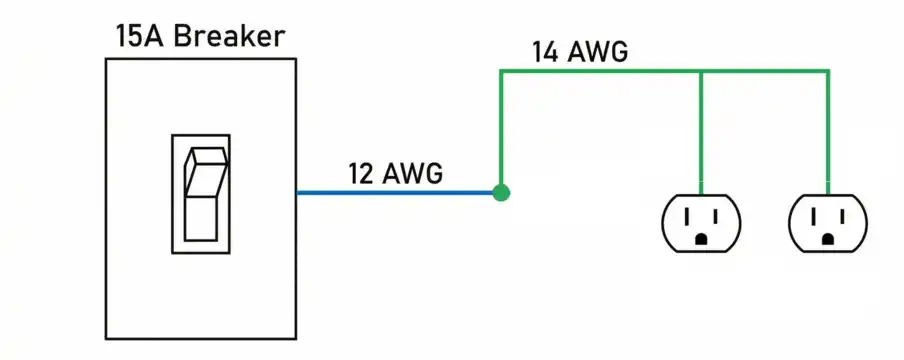
Yes, this is generally allowed for common copper branch-circuit wiring when the installation meets the applicable NEC requirements.
Consider a 15-amp circuit that uses 12 AWG copper cable from the panel to a junction box. From the junction box, the circuit continues with 14 AWG copper cable to several receptacles.
The 12 AWG section can carry the circuit load, and the 14 AWG section is protected by the 15-amp breaker. The larger 12 AWG conductor does not create a problem simply because the circuit later changes to 14 AWG.
The important point is that the 14 AWG portion remains protected by a breaker that does not exceed its applicable 15-amp limit.
4. Can You Mix 12 and 14 Gauge Wire on a 20-Amp Circuit?
For a normal branch circuit using 14 AWG copper, no. You should not place a 14 AWG copper conductor on a 20-amp branch circuit simply because the rest of the circuit uses 12 AWG wire.
For example, imagine a 20-amp circuit wired with 12 AWG copper from the panel. Someone extends the circuit using 14 AWG copper because it is available. The fact that the original section uses 12 AWG does not make the 14 AWG extension suitable for a 20-amp breaker.
The 14 AWG copper conductor falls under the NEC small-conductor limitation of 15 amps. A 20-amp breaker can therefore provide more overcurrent protection than the 14 AWG conductor is permitted to have under that rule.
The correct solution is not to assume that a short section of 14 AWG wire is acceptable. The circuit should be evaluated against the applicable code requirements before it is energized or modified.
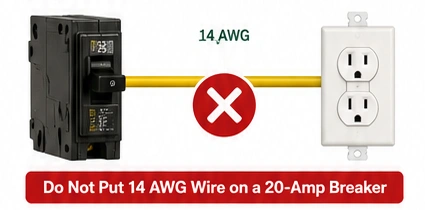
5. Why a 15-Amp Breaker Can Protect Both Wire Sizes
A 15-amp breaker can protect both 12 AWG and 14 AWG copper conductors in a common branch-circuit application.
The reason is that 14 AWG copper is limited to 15 amps under NEC 240.4(D), while 12 AWG copper has a 20-amp limit under the same small-conductor provisions. A 15-amp breaker does not exceed the 15-amp protection limit for the 14 AWG conductor.
Here is a simple example. Suppose a 15-amp circuit has 40 feet of 12 AWG copper cable and another 30 feet of 14 AWG copper cable. The circuit still has a 15-amp breaker.
The difference in wire size does not automatically make the circuit unsafe. The breaker protects the smaller 14 AWG conductor at the applicable 15-amp limit.
6. Practical Example: Adding an Outlet to a 15-Amp Circuit
Imagine that you have an existing 15-amp circuit wired with 12 AWG copper. You want to add an outlet farther along the circuit.
You might find that the new cable is 14 AWG copper. Using the 14 AWG cable does not automatically make the installation unacceptable simply because the original cable is 12 AWG.
The circuit breaker remains 15 amps, so the 14 AWG copper is not being protected by a 20-amp breaker.
The installation still has to comply with other applicable requirements, including box fill, grounding, connections, cable protection, device ratings, and local code requirements. The wire gauge alone does not determine whether the entire installation is compliant.
7. Practical Example: A 20-Amp Circuit With One Section of 14 AWG Wire
Now consider a 20-amp circuit wired with 12 AWG copper. A homeowner replaces a damaged section with 14 AWG copper but leaves the 20-amp breaker in the panel.
This is not something you should treat as a normal mixed-gauge installation.
The 14 AWG copper is subject to the 15-amp limit in NEC 240.4(D). Leaving the circuit on a 20-amp breaker does not make the smaller conductor equivalent to 12 AWG.
The circuit needs to be corrected or evaluated by a qualified electrician according to the applicable code.
8. Practical Example: A Short Piece of 14 AWG Wire
Some people assume that a short section of 14 AWG wire can be used on a 20-amp circuit because the section is only a few feet long.
Do not use wire length alone as a reason to change the breaker protection.
A short piece of smaller wire does not automatically become suitable for a larger breaker. The applicable NEC requirements must be checked for the actual installation.
For ordinary residential branch-circuit work, the safer approach is to use 12 AWG copper throughout a 20-amp circuit unless a qualified professional determines that another arrangement is permitted by a specific code provision.
9. 12 AWG Wire on a 15-Amp Circuit
Using 12 AWG copper on a 15-amp circuit is generally acceptable.
The larger conductor does not require you to install a 20-amp breaker. A 15-amp breaker can remain in place.
For example, a homeowner may have 12 AWG cable left over from another project and use it for a 15-amp branch circuit. The breaker rating does not have to match the maximum ampacity of the conductor. The conductor can have a higher allowable ampacity than the circuit breaker rating.
The breaker still has to be appropriate for the circuit, the connected load, and the applicable code requirements.
10. What Does the NEC Say About 12 and 14 AWG Wire?
NEC 240.4 covers protection of conductors against overcurrent. The small-conductor provisions in 240.4(D) list 14 AWG copper at 15 amps and 12 AWG copper at 20 amps.
NEC 210.19 also addresses branch-circuit conductor sizing. Branch-circuit conductors must have an ampacity that is sufficient for the load and must account for applicable conditions such as continuous loads and correction or adjustment factors.
This means breaker size is not the only part of the calculation. The actual load and installation conditions also matter.
The exact NEC edition adopted in your area may differ from the edition used for reference here. Local amendments can also change requirements. For electrical work in the United States, check the code adopted by your state, city, or other authority having jurisdiction.
11. What About Voltage Drop?
Wire size also affects voltage drop, especially on long circuits or circuits carrying higher loads.
NEC 210.19 includes an informational note stating that designing branch-circuit conductors for no more than 3% voltage drop at the farthest outlet, with a maximum total drop of 5% for feeders and branch circuits together, provides reasonable efficiency of operation. This is an informational recommendation rather than a general 3% mandatory limit for every branch circuit.
A long circuit may therefore need a larger conductor even if the circuit breaker rating has not changed.
For example, a 15-amp circuit might use 12 AWG copper instead of 14 AWG to reduce voltage drop over a long run. That does not mean the circuit needs a 20-amp breaker.
12. What If You Find Both 12 and 14 Gauge Wire in Your Home?
Finding both wire sizes on the same circuit does not automatically mean the circuit is unsafe or incorrectly wired.
First, identify the circuit breaker rating. Then identify where the different wire sizes are used.
If the circuit has a 15-amp breaker, the presence of both 12 AWG and 14 AWG copper may be acceptable, assuming the rest of the installation meets the applicable requirements.
If the circuit has a 20-amp breaker and you find 14 AWG copper, do not assume that the wire is acceptable because it is only used for a short distance or because most of the circuit uses 12 AWG.
Do not replace a breaker with a larger one just because the circuit trips. A larger breaker can allow more current to flow through conductors that are not suitable for that rating.
13. How to Identify 12 AWG and 14 AWG Wire
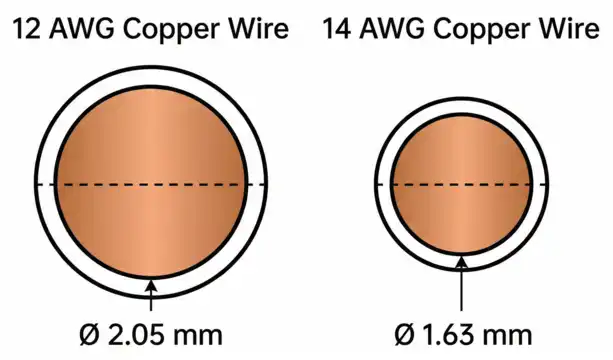
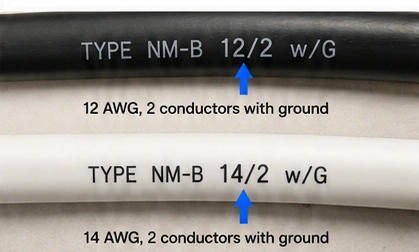
The easiest way to identify a cable is usually to read the markings printed on its outer jacket.
Common residential cable markings can include descriptions such as 12/2 or 14/2. The first number indicates the conductor gauge, while the second number indicates the number of insulated conductors in the cable. A ground conductor may also be present.
The markings on individual conductors can also provide information. Do not rely only on the physical diameter of the wire because insulation thickness and cable construction can make visual comparisons misleading.
Turn off power before inspecting wiring. If you are not qualified to work inside an electrical panel or junction box, have the wiring checked by a qualified electrician.
14. Can You Change a 20-Amp Breaker to a 15-Amp Breaker?
Changing a 20-amp breaker to a 15-amp breaker may be part of correcting a circuit that contains 14 AWG copper, but the entire installation still needs to be checked.
For example, if a circuit contains 14 AWG copper and is currently protected by a 20-amp breaker, installing a 15-amp breaker addresses the overcurrent protection issue associated with the 14 AWG conductor under the small-conductor rule. Other parts of the installation still need to meet the applicable code.
A breaker change should not be made as a guess. The circuit load, conductor type, equipment ratings, and local requirements should also be checked.
15. Common Mistakes to Avoid
One common mistake is assuming that every wire on a 20-amp circuit must be 12 AWG only because 12 AWG is commonly used for 20-amp residential circuits. The actual conductor requirements depend on the applicable code and installation.
Another mistake is assuming that a short length of 14 AWG wire is automatically acceptable on a 20-amp circuit. Wire length alone does not provide a general exemption from conductor protection requirements.
A third mistake is replacing a tripping 15-amp breaker with a 20-amp breaker. The breaker may be tripping because the circuit is overloaded, a device has a problem, or another electrical fault exists. Increasing the breaker size without checking the wiring can create a dangerous condition.
16. Final Answer
Yes, 12 AWG and 14 AWG copper wire can generally be mixed on the same 15-amp branch circuit when the installation meets the applicable electrical code.
The important limit is the protection provided to the smaller conductor. Under the NEC small-conductor rule, 14 AWG copper is limited to 15 amps, while 12 AWG copper is limited to 20 amps.
A 12 AWG conductor can be used on a 15-amp circuit, but that does not mean the breaker should be increased to 20 amps. A 14 AWG conductor should not simply be placed on a 20-amp breaker because another part of the circuit uses 12 AWG.
For an existing circuit with mixed wire sizes, identify the breaker rating and the conductor sizes before making changes. If the wiring does not clearly match the applicable code requirements, have a qualified electrician inspect it.
17. Frequently Asked Questions
Yes. For common copper branch-circuit wiring, 12 AWG and 14 AWG conductors can generally be used on the same 15-amp circuit if the complete installation complies with the applicable electrical code.
Not for a normal branch-circuit installation governed by the NEC small-conductor rule. NEC 240.4(D) limits 14 AWG copper to 15 amps under that provision.
Yes. A 12 AWG copper conductor can be used on a 15-amp circuit. The conductor does not have to be the same ampacity as the breaker.
No. A short length does not automatically make 14 AWG copper suitable for a 20-amp breaker. The actual installation must comply with the applicable NEC provisions.
The 3% figure appears in an informational note associated with branch-circuit conductor sizing. It is presented as a design recommendation for reasonable efficiency rather than a blanket mandatory limit for every branch circuit.
Do not assume that the installation is acceptable. Avoid increasing the breaker rating further. Have the circuit evaluated and corrected according to the applicable electrical code.