
An energy meter measures electrical energy consumption by continuously calculating power and integrating it over time. It multiplies voltage and current values flowing through a circuit, factors in power factor, and sums this power over hours to produce the total energy used in kilowatt-hours (kWh).
Electromechanical meters uses rotating aluminum disc driven by induction while digital and smart meters use current sensors, ADCs, and microcontrollers for precise calculation of energy consumption.
1. What is an Energy Meter?
An energy meter is a device that measures the amount of electrical energy consumed by a load over a specific period of time. The unit of measurement is kilowatt-hour (kWh) also known as a “unit” of electricity.
One kWh means 1000 watts of power consumed continuously for one hour. For example, if you run a 1000-watt heater for one hour, you consume 1 unit of electricity. If you run a 100-watt bulb for 10 hours, you also consume 1 unit.
Energy meters calculate this consumption by multiplying voltage, current, and time, then accounting for the power factor of the load.
2. Basic Working Principle
Energy meters work on the principle of measuring instantaneous power and integrating it over time. Power in an AC circuit is calculated as:
\(P = V \times I \times \cos \phi\)
Where \(V\) is voltage, \(I\) is current, and \(\cos \phi\) is the power factor.
The energy meter continuously multiplies the voltage and current values flowing through the circuit. It then multiplies the power value with time in hours to get the total energy consumed. The fundamental equation for energy is given by:
\(\text{Energy (kWh)} = \text{Power (kW)} \times \text{Time (hours)}\)
Traditional energy meters uses electromechanical means for calculating energy. However the modern meters uses digital circuits and microprocessors to calculate the energy consumed.
3. Types Of Energy Meters
3.1 Electromechanical Energy Meters
The electromechanical energy meters are the older type of analog meters that used a rotating aluminum disc visible through a glass window. They work on the principle of electromagnetic induction similar to an induction motor.
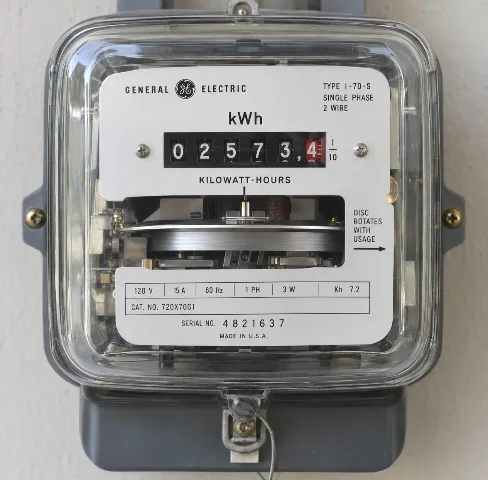
An electromechanical energy meter has two coils: a current coil and a voltage coil. The current coil carries load current and produces a magnetic field proportional to current. The voltage coil is connected across the supply and produces a magnetic field proportional to voltage.
These two magnetic fields interact with the aluminum disc and induces eddy currents in it. The interaction between the eddy currents and the magnetic fields creates a torque that rotates the aluminum disc. The speed of rotation is proportional to the power being consumed.
A counter mechanism connected to the disc’s spindle counts the number of rotations. Each rotation denotes a fixed amount of energy and is calibrated during manufacturing. This count gets displayed on a mechanical dial which gives the total energy consumed in kWh.
For example, if a meter has a constant of 1200 revolutions per kWh, then 1200 rotations of the disc equal 1 unit of electricity consumed.
3.2 Digital Energy Meters
Digital energy meters also called static meters have replaced the mechanical design with electronic components. They use current transformers and voltage sensors to measure the electrical parameters.
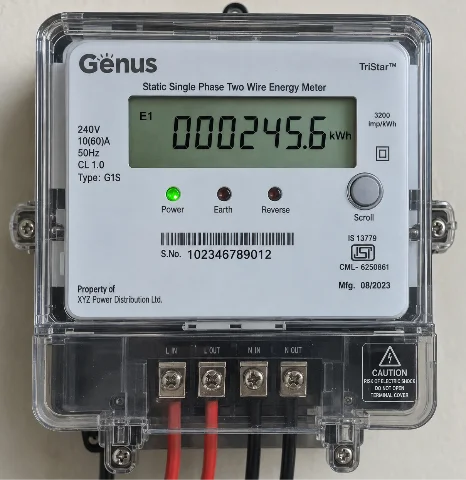
The current sensor produces a voltage signal proportional to the load current. Similarly, the voltage sensor produces a signal proportional to the supply voltage. These analog signals get converted into digital values using an Analog-to-Digital Converter (ADC).
A microcontroller inside the meter processes these digital values and calculates the instantaneous power by multiplying the digitized voltage and current samples. The microcontroller integrates this power over time to compute the energy consumption.
The result gets displayed on an LCD or LED screen which shows the total units consumed. Digital meters also record additional parameters like voltage, current, power factor, and maximum demand.
3.3 Smart Energy Meters
Smart energy meters work on the same principle as digital meters but has added communication capability. These meters send consumption data directly to the utility company through GSM, RF, or PLC (Power Line Communication) technology.
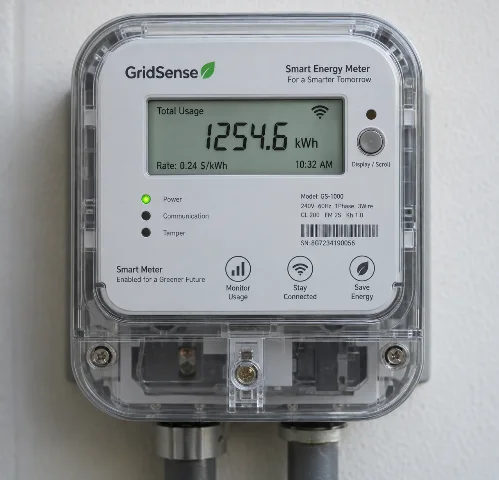
Smart meters eliminated the need for manual meter reading. They support features like time-of-use billing, remote disconnection, and real-time monitoring through mobile apps.
For example, a smart meter installed in a commercial building can send hourly consumption data to the utility server. This data helps both the consumer and the utility track usage patterns and detect anomalies.
4. Internal Components Of A Digital Energy Meter
A digital energy meter contains the following main components:
- Current Sensor: Current sensor is usually a current transformer (CT) or shunt resistor that measures load current without direct contact with high current lines.
- Voltage Sensor: The voltage is a voltage divider circuit or potential transformer that steps down the supply voltage to a measurable level.
- ADC (Analog-to-Digital Converter): Converts the analog voltage and current signals into digital data for processing.
- Microcontroller: The processing unit that calculates power, energy, and other electrical parameters using the digitized signals.
- Real-Time Clock (RTC): Keeps track of time for calculating energy over specific intervals, especially useful in time-of-use billing.
- Memory (EEPROM): Stores calibration data, historical consumption records, and configuration settings.
- Display Unit: Shows the energy consumption and other parameters an LCD or LED screen.
- Communication Module (in smart meters): Enables data transmission to the utility server using wireless or wired protocols.
5. Single Phase Vs Three Phase Energy Meters
Single phase energy meters are used in residential connections where the supply voltage is 230V and has only one live wire and one neutral wire. These meters measure energy consumption for standard household loads like lights, fans, and appliances.
Three phase energy meters are used in industrial and commercial setups where the supply has three live wires (R, Y, B phases) along with a neutral. These meters measure power across all three phases and sum them to get total energy consumption.
For example, a factory running motors, compressors, and heavy machinery will have a three-phase energy meter installed to accurately measure the higher power demand.
6. Calibration And Accuracy
Calibration of energy meters are done to make sure they measure with high accuracy. This is defined by accuracy classes such as Class 0.5, Class 1, and Class 2, based on international standards like IEC 62053.
Class 0.5 meters have less than 0.5% error margin, commonly used in industrial billing. Class 1 and Class 2 meters have higher permissible errors and therefore used in residential setups.
Calibration of energy meters involves testing the meter against a known reference load and adjusting internal parameters until the displayed reading matches the actual consumption.
7. Meter Constant
Every energy meter has a meter constant, which defines the relationship between the meter’s output (rotations for electromechanical, or pulses for digital) and the actual energy consumed.
For electromechanical meters, this is expressed as revolutions per kWh. For digital meters, this is expressed as pulses per kWh indicated by a blinking LED on the meter.
For example, a digital meter with a constant of 1600 pulses/kWh means the LED blinks 1600 times for every unit of energy consumed. This constant helps in testing and verifying meter accuracy in the field.
8. How Billing is Calculated
Utility companies read the meter at fixed intervals, usually monthly. The difference between the current reading and the previous reading gives the units consumed during that period.
For example, if the previous reading was 5000 kWh and the current reading is 5300 kWh, the consumption for that billing cycle is 300 units. This value gets multiplied by the applicable tariff rate to generate the bill amount.
Smart meters simplify this process by sending automatic readings.
9. Summary
Energy meters convert electrical consumption into measurable kWh units through continuous power calculation over time. Electromechanical meters rely on induction principles with rotating discs, while digital and smart meters use current sensors, ADCs, and microcontrollers for accurate digital processing. Both types depend on proper calibration and defined accuracy classes to maintain reliable billing. Smart meters add communication modules for automatic data transmission which removes the manual reading errors.
10. Frequently Asked Questions (FAQs)
Energy meters measure electrical energy in kilowatt-hours (kWh), commonly called a “unit” of electricity.
It uses current and voltage coils to create magnetic fields that induce eddy currents in an aluminum disc, causing it to rotate at a speed proportional to power consumption.
Digital meters calculate and display energy consumption using electronic components. Smart meters add communication capability to transmit this data directly to the utility company.
Three phase meters handle higher power loads found in industrial and commercial setups, measuring energy across three live wires instead of one.
The meter constant shows the relationship between the meter’s mechanical rotations or electronic pulses and the actual energy consumed, used for testing and verifying accuracy.
Yes, older electromechanical meters can be tampered with using external magnets or reversed connections. Modern digital and smart meters include tamper detection features to prevent this.
Residential meters typically use Class 1 or Class 2 accuracy standards, while industrial setups often use more precise Class 0.5 meters.